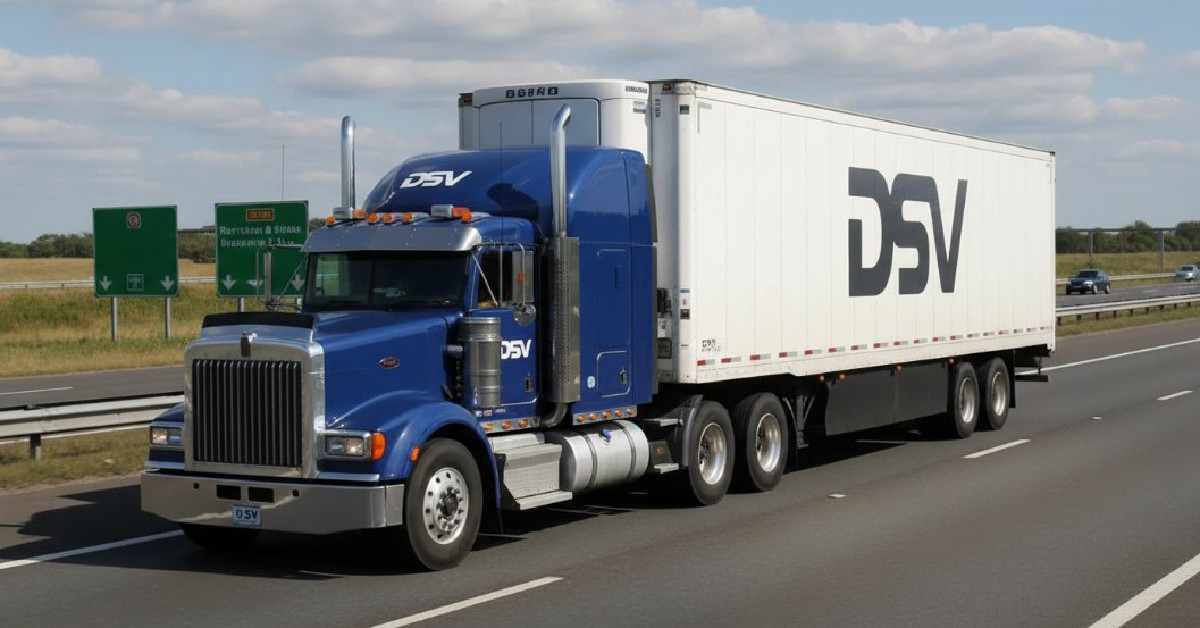
Danish logistics giant DSV is rolling out self-driving trucks, joining a wave of commercial autonomous freight deployments that remain mostly limited to American highways while Europe struggles to keep pace.
The announcement puts DSV in the company of major logistics players like DHL and Ryder, who have already begun moving real freight with autonomous trucks on defined highway corridors in Texas and across the American Southwest. But for anyone watching from Denmark, the move raises a sharper question: is this innovation happening here, or are we just watching from the sidelines?
As reported by DR, DSV’s deployment reflects the broader reality of autonomous trucking in 2026. The technology works, but only in narrow operational bands. Most current systems operate at Level 4 automation, meaning they can handle highway driving between logistics hubs without human intervention, but they are not ready for every road, every weather condition, or every load.
The business case is efficiency, not sci-fi
The commercial logic behind self-driving trucks is straightforward. Long-haul motorway routes are repetitive, predictable, and increasingly constrained by driver shortages. Autonomous systems promise better asset utilisation, fewer delays tied to driver hours, and potentially 24/7 operations on key corridors.
Volvo Autonomous Solutions and DHL Supply Chain have launched autonomous operations in Texas using production-ready Volvo VNL trucks powered by Aurora Driver software. Ryder and International Motors are running 1,000 kilometre autonomous freight routes. Daimler Truck has tested Level 4 Class 8 trucks on public interstates near Albuquerque.
The pattern is clear: autonomy is being introduced where routes are simple and the economics can be made to work. That means motorways, not city centres. It means hub-to-hub freight, not door-to-door delivery. And it means human drivers still handle the first and last miles.
Denmark is falling behind
Here is where the story gets uncomfortable for Denmark. Industry voices have been warning for months that Denmark is losing ground to Norway, Sweden, and Switzerland in autonomous vehicle development. The concern is not just about technology, but about whether Denmark can build the legal and testing infrastructure needed to attract investment.
Mobility Denmark has explicitly called for a government that can make Denmark ready for self-driving vehicles. The framing is blunt: Denmark risks becoming a regulatory laggard while neighbours move faster. That matters in a small, open economy where productivity and logistics efficiency are tied to competitiveness.
The broader European challenge is even trickier. Autonomous trucking depends on cross-border legal clarity, and European freight is inherently international. A truck approved in Denmark must still function under different enforcement regimes in Germany, Sweden, and Poland. The regulatory environment is fragmented, and that slows deployment compared to the US.
Safety and liability remain unresolved
The technology may be advancing, but the legal framework is still catching up. If an autonomous truck crashes, who is responsible? The fleet operator? The software provider? The truck manufacturer? The maintenance contractor?
Current deployments try to avoid the question by keeping operations within tightly controlled domains. Many pilots still include a human supervisor in the cab or rely on remote monitoring. That is not a sign of failure, but it does reflect the fact that liability, insurance, and accountability are still being worked out.
The safety argument for autonomy is that it reduces human error, fatigue, and distraction. But complex weather, mixed traffic, and edge cases can still overwhelm current systems. The question is not whether autonomous trucks are safer in theory, but whether they are safer in practice across the full range of real-world conditions.
What this means for jobs and drivers
The most likely outcome is not that drivers disappear, but that their work changes. The hub-to-hub model explicitly relies on human drivers for urban distribution, last-mile delivery, and non-standard freight. Autonomy may reduce demand for long-haul motorway driving, but it is unlikely to eliminate the need for skilled operators anytime soon.
That said, unions and labour groups have reason to watch closely. Automation shifts bargaining power, changes skill requirements, and concentrates control among fleet owners and technology vendors. For Denmark, where freight labour is highly organised, the question is whether automation complements the existing workforce or creates new tension around job security.
I have covered DSV and Danish logistics for years, and what strikes me about this announcement is how much of the action is happening elsewhere. The technology is being tested and deployed in the US. The regulatory framework is being built in Britain and select EU states. Denmark is talking about catching up.
DSV’s move is strategically sound, but it also highlights a deeper risk: that Denmark becomes a consumer of autonomous logistics technology rather than a developer or early adopter. That would be a missed opportunity in a country that prides itself on transport innovation and efficiency.
The other issue that rarely gets enough attention is climate. Autonomous trucks are not automatically green. They may improve efficiency and reduce empty kilometres, but the vehicle itself still needs to be electrified or powered by low-carbon fuels if the transport is to become climate-neutral. A self-driving diesel truck is not a climate solution.
Where this goes next
The most probable scenario is that autonomous trucking scales gradually on select corridors where the economics, regulation, and infrastructure align. That will likely happen faster in the US than in Europe. For Denmark, the key question is whether policymakers create the test corridors, liability frameworks, and regulatory clarity needed to attract pilots and investment.
DSV’s rollout signals that the company believes autonomous trucking will matter. Whether that happens on Danish roads or just on highways abroad depends on decisions being made now in Copenhagen, Brussels, and across Scandinavia.
Sources and References
DR: Millioner milliarder DSV ruller nu ud med selvkørende lastbiler
The Danish Dream: DSV A/S Global Logistics