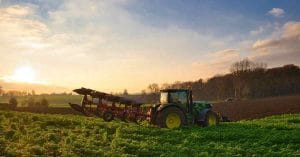
Danish farmers are testing laser technology to kill weeds in organic fields, but the expensive machines work only on small plants and can’t solve the toughest root-weed problems that plague Danish agriculture.
Somewhere in Denmark right now, a robot is creeping through a vegetable field. Cameras scan the soil, software identifies tiny weed seedlings between crop rows, and a fiber laser beam zaps each unwanted plant in fractions of a second. The technology sounds like science fiction, but it’s real, and it’s being tested on Danish organic farms that are desperate for alternatives to back-breaking manual weeding.
The laser systems are part of a broader European push toward chemical-free farming. An EU research project called WeLASER wrapped up field trials in 2023, including tests at Aarhus University, focusing on sugar beets and vegetables. As reported by DR, Swedish and German companies are now selling commercial versions. Danish innovation centers and organic consultants are watching closely.
Why Danish organic farmers are interested
Organic farming in Denmark bans synthetic herbicides and GMOs. That leaves farmers with crop rotation, cover crops, mechanical hoeing, and manual weeding. For row crops like carrots, onions, and beets, weeds inside the rows are the nightmare. Mechanical hoes can’t reach them without damaging plants. So you hire people to crawl through fields pulling weeds by hand.
Labor costs are crushing. Seasonal workers are hard to find. One Danish trial showed that combining mechanical hoeing with manual weeding delivered 43 hectokilograms per hectare in spring cereals, versus 39 without the weeding. That four-hectokilogram difference represents hours of human labor that many farmers can no longer afford.
I’ve watched this squeeze play out. Organic vegetable producers tell me they spend more on weeding than on almost any other variable cost. When you can’t find enough hands, you either accept lower yields or you quit. Several Danish organic farms have done exactly that in recent years, as reported by Videnskab.dk.
How the technology actually works
The laser systems use RGB or multispectral cameras combined with artificial intelligence to distinguish crop from weed in real time. A control unit calculates the weed’s precise location, and a galvanometer-steered laser hits the plant’s growth point. The concentrated heat coagulates cells, and the weed wilts.
It sounds elegant. But there are hard limits. The technology works best on tiny weeds at the cotyledon or two-to-four-leaf stage. At that size, a brief pulse destroys the growth point with minimal energy. Larger weeds need repeated hits. Perennial root weeds like Canada thistle, couch grass, and sow thistle can regenerate from deep root fragments that lasers can’t touch.
Danish consultants are clear about this. Lars Egelund Olsen and others stress that root weeds require starvation strategies over multiple seasons. You need crop rotation with at least 20 percent grass-clover, repeated mowing to stress taproots, and spring plowing to fragment rhizomes. Laser can’t replace that agronomic foundation. It’s a supplement, not a silver bullet.
The economics don’t add up for most farms
Commercial laser systems cost several hundred thousand kroner. They cover 1.5 to 3 meters in width and crawl along at 0.5 to 2 kilometers per hour, depending on weed density. That means a single machine can handle maybe five to ten hectares per day in small-seeded vegetables. Fine for specialized growers, useless for large grain operations.
There’s no solid Danish business case yet. A few pilot projects report 50 to 80 percent labor savings compared to manual hoeing when conditions are right. But “when conditions are right” is doing a lot of work in that sentence. The machines need stable light, dry soil, and precise GPS. Software glitches happen. Service contracts add up.
I’ve spoken with Danish organic farmers who are curious but cautious. They see laser as something for high-value crops like organic salads or specialty produce, not for everyday use. The economic crisis in Danish organic farming makes big tech investments risky. When your margins are thin, you stick with what works.
Policy pressure and the Green Deal context
EU policy is pushing this technology forward. The Green Deal and Farm to Fork strategy aim for a 50 percent reduction in pesticide use and 25 percent organic farmland across the EU. Denmark has a national target of 21 percent organic land by 2030, up from around 11.7 percent in 2022. That’s a big jump, and it has to happen without increasing chemical load on groundwater.
Laser fits neatly into the political narrative. It’s non-chemical, it’s digital, it’s “green high-tech.” Danish companies and research institutions can position themselves as leaders. EU Horizon programs fund the development. It all looks good in grant applications and ministerial speeches.
But on the ground, the story is messier. Organic farmers are dealing with falling sales and rising costs. They need solutions that pay off within a season or two, not aspirational tech that might mature in five years.
Who benefits, and who gets left behind
There’s a structural question here that nobody wants to say out loud. Expensive technology favors large, capital-rich farms. If laser becomes the standard for efficient organic vegetable production, smaller family operations without access to financing may struggle to compete. Organic farming in Denmark has traditionally been more egalitarian, with room for modest-scale producers. High-tech could change that.
On the other hand, proponents argue that automation helps small farms survive precisely because they can’t hire enough workers. A robot doesn’t call in sick or demand overtime. It can run through the night if needed. Whether that trade-off is worth it depends on whom you ask.
Safety, regulation, and the fine print
Lasers powerful enough to kill plants are classified as Class 3B or 4 under EU rules. They require enclosures, emergency shutoffs, sensors to detect people or animals, and CE marking under the Machinery Directive. Manufacturers have to prove that eyes and skin are protected from direct beams and reflections.
In practice, that means the machines often operate under protective shields close to the ground and can’t be used near public roads. There’s