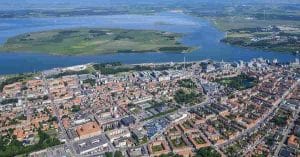
Amaliehaven is the small but mighty harborfront garden between Amalienborg Palace and Copenhagen’s inner harbor, reopened in 2024 after a comprehensive restoration that gave Denmark’s most prestigious modern garden a new lease on life.
Why Amaliehaven Deserves a Slow Walk, Not a Quick Selfie
I have lived in Copenhagen long enough to develop strong opinions about its public spaces. Amaliehaven is one of the few that still surprises me, even after dozens of visits over the years.
Most tourists rush through it in five minutes, on their way from Kongens Have to the Little Mermaid. They miss the point. This is not just a photo stop. It is a layered piece of Copenhagen history compressed into 1.6 hectares of stone, water, bronze, and very deliberate symmetry.
Where Amaliehaven Sits in Copenhagen
Amaliehaven occupies a narrow strip on Toldbodgade in the Frederiksstaden neighborhood. It runs between Amalienborg Palace and the inner harbor, completing the famous axis that begins at the Marble Church.
The garden lies on what was once Larsens Plads, an active shipyard and cargo quay. As reported by the A.P. Møller Foundation, this conversion of working harbor into public garden made Amaliehaven a prototype for Copenhagen’s later waterfront transformation. Decades before Nordhavn or Islands Brygge, this small park showed what was possible.
How to Get There
The nearest metro stop is Marmorkirken on the M3 Cityringen line. From there it is a five minute walk past Frederik’s Church, through the Amalienborg palace square, and across Amaliegade.
You can also walk from Nyhavn in roughly five minutes along the harbor. Buses 23 and 992 stop nearby on Store Kongensgade.
The Story Behind Amaliehaven: A Gift From Mærsk
Amaliehaven was inaugurated on 10 May 1983 by shipping magnate Mærsk Mc-Kinney Møller. The garden was a gift from the A.P. Møller and Chastine Mc-Kinney Møller Foundation, timed to mark the 70th anniversary of the shipping company.
It was framed officially as a gift “to the Danish people,” not just to Copenhagen. That phrasing matters. It signals the scale of corporate philanthropy that has quietly shaped Danish public space for over a century.
The Designers: Belgian Lines, Italian Bronze
The A.P. Møller Foundation skipped the Danish establishment and hired Belgian landscape architect Jean Delogne. The sculptural commission went to Italian artist Arnaldo Pomodoro, one of the most important modernist sculptors of his generation.
Pomodoro produced a series called Pillari per Amaliehaven, finished in 1982 to 1983. The bronze pillars rise roughly nine meters from the lawn, their incised surfaces catching the light off the harbor. They are, in my opinion, the most underappreciated public sculptures in Copenhagen.
Joint Ownership, Public Access
After the gift, the garden became jointly owned by the Danish state and Copenhagen Municipality. As stated by Slots- og Kulturstyrelsen, the Agency for Culture and Palaces maintains it as part of the national heritage portfolio.
The garden is always open. There is no gate, no fee, no closing time. That continuous public access is the most Danish thing about Amaliehaven, and the easiest thing for visitors to take for granted.
What You Actually See: Design and Layout
The plan is rectangular, with a strong central axis that lines up with the Marble Church dome to the west and the Copenhagen Opera House across the harbor to the east. Stand at the fountain at sunset and you understand why people call it the city’s most theatrical viewpoint.
Pomodoro’s bronze pillars frame the long sides like sentinels. Trimmed hedges, raised beds, and stone terraces step down toward the water in carefully measured intervals.
The Central Fountain
The centerpiece is a large multi-basin fountain with vertical jets and cascading water. The structure stretches along the central axis and forms the visual anchor of the entire composition.
The sound of the water softens the noise of the city. On hot summer afternoons, the mist drifting off the basins is the closest thing to air conditioning the harbor offers.
Planting and Microclimate
The flora is described in official sources as “righoldig,” meaning richly varied. You will see roses, rhododendrons, tulips in spring, and clipped boxwood hedges that hold the geometry together year round.
The maritime exposure makes planting tricky. Salt spray and harbor winds limit what survives, which is why the palette leans toward hardy perennials and durable evergreens rather than fragile annuals.
The 2024 Restoration: What Changed
After 41 years of weather, salt, and roughly a million annual visitors, Amaliehaven was worn out. The fountains had failed, the paving had cracked, and the planting was tired.
The A.P. Møller Foundation funded a comprehensive restoration once again. Slots- og Kulturstyrelsen carried out the work, and the garden reopened in 2024 as a renewed version of itself.
What the Restoration Included
- Fountains and water systems rebuilt with modern pumps, drainage, and water quality controls.
- Pomodoro’s bronze pillars conserved and cleaned to restore their original patina.
- Paving and terraces repaired and made more durable for heavy foot traffic.
- Planting beds replanted to revive the original horticultural vision.
- New lighting design by Okholm Lighting, designed to highlight sculptures and architecture after dark.
Why the New Lighting Matters
In a city where November sunsets arrive before 4pm, evening lighting is not a luxury. The new scheme transforms Amaliehaven into a usable winter space, picking out the bronze pillars and water jets with calibrated, low-glare illumination.
I visited in January after the reopening. The garden felt completely different, more intimate, almost cinematic, with the Opera House glowing across the dark water.
Amaliehaven Versus Copenhagen’s Other Parks
Copenhagen has plenty of green space, but Amaliehaven plays a different role than most. It is not a recreational park like Fælledparken, where Copenhageners actually picnic, jog, and gather.
Think of it instead as a piece of civic theater. It exists to frame views, to anchor an axis, and to host quiet contemplation. For raw green space you have Frederiksberg Gardens or Ørstedsparken. For composition, sculpture, and royal context, you have Amaliehaven.
An Expat’s Practical Guide to Visiting Amaliehaven
If you have just moved to Denmark, here is the honest version of what to expect, what to do, and when to come.
Best Time of Year and Day
The garden peaks visually from mid May to mid September, when the flower beds fill in and the fountain runs at full power. As reported by VisitCopenhagen, the garden is open year round and free to enter.
I prefer early morning, before the cruise ship groups arrive around 10am. The light hits the bronze pillars from the east, and you often have the entire garden to yourself.
Combine It With a Walking Route
A solid two hour loop: start at Marmorkirken, walk through Amalienborg, descend into Amaliehaven, follow the harbor promenade north to Langelinie and the Little Mermaid, then loop back via Langelinie Park. You hit five major sights in one walk.
This route also gives you the best angles of the Amalienborg axis, which connects monarchy, religion, and contemporary culture in a single sightline. It is one of Europe’s great planned urban experiences.
Photography Tips That Actually Work
- Shoot from the central fountain looking west toward the Marble Church dome at golden hour.
- Shoot from the eastern terrace looking back across the water toward the Opera House at blue hour.
- Get close to Pomodoro’s bronzes for texture shots. The patina rewards detail.
- Avoid noon in summer, when the light is flat and the crowds are thickest.
What to Skip
Skip the paid guided tours that include Amaliehaven as a five minute drive-by. The garden rewards slow time, not narration. Bring a coffee from one of the cafés on Bredgade and just sit.
Events at Amaliehaven: More Than a Garden
Amaliehaven occasionally hosts public installations and civic events that exploit its visibility and symbolic location. In recent years, the Antarctica 200 expedition brought the Estonian research vessel S/Y Admiral Bellingshausen to the quay, with a public climate change art installation in the garden itself.
This is how Amaliehaven earns its keep as a public space. It is not just decorative. It functions as a stage for messages that need a high-profile setting, from climate to cultural diplomacy.
Why Amaliehaven Matters to Expats
For anyone settling into life in Denmark, Amaliehaven is a quiet lesson in how this country thinks about public space. A private foundation, the state, and the municipality co-own and co-fund a garden that costs nothing to enter and never closes.
That arrangement would be unthinkable in most countries I have lived in. It tells you something real about Danish institutional culture, where corporate fortunes, royal heritage, and public access are still entangled in ways that work.
The Maersk Factor
The A.P. Møller name is everywhere in Denmark once you start looking. The same foundation that built Amaliehaven also funded the Copenhagen Opera House, which stands directly across the harbor.
You are essentially looking at two Maersk gifts in conversation with each other, separated by a strip of water. For expats, understanding this philanthropic infrastructure helps decode why so much of Copenhagen’s cultural landscape feels both private and public at once.
Frequently Asked Questions About Amaliehaven
What is Amaliehaven?
Amaliehaven is a 1.6 hectare public garden in Copenhagen, located between Amalienborg Palace and the inner harbor. It was designed by Belgian landscape architect Jean Delogne, inaugurated in 1983, and reopened in 2024 after a full restoration.
Who paid for Amaliehaven?
The garden was a gift from the A.P. Møller and Chastine Mc-Kinney Møller Foundation, given to the Danish people in 1983. The same foundation also financed the 2024 restoration, carried out by Slots- og Kulturstyrelsen.
Is Amaliehaven free to visit?
Yes. Amaliehaven is always open, with no admission fee and no closing time. It is freely accessible 24 hours a day, year round.
What time of year is best for visiting Amaliehaven?
Late May through early September offers the fullest planting and the most reliable fountain operation. Winter visits are now significantly improved thanks to the new lighting installed during the 2024 restoration.
How do I get to Amaliehaven by public transport?
Take the M3 Cityringen metro to Marmorkirken station, then walk five minutes east through Amalienborg square. Buses 23 and 992 also stop nearby on Store Kongensgade.
Who made the sculptures in Amaliehaven?
The bronze pillars in Amaliehaven were created by Italian sculptor Arnaldo Pomodoro between 1982 and 1983. The series is titled Pillari per Amaliehaven and is integral to the garden’s original design.
What was on the site before Amaliehaven?
Before 1983, the site was part of Larsens Plads, a working harbor quay used for shipping and shipyard activities. The garden’s creation was an early example of Copenhagen’s industrial-to-public waterfront transformation.
Is Amaliehaven accessible for wheelchairs and strollers?
Yes. The garden has paved pathways, gentle ramps between terraces, and step-free access from the harbor promenade. The 2024 restoration further improved surface conditions throughout.
Can I have a picnic at Amaliehaven?
Picnics are tolerated but not really the point. The garden is formally designed and intensively used, so most locals prefer larger parks like Kongens Have for full picnics.
How long should I spend at Amaliehaven?
Plan 30 to 45 minutes for a proper visit, longer if you want to study the sculptures and the architectural axis. Most people pair it with Amalienborg, the Marble Church, and the harbor walk to Nyhavn.
Final Thoughts on Amaliehaven
I keep returning to Amaliehaven not because it is the most beautiful park in Copenhagen, but because it is the most carefully composed. Every line, every pillar, every jet of water was placed with intent.
After the 2024 restoration, that intent reads more clearly than it has in decades. If you live in Denmark and have not yet given Amaliehaven a proper visit, do it on the next clear evening. The lighting alone is worth the walk.