Wondering what to do in Denmark beyond the usual postcard shots? Here is the honest expat guide to 24 unforgettable spots, plus the food, festivals, and bike rides that make this country click.
What to Do in Denmark: An Expat’s Honest Take
I have lived in Denmark long enough to stop romanticising it. And yet, when friends ask me what to do in Denmark, my list keeps growing. The country packs castles, coastlines, and quiet design into a space smaller than Switzerland.
You can cycle past royal palaces in the morning and stand on chalk cliffs by afternoon. The trains run, the harbours are clean, and even the rain feels organised. According to VisitDenmark, the country welcomed over 60 million overnight stays in recent years.
This guide skips the tired listicles. I will tell you what is worth your time, what to skip, and where the locals actually go. Let us get into it.
9 Top Attractions Outside Copenhagen
Copenhagen is the front door. The rest of the country is where Denmark gets weird, quiet, and beautiful. Hop on a DSB train and go.
1) Kronborg Castle in Helsingør
If you are wondering what to do in Denmark on a first weekend, start here. Kronborg Castle is the setting of Hamlet and a UNESCO World Heritage Site. It sits at the narrowest point of the Øresund strait, staring straight at Sweden.
The casemates beneath the castle hide the sleeping statue of Holger Danske. Locals will tell you he wakes when Denmark is in danger. The train from Copenhagen takes 45 minutes and costs around 120 DKK.
2) Frederiksborg Castle in Hillerød
Frederiksborg is the Renaissance showpiece Danish royals built to outshine everyone. It now houses the Museum of National History, with portraits of every monarch back to Christian I. The Baroque gardens are free and open year round.
I bring every visitor here because the building looks unreal in any weather. In winter, the moat freezes and the whole place feels like a Hans Christian Andersen tale.
3) Møns Klint
Møns Klint is Denmark’s most dramatic landscape, full stop. The chalk cliffs drop 128 metres into the turquoise Baltic, and yes, the water is actually that colour in summer. The GeoCenter at the top explains the 70-million-year-old fossils underfoot.
Bring proper shoes. The 497 steps down are easy. The way back up is not.
4) Aarhus
Denmark’s second city has a swagger that Copenhagen does not. ARoS Art Museum crowns the skyline with Olafur Eliasson’s rainbow panorama. Walk through Den Gamle By, a full open-air museum of Danish history from 1600 to today.
For expats, Aarhus is also one of the best places to live in Denmark if Copenhagen feels too expensive. It is younger, cheaper, and walkable.
5) Skagen and Grenen
At the northern tip, two seas literally collide. The Skagerrak and the Kattegat smash into each other in a visible line of foam. The light here drew the 19th-century Skagen Painters, and you will see why within five minutes of arriving.
Eat fresh plaice at the harbour. Walk to the buried church, where only the tower pokes out of the dunes. It is one of the strangest sights in the country.
6) Viking Ship Museum in Roskilde
Five real Viking ships, hauled from the fjord in 1962, sit in a glass hall by the water. You can watch boat builders use Iron Age tools in the working yard. In summer, you can sail a reconstructed Viking ship yourself.
For more royal Roskilde, walk 10 minutes to Roskilde Cathedral. It is the burial place of 40 Danish kings and queens, and another UNESCO site.
7) LEGOLAND Billund
Yes, you should go even without kids. LEGOLAND opened in 1968 next to the original LEGO factory, and Miniland still uses 20 million bricks. The new LEGO House in the town centre is even better for adults.
If you want more rollercoasters, check the full list of best amusement parks across Denmark.
8) Egeskov Castle on Funen
Egeskov is the best-preserved Renaissance water castle in Europe. It was built in 1554 on oak piles driven into a lake, hence the name “oak forest”. The gardens include a treetop walk and one of Europe’s largest hedge mazes.
The vintage car and motorcycle collection in the outbuildings is a genuine surprise. Go for the castle, stay for the 1937 Bugatti.
9) Bornholm Island
Bornholm sits closer to Poland than to Copenhagen, and feels like a different country. Smoked herring, four round medieval churches, granite cliffs, and the Hammershus ruins. The island has more Michelin-recognised restaurants per capita than Copenhagen.
Take the combined train and ferry from Copenhagen via Ystad. In summer, book accommodation months ahead.
15 Things to Do in Copenhagen
Copenhagen is small enough to walk and flat enough to cycle. I do both daily. Here is what is actually worth your time in the capital.
1) Tivoli Gardens
Tivoli opened in 1843 and inspired Walt Disney himself. It is part amusement park, part concert venue, part winter wonderland. The Christmas market here is the reason I never leave Denmark in December.
Buy the unlimited rides wristband if you have kids. The Demon rollercoaster still holds up at 40 years old.
2) Nyhavn
The painted 17th-century townhouses are a cliché for a reason. Hans Christian Andersen lived at numbers 18, 20, and 67 across his life. Skip the overpriced restaurants and grab a beer from Netto, the Danish way.
3) The Little Mermaid Statue
She is small. She is often crowded. She has been beheaded twice and blown off her rock once. Go, take the photo, move on. Edvard Eriksen sculpted her in 1913 based on his wife Eline.
4) Christiansborg Palace
This is the only building in the world that houses all three branches of a country’s government. Parliament, Supreme Court, and the royal reception rooms share one address. Climb the 106-metre tower for free, the best view in the city.
5) Rosenborg Castle
Built by Christian IV in 1606 as his summer retreat, now home to the Danish crown jewels. The Knights’ Hall with its three silver lions is worth the ticket alone. The surrounding Kongens Have park is where every Copenhagener picnics in summer.
6) Amalienborg Palace
Four identical rococo palaces around an octagonal square, home to King Frederik X. The changing of the guard happens daily at noon. If the royal standard is flying, the king is home.
7) The Round Tower
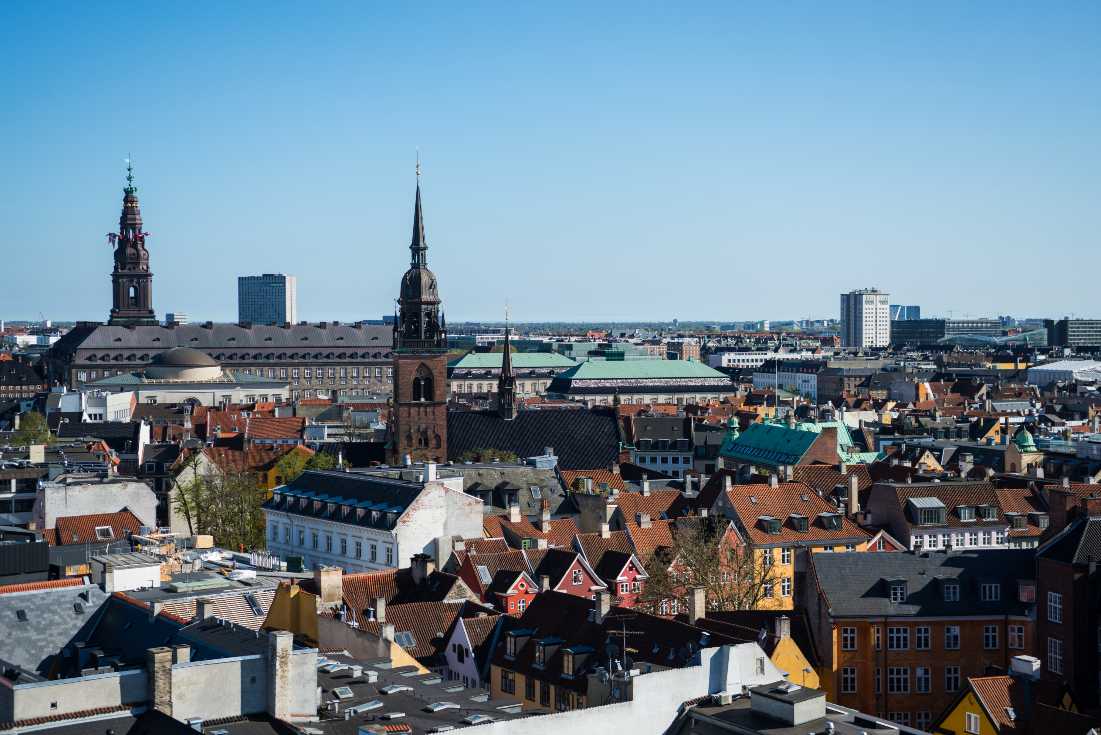
Christian IV’s 17th-century observatory has no stairs, just a 209-metre spiral ramp. Tsar Peter the Great famously rode his horse to the top in 1716. The view across the old town beats most rooftop bars.
8) National Museum of Denmark
Free entry. Vikings, the Egtved Girl from 1370 BC, and the actual Sun Chariot. Plan three hours minimum. For more options, see this guide to the must-visit museums in Copenhagen.
9) Freetown Christiania
The self-governing hippie commune founded in 1971 still exists on former military land. Pusher Street is gone after years of police pressure, but the murals, music venues, and Café Nemoland remain. Respect the no-photo rule in certain areas.
10) Strøget
One of Europe’s longest pedestrian streets, running 1.1 kilometres through the old town. Royal Copenhagen, Illums Bolighus, and Hay sit between Vesterport and Kongens Nytorv. The side streets off Strøget are where Copenhagen actually shops.
11) Copenhagen Opera House
Henning Larsen’s 2005 building sits across the harbour from Amalienborg, a billionaire’s gift from Mærsk. Even without a ticket, the foyer is open during the day. Take the free harbour bus number 991 or 992 to reach it.
12) Ny Carlsberg Glyptotek
Brewer Carl Jacobsen’s personal art collection: Egyptian mummies, Roman busts, Rodin, Gauguin, Degas. The winter garden under the glass dome is the best free coffee spot in central Copenhagen. Free entry on Tuesdays.
13) Louisiana Museum of Modern Art
Skipped in most lists, which is criminal. A 35-minute train ride north to Humlebæk gets you to one of the best modern art museums in Europe. Picasso, Giacometti, and a sculpture park overlooking the sea to Sweden.
14) Botanical Garden
The 1874 palm house feels like Victorian London transplanted into Copenhagen. Free entry, 13,000 plant species, and quiet on rainy days. See the full Botanical Garden guide for the best routes.
15) Designmuseum Danmark
Arne Jacobsen, Hans Wegner, Verner Panton, and the entire vocabulary of Danish modernism in one building. After a major renovation in 2022, it is sharper than ever. The chair corridor alone is worth the visit.
What to Do in Denmark Beyond the Sights
The standard attractions are only half of it. The other half is how Danes actually live, and you can join in.
Cycle Everything
Copenhagen has 385 kilometres of bike lanes and more bikes than cars. Renting one for a week costs less than two taxi rides. Read this proper cycling in Copenhagen guide before you grab handlebars.
Swim in the Harbour
The Copenhagen harbour has been clean enough to swim in since 2002. The harbour baths at Islands Brygge, Sluseholmen, and Sandkaj are free. In winter, join the locals for ice swimming and a sauna.
Eat Properly
Smørrebrød at Schønnemann, a flæskestegssandwich from a butcher, a pølse from a street cart, a cinnamon snail from Juno or Andersen Bakery. Add a New Nordic tasting menu at Geranium or Alchemist if your budget allows. Copenhagen now has more Michelin stars than Stockholm and Oslo combined.
Catch a Festival
Roskilde Festival in late June is one of Europe’s biggest, with 130,000 attendees. The Copenhagen Jazz Festival takes over the city for ten days in July. For more options, see the best music festivals in the capital.
Experience Hygge in Winter
Hygge is not a noun you buy on Instagram. It is what Danes do from October to March to survive the dark. Light candles, eat slow food, stay in. For the full ride, check the guide to winter in Denmark.
When to Visit Denmark
Denmark has four real seasons, and each delivers a different country. Knowing what to do in Denmark depends entirely on when you arrive.
Summer (June to August)
Long days, sometimes 18 hours of light, harbour swimming, and outdoor concerts everywhere. This is peak season, so book early. See the full summer in Denmark guide.
Winter (December to February)
Christmas markets, Tivoli in lights, mulled gløgg, and the deepest cosy season on earth. Days are short but indoor culture explodes. Read more in our Christmas in Denmark guide.
Shoulder Seasons
April, May, September, and October are the quiet sweet spot. Fewer tourists, better hotel rates, decent weather. The full Denmark weather guide breaks down each month.
FAQ: What to Do in Denmark
Is Denmark worth visiting?
Yes, especially if you value design, history, and walkable cities. Denmark ranks consistently among the top three happiest countries in the World Happiness Report. The combination of clean infrastructure, English-speaking locals, and short distances makes it one of Europe’s easiest trips.
How many days do you need in Denmark?
Three days covers central Copenhagen. Five days lets you add Helsingør, Roskilde, and Louisiana. A full week opens up Aarhus, Odense, and a day on Møns Klint or Bornholm.
What is Denmark famous for?
Vikings, LEGO, hygge, the world’s oldest monarchy, Hans Christian Andersen, and Noma. Add the bicycle infrastructure, the welfare state, and the design heritage from Arne Jacobsen to Bang and Olufsen. For more, see these facts about Denmark.
Can you visit Denmark without speaking Danish?
Absolutely. Around 86 percent of Danes speak fluent English, the highest rate in any non-English-speaking country. Signs, menus, and museum exhibits are all bilingual. Read more about whether you can live in Denmark without speaking Danish.
What is the best month to visit Denmark?
June for festival season and long days, December for hygge and Christmas markets. May and September give you the best weather to crowd ratio. Avoid early April unless you enjoy horizontal rain.
Is Denmark expensive for tourists?
Yes, but smart choices help. A meal out runs 200 to 400 DKK, a coffee 45 DKK, a museum ticket 100 to 150 DKK. Bike rental, supermarket lunches, and the Copenhagen Card cut costs sharply. See the full cost of living in Denmark breakdown.
What should you not do in Denmark?
Do not jaywalk, do not tip excessively, do not stand in the bike lane, do not skip the queue. Danes are polite but rule-bound. The full list of things not to do in Denmark is required reading.
Final Word
After years here, my honest answer to what to do in Denmark is this: slow down. The country rewards walking, cycling, and sitting in cafés longer than feels productive. The castles and museums are excellent, but the real Denmark happens between them.
Go to Tivoli, then go to a harbour bath. See Kronborg, then eat smørrebrød on a bench. The list above will keep you busy for a month. The lifestyle will keep you coming back.
More Articles to Explore
- 25 Things to Do in Denmark That’ll Make You Happy
- What to See in Denmark: 25 Must-see places
- Copenhagen Hidden Gems: Off the Beaten Path
- Unique Denmark Heritage Sites: An Exploration Guide for Expats
- Beaches in Denmark: The Ultimate Guide for Expats
- Guided Tours in Copenhagen: All you need to know
- Top Photography Spots in Copenhagen
- Unique Outdoor Things to Do in Copenhagen
- The Best Indoor Activities in Copenhagen for a Rainy Day
- Discovering the Best of Nightlife in Copenhagen
- Exploring Danish Architecture in Copenhagen
- Copenhagen Street Food and Farmers Markets
- Guide To Spring In Denmark
- Top 20 Reasons to be Living in Denmark
- Denmark Culture Shock: How to Adjust