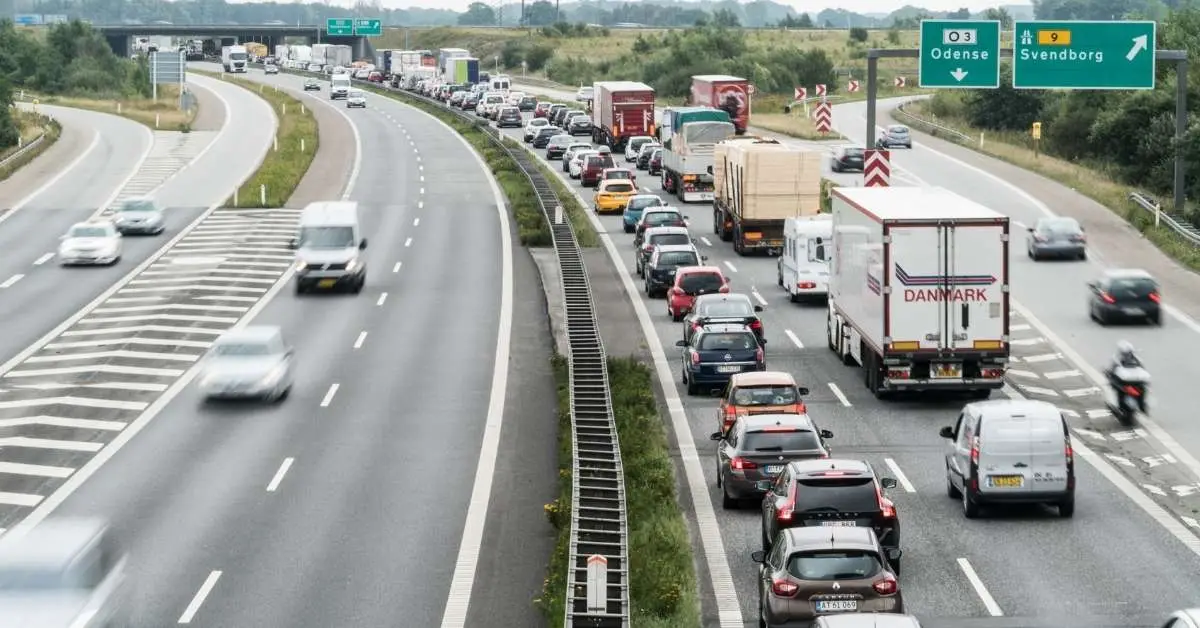
Some Danish riders and instructors are now publicly calling for legal low-speed lane filtering, but the country’s official accident data has no specific code to identify filtering as a cause in motorcycle crashes. In the national 2023 accident statistics, there is no field to record lane splitting as a factor in any motorcycle injury crash.
Some riders and instructors want the right to filter between queues at low speeds, pointing to rules in Utah, Montana and parts of Europe as context. But they face a problem few outlets have noticed: the national accident variable catalogue, maintained by Trafikstyrelsen and Vejdirektoratet, contains no field for lane splitting as a primary cause. Police record speeding, alcohol, distraction and overtaking, but have no specific code for the manoeuvre now at the centre of debate.
That makes Denmark unusual in more than one way. Road rules here place strong emphasis on cyclist safety, reflecting the country’s high cycling rates and dedicated bike lanes. According to Danish road rules notified to the EU via the Your Europe portal, drivers must use the lane specified for their vehicle, and general overtaking rules apply. In practice, riding between queues can be regarded as unlawful overtaking, even at low speed.

For expats arriving from countries where filtering is legal, this comes as a surprise. Britain allows it under the Highway Code. California explicitly permits it under Vehicle Code section 21658.1. France ran a national lane filtering experiment on selected roads at speeds up to 50 km/h, but ended the programme after an evaluation reported increased accidents. In Denmark, a dangerously executed filtering manoeuvre could, if judged vanvidskørsel, lead to seizure and later confiscation of the vehicle, even if the bike is rented or borrowed.
International Models Denmark Doesn’t Follow
Utah’s law allows lane filtering at up to 24 km/h between fully stopped vehicles on roads with limits of 72 km/h or below. Montana permits filtering at up to 32 km/h when surrounding traffic moves at 16 km/h or less. Both states set precise speed and traffic conditions in their statutes.
Denmark has done neither. No dedicated national study on lane filtering safety appears in recent official publications from Transportministeriet, Trafikstyrelsen or Vejdirektoratet. Rider organisations cite foreign research suggesting filtering reduces rear-end crashes. Critics argue that, given Denmark’s high cycling rates and complex junctions, any manoeuvre encouraging motorcycles to move between lanes could threaten vulnerable road users.
The debate largely relies on foreign data because Danish police accident forms do not have a specific field to record whether a motorcycle was filtering when it crashed.
Confiscation and the Expat Risk
The 2021 vanvidskørsel provisions introduced very strict sanctions for extreme driving. According to Færdselsloven section 117c, driving more than 100 percent above the speed limit when exceeding 100 km/h, or with a blood alcohol level of at least 2.0 promille, can lead to seizure and later confiscation of the vehicle. This applies regardless of whether you own, lease, rent or borrow it, and confiscation follows a judicial decision rather than happening automatically.

Only if a manoeuvre meets vanvidskørsel criteria, such as extreme speed or a very high blood alcohol level, can it lead to confiscation. Ordinary reckless driving leads to fines and licence sanctions, not confiscation. For internationals accustomed to more permissive attitudes, the line between tolerated and illegal can be invisible until a patrol car appears.
Danish rules also require small mopeds to use cycle paths unless signs indicate otherwise, and mandate liability insurance for all motorcycles. Riding without coverage is illegal. Using a foreign registered bike while resident in Denmark generally requires a permit or tax arrangement through Motorstyrelsen, the motor vehicle agency.
A Political Problem Without Data
Some riders argue that legalising filtering with clear speed caps would align Denmark with practice in other countries and make enforcement more straightforward than the current blanket prohibition. Meanwhile, Denmark allows 17-year-olds to drive cars under supervision, while motorcycle licensing remains stricter, which some riders see as policy that favours cars over two wheels.

Critics point to Denmark’s very high cycling rates, documented by Eurostat and the OECD, and warn that adding a second fast-moving vehicle type between lanes could complicate already dangerous right-turn intersections. There are also concerns that legal filtering could blur into aggressive lane-changing on high-powered bikes, undermining the lane discipline that Danish traffic rules prioritise.
Neither side can point to domestic evidence, because the data gap remains unbridged. Any change would likely require Transportudvalget to consider better monitoring or pilot schemes before reform moves forward. For now, expat riders should treat filtering as potentially illegal under current lane-use rules and follow official English-language guidance on the EU Your Europe portal and congested road conditions in Denmark.
Riders should also pay close attention to traffic interactions at cycle lanes and right-turn junctions, where Denmark records a disproportionate share of serious accidents. Motorcycles must never use bicycle lanes except where explicitly permitted. Those monitoring the debate can follow developments through the Transport Ministry and motorcycle associations, where any pilot schemes would likely be announced first. For now, the safest approach is to wait in cycle lane-adjacent queues and stay within the law.