
What are Hans Christian Andersen’s most famous fairy tales?
His best-known tales include “TheHans Christian Andersen turned poverty and heartbreak into the world’s most beloved fairy tales, from “The Little Mermaid” to “The Ugly Duckling.” For expats in Denmark, his story is the country’s origin myth made flesh. Before he became the great spinner of fairy tales, he was just a poor kid from Odense, certain he was meant for more.
- Hans Christian Andersen’s Early Life: Born in 1805 in Odense, Denmark, Andersen grew up in poverty surrounded by stories, which fueled his imagination and future writing.
- Struggles Before Success: After moving to Copenhagen at 14, Andersen faced multiple failures in acting and writing before gaining support to pursue his education.
- Breakthrough with Fairy Tales: His 1835 collection ‘Fairy Tales Told for Children’ introduced a unique, melancholic style loved by readers, marking his rise as a storyteller.
- Famous Fairy Tales and Impact: Andersen’s stories like ‘The Little Mermaid’ and ‘The Ugly Duckling’ are global classics that shaped the fairy tale genre and cultural legacy.
- Andersen’s Legacy: His influence endures through literary awards, museums, statues, and adaptations, including Disney’s ‘The Little Mermaid’, keeping his stories alive.
Hans Christian Andersen’s Early Life: A Boy With Nothing but Stories
Hans Christian Andersen was born on April 2, 1805, in Odense. His father was a poor shoemaker. His mother washed other people’s clothes for a living. There was no money and no family name to lean on.
His father died in 1816, when Andersen was eleven. The boy was sent to work in factories, but the labor crushed him. He spent more time singing and reciting plays than working.
After his confirmation at St. Canute’s Cathedral, he made a decision. At fourteen, in 1819, he left for Copenhagen with almost no money. He was convinced he was destined for greatness. Reality, as it tends to do here, disagreed.
Copenhagen Did Not Roll Out the Carpet
Andersen tried acting, dancing, and singing at the Royal Danish Theatre. He had a fine soprano voice until it broke. His tall, awkward frame did not fit the stage.
His writing, though, caught attention. Jonas Collin, a director at the theatre, saw something raw and real. According to the Britannica, Collin persuaded King Frederik VI to fund Andersen’s schooling. The catch was brutal. He had to finish grammar school first.
School was misery. At Slagelse and Elsinore, headmaster Simon Meisling belittled and humiliated him. Andersen later called those years the darkest of his life. But he refused to crawl back to Odense empty-handed.

The Writer Who Failed Before He Found His Voice
Andersen started his literary career in 1822 with poetry and sketches. He wanted to be taken seriously as a novelist and playwright. The Copenhagen literary elite mostly shrugged.
His 1835 novel “The Improvisatore” did bring him fame across Europe. But that same year he tried something stranger. He published a thin booklet called “Fairy Tales Told for Children.”
The first stories included “The Tinderbox,” “Little Claus and Big Claus,” and “The Princess and the Pea.” Critics were unsure. These were not the tidy moral lessons of the day. They were odd, personal, and often sad. Yet readers kept coming back for more.
That is the part I find most human. Andersen wrote for anyone who felt out of place or overlooked. He understood outsiders because he was one. Living here as a foreigner, I recognize that ache instantly.
Fame, Heartbreak, and an Uneasy Relationship With Success
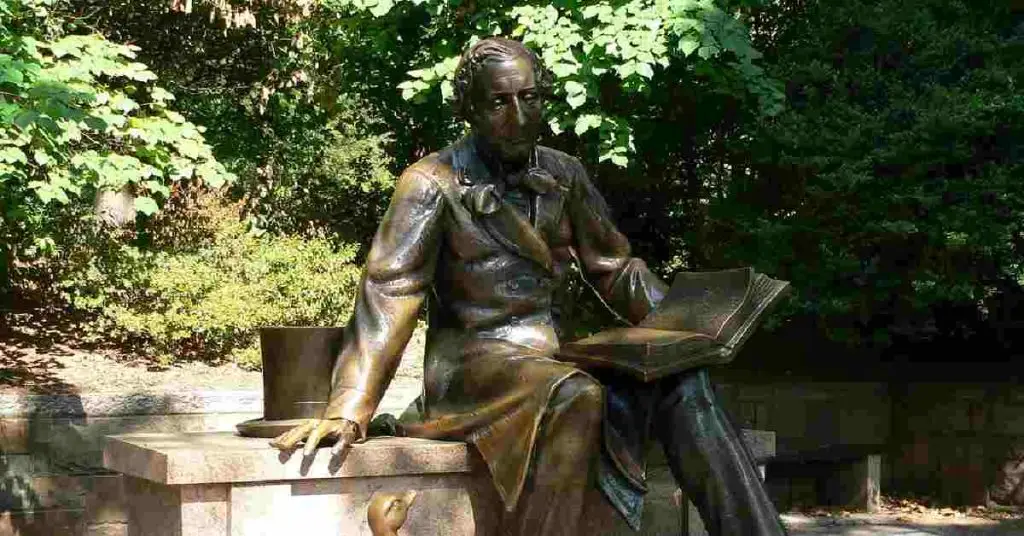
By the 1840s, Andersen was a household name. His tales were translated and devoured across the continent. He became one of Denmark’s biggest cultural exports, alongside figures like sculptor Bertel Thorvaldsen and the wider Danish Golden Age.
He loved to travel and once wrote that to travel is to live. He met Charles Dickens in England in 1847. A decade later he stayed at Dickens’s home for five weeks. As noted by the Wikipedia record, he badly overstayed his welcome, and Dickens quietly cut contact.
His love life was a string of heartbreaks. He pined for Riborg Voigt, Louise Collin, and the Swedish singer Jenny Lind. Lind inspired “The Nightingale” but only ever offered friendship. Andersen never married and likely died a virgin.
Hans Christian Andersen’s Most Famous Fairy Tales
Andersen wrote more than 150 fairy tales. They have been translated into over 125 languages, according to the Hans Christian Andersen Museum. These are the ones that shaped childhoods worldwide.
- “The Little Mermaid” – Before Disney softened it, this was a tragedy about love and sacrifice. The bronze Little Mermaid statue has guarded Copenhagen’s harbor since 1913.
- “The Ugly Duckling” – As much about Andersen himself as the duckling who becomes a swan.
- “The Snow Queen” – A sweeping epic that loosely inspired Disney’s “Frozen” in 2013.
- “The Emperor’s New Clothes” – Biting satire about vanity and the lies adults tell each other.
- “The Princess and the Pea” – Short, strange, and somehow unforgettable.
And then there is “The Little Match Girl.” No rescue, no warm ending. Just cold, hunger, and death. That was Andersen at his most honest. He refused to pretend that every life turns out kindly.
Why Hans Christian Andersen Still Matters to Expats in Denmark
You cannot escape Andersen here, and honestly you should not try. His face has appeared on Danish stamps and banknotes. His statue sits near Copenhagen City Hall, and there is a dedicated H.C. Andersen statue worth seeking out.
In Odense, the Hans Christian Andersen experience sprawls across an entire quarter. The new museum, designed by Japanese architect Kengo Kuma, opened in 2021. It is part of the wider Odense City Museums network.
If you want to understand Danish self-image, start with him. Andersen embodies the underdog who rose without inherited wealth. That tension between humble roots and global fame still runs through Danish culture today.
The Hans Christian Andersen Legacy Beyond the Fairy Tales
Andersen was never only a children’s author. He wrote novels, travel books, poems, plays, and a sprawling autobiography. His struggles and outsider status bled into everything he produced.
His name now marks institutions and honors around the world.
- The Hans Christian Andersen Award, often called the “Little Nobel Prize,” is the top global honor in children’s literature. It has run since 1956, awarded by IBBY.
- His birthday, April 2, is now International Children’s Book Day.
- His original handwritten manuscripts have gone online for readers worldwide.
- Statues, parks, and even an asteroid carry his name.
Then there is Disney. The animated “Little Mermaid” introduced him to generations who never read a word he wrote. It was not his bleak version, but it kept his name alive. He belongs in any list of famous Danish people who shaped the world.
Andersen died on August 4, 1875, of liver cancer, at a friend’s villa near Copenhagen. He was a national treasure by then, honored and wealthy. The poor boy from Odense had finally won.

Frequently Asked Questions
Who was Hans Christian Andersen?
Hans Christian Andersen was a Danish author born in Odense in 1805. He wrote more than 150 fairy tales, including “The Little Mermaid” and “The Ugly Duckling,” translated into over 125 languages and beloved worldwide.
What are Hans Christian Andersen’s most famous fairy tales?
His best-known tales include “The