A caterpillar treated as a public health hazard across much of Europe is, on Bornholm, a long-established local species that international visitors encounter with limited warning. Denmark hosts one of the northernmost known populations of the northern pine processionary moth, yet manages it far more casually than EU neighbours handle related species.
The TV 2 Bornholm report showed northern pine processionary caterpillars marching across a Dueodde terrace in summer and featured locals expressing delight at the spectacle. What the coverage underplayed is that closely related processionary species trigger eradication campaigns in France, tree-vacuuming operations in Germany, and urgent veterinary warnings across southern Europe. On Bornholm, the caterpillars move past summer-house guests with limited signage and little or no consolidated English-language guidance.
According to Statistics Denmark, Bornholm recorded around 1.4 million overnight stays in commercial accommodations in 2023, up roughly 23 percent compared with 2018. Statistics Denmark’s StatBank shows that foreign nationals account for roughly 32 to 35 percent of all overnight stays during peak summer months, with Germans forming the largest group. That means many international visitors are present in Dueodde and other pine-forested holiday areas precisely when the caterpillars descend from nests and cross paths and terraces to pupate.

Why the Northern Pine Processionary Moth Matters
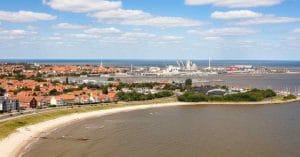
The species on Bornholm is the northern pine processionary moth, Thaumetopoea pinivora, distinct from the Mediterranean pine processionary (T. pityocampa) and the oak processionary (T. processionea) found on the Danish mainland. According to local entomological sources including expert Michael Stoltze, the species has been present on southern Bornholm since at least the 1930s, and local experts estimate it may have been there for around 100 years. It is confined in Denmark to Dueodde and the surrounding pine forests, in an unusually warm island microclimate.
For the rest of Europe, closely related processionary species are a growing problem. Long-term climate records from the Danish Meteorological Institute show that average winter temperatures on Bornholm have risen by around 1.3 to 1.5 degrees Celsius since the 1961 to 1990 baseline. That warming has reduced frost days and improved survival rates for overwintering larvae. European modelling studies project that, by 2050, suitable climate for T. pityocampa could cover most of southern Scandinavia.
Meanwhile, outbreaks of the oak processionary moth have been documented in Odense and other parts of Fyn, and locally on Amager in Copenhagen, in recent years. Those incidents prompted localised tree-vacuuming operations and municipal warnings to schools and kindergartens. Management currently occurs at municipal and local level, with no clearly publicised national management plan specific to processionary caterpillars.
Health Risks the Cheerful Coverage Underplayed
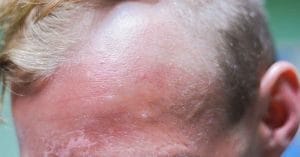
The caterpillars’ tiny barbed hairs can provoke severe allergic reactions, conjunctivitis, and in rare cases respiratory distress. Dogs and children face particular risk when investigating nests or processions. According to a Robert Koch Institute survey in North Rhine-Westphalia, oak processionary exposure led to over 1,000 treatment cases in a single season, mostly skin rashes and eye irritation.
Publicly accessible sources do not provide specific Danish case statistics for northern pine processionary exposures, so incident data remain unclear. According to an EU Scientific Committee health risk assessment, exposure to processionary hairs can cause intense pruritic dermatitis, conjunctivitis, and bronchospasm, and repeated exposures may lead to persistent sensitisation.

According to a European veterinary advisory note, companion animals are at high risk of serious mouth and tongue injury after contact with nests or processions. In several EU countries, including Germany and the Netherlands, municipalities have closed playgrounds or cordoned off areas in response to oak processionary infestations, according to local reports. Bornholm has few visible closures or multilingual warnings, and guidance is mainly in Danish.
What Internationals Need to Know
Northern pine processionary larvae on Bornholm are most visible in summer, when they descend from nests and travel in processions to pupate. Visitors using summer houses near pine stands or dunes should keep children and dogs away from old pine trees with conspicuous white silk nests. If contact occurs, wash clothes at high temperature and rinse exposed skin gently without rubbing.
Dog owners should seek immediate veterinary care if animals drool excessively, paw at their mouths, or show tongue swelling. For humans experiencing rash, eye irritation, or breathing difficulty, contact your GP or dial 1813 for medical helpline support, or 112 in emergencies. Staff can usually assist callers in English.

Municipal nature and environment departments typically handle reports of pests on public land. Information online is mainly in Danish. Foreign residents can also consult European public advisories from Germany, France, and EU health bodies, which offer detailed pictorial guides in English for nest identification, first aid, and pet risks.
A Preview of Denmark’s Climate Future
In several EU countries, oak processionary infestations have led to closures of affected schools and parks, whereas Bornholm’s long-established northern pine processionary is often described more as a local phenomenon. Bornholm’s population illustrates how warmth-loving processionary species can persist at Denmark’s southern fringe. Newer arrivals like oak processionary reflect the broader climate-driven northward spread of species across Europe.
For internationals living in Denmark, the pattern is becoming familiar. As Mediterranean and continental species move north, southern European health and allergy issues will increasingly appear in a Nordic context, often before authorities have adapted communication and management practices to match.