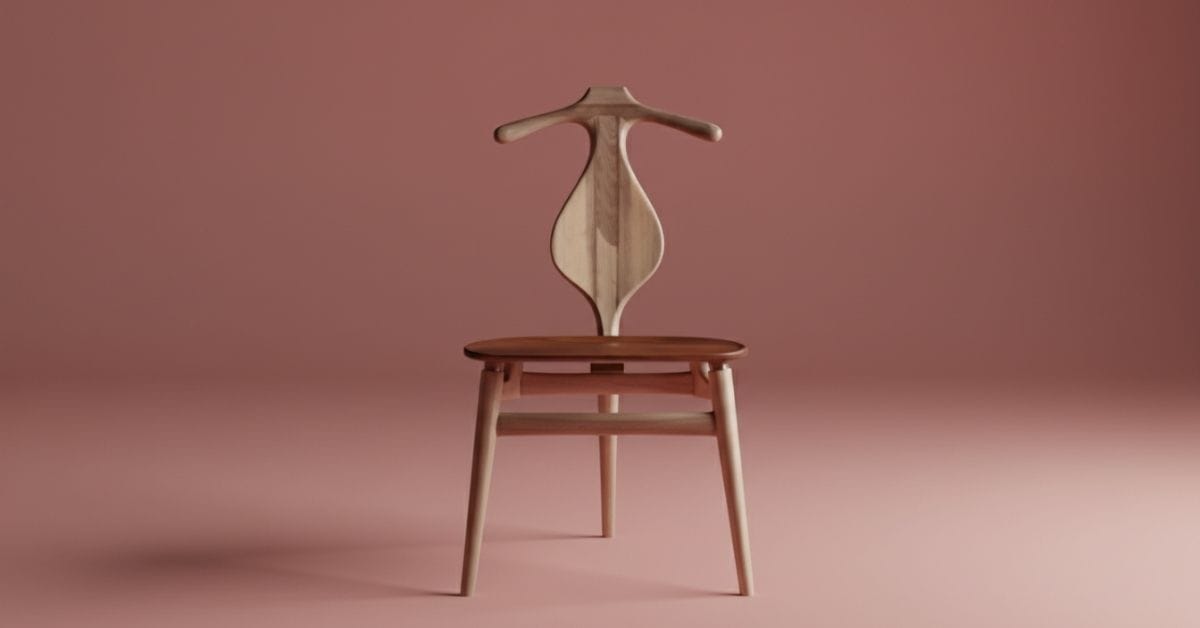
The mid-20th century witnessed the rise of many iconic pieces of furniture, but few have stood the test of time like the Valet Chair by Hans J. Wegner.
Key Points:
- An Icon of Danish Design: The Valet Chair, designed in 1953, exemplifies Danish design principles of simplicity, functionality, and beauty, serving practical domestic needs.
- Hans J. Wegner – The Master Designer: Hans J. Wegner, a key figure in Danish design, created over 500 chairs, with the Valet Chair reflecting his philosophy of craftsmanship, ergonomics, and understated elegance.
- Design Purpose and Functional Qualities of the Valet Chair: This multifunctional chair serves as a coat hanger, trouser hanger, and hidden storage, seamlessly combining utility with elegant design.
- Material Integrity and Craftsmanship: Made from durable, high-quality woods like teak, oak, or cherry, each chair showcases traditional Danish joinery and meticulous craftsmanship.
- Why the Valet Chair Remains Important Today: Its timeless relevance, collectible value, and embodiment of Danish design principles affirm the Valet Chair as a lasting symbol of functionality and elegance.
An Icon of Danish Design
Crafted with meticulous attention to both function and form, this chair represents a landmark in Danish design, combining aesthetic purity with everyday practicality. Designed in 1953 and first presented to the public in 1954, the Valet Chair captures the core ideals of Denmark’s approach to modern furniture: simplicity, functionality, and beauty driven by purpose.
This chair isn’t merely a seat, it’s a personal assistant in furniture form. A place to hang your suit, store small essentials, and, of course, sit comfortably. A thoughtful response to domestic needs, the Valet Chair is a prime example of how good design can improve daily life. It remains a beloved classic that speaks to connoisseurs of Danish furniture and aficionados of high-quality, purposeful design.
Hans J. Wegner – The Master Designer
Born in 1914 in Tønder, Denmark, Hans J. Wegner was more than just a furniture designer, he was one of the visionary pillars behind what is now globally celebrated as Danish design. Wegner designed over 500 chairs in his lifetime, with more than 100 of those still in production today. His philosophy was rooted in craftsmanship, ergonomics, and understated elegance.
Wegner’s approach was profoundly human-centric. He believed that furniture should serve its users seamlessly while possessing sculptural qualities that could enrich an interior. The Valet Chair was created after Professor Thorkild Kristensen, a Danish statesman, challenged Wegner to design a chair where a gentleman could properly hang his clothes at the end of the day. Wegner responded not just with a wooden frame or decorative form, but with an entire lifestyle solution in physical shape.
The Valet Chair was introduced at the Cabinetmakers’ Guild Exhibition in Copenhagen in 1953, showcasing Danish craftsmanship at its highest level. It gained instant recognition not only for its unique composition but also for its clever integration of multiple uses.
Design Purpose and Functional Qualities of the Valet Chair
In Danish culture, a piece of furniture is never merely decorative; it is expected to perform. The Valet Chair perfectly embodies this principle. It seamlessly integrates several functionalities:
- Coat Hanger: The curved backrest doubles as a suit or blazer hanger, its ergonomic shape perfectly suited to preserve the shoulder line of garments.
- Trouser Hanger: Beneath the seat is a glide-out bar for draping trousers neatly without creasing them, similar to a traditional valet stand.
- Hidden Storage: The seat itself lifts up to reveal a small compartment, ideal for storing a watch, cufflinks, or other menswear accessories.
This trifecta of tailoring-friendly features is what gives the Valet Chair its “clever” designation. It doesn’t loudly proclaim its utility; instead, it invites users to discover the subtleties of its engineering through gentle interaction.
The unified frame ensures structural integrity, while the compact form makes it ideal for bedrooms, dressing areas, or hallways, spaces where functional elegance is particularly required. With a height of about 94 cm and a seat width of approximately 51 cm, the Valet Chair is remarkably space-conscious while offering ample room for comfort.
Material Integrity and Craftsmanship
True to the legacy of Danish craftsmanship, the materials used in the Valet Chair reflect both quality and longevity. It is commonly made from solid woods like teak, oak, or cherry, each chosen for its durability, aesthetic appeal, and warm tones that age gracefully.
Every joint, curve, and finish is executed with traditional joinery techniques handed down through generations of Danish cabinetmakers. The hand-sanded edges, invisible screws, and perfectly balanced grain alignment make every chair an individual work of art. In harmony with Denmark’s design ethos, no part of the chair is superfluous; each element is present because it serves a real purpose.
Hans J. Wegner once said, “A chair should have no back; it should be beautiful from every angle.” This philosophy resonates deeply in the Valet Chair’s design. From the elegantly curved backrest to the tapered legs, from its horizontal alignment to its vertical symmetry, the chair’s silhouette is as captivating as its functionality.
Why the Valet Chair Remains Important Today
After nearly 70 years on the global design stage, the Valet Chair continues to be a favorite among collectors, architects, and interior designers, celebrated not only for its historic importance but also for its timeless relevance. It remains a symbol of Danish design genius and a benchmark for how well furniture can adapt to human lives with grace and intelligence.
Interest in the Valet Chair has not waned; in fact, it has grown. According to statistics from international design auctions, demand for classic mid-century Danish furniture has increased by over 30% in the last 10 years. Collectors seek out original editions from the 1950s, while design-savvy homeowners opt for new, authenticated productions. It is just as at home in a vintage-themed residence as it is in a cutting-edge contemporary apartment.
In an era driven by fast furniture and throwaway design, the Valet Chair stands as a profound counter-message. It champions the art of slow make, intentional living, and a return to tradition without sacrificing modern lifestyle needs.
Combining understated elegance, multi-functionality, and impeccable craftsmanship, the Valet Chair by Hans J. Wegner is not only a piece of furniture but a statement of design theory, a tool for daily ritual, and a pinnacle of what makes Danish furniture design renowned across the world.
Why You Should Own The Clever Valet Chair by Hans J. Wegner
Function Meets Timeless Form
In the world of interior furnishing, the best pieces do more than merely fill a space; they complement a lifestyle. The Valet Chair by Hans J. Wegner embodies that philosophy with unparalleled poise. Combining a sculptural silhouette with utilitarian brilliance, this chair doesn’t just blend into your interior; it elevates it.
At its core, the Valet Chair answers simple, everyday needs: where to comfortably sit while dressing, where to hang a suit without wrinkling, and where to place a watch or cufflinks at the end of the day. This kind of thoughtful design is at the heart of Danish design, where practicality is never divorced from elegance. It is this deep integration of beauty and function that has made the Valet Chair a cherished statement piece in Danish households for over 70 years.
In a world leaning heavily toward minimalism, particularly in Northern Europe and Scandinavia, the Valet Chair exemplifies how objects can serve multiple roles while enhancing the calm, uncluttered atmosphere synonymous with Danish home interior design.
The Danish Lifestyle: A Philosophy in Wood
In Denmark, home design is more than aesthetics, it is a lifestyle. Built on the idea of “hygge,” or the creation of warmth, comfort, and gentle well-being through everyday design, Danish interiors are carefully curated to foster balance, purpose, and emotional connection.
Within this framework, the Valet Chair shines. Its walnut or oak tones resonate with the prevailing materiality of Danish homes, natural wood, muted color schemes, and airy spaces. Its small footprint and multi-functionality make it especially suited to Copenhagen apartments or smaller Nordic homes where layout efficiency is crucial. Standing just under 1 meter tall with a seat width of approximately 51 cm, the chair accommodates needs without crowding a room.
This is why modern Danish families and design lovers from Tokyo to Toronto seek out Wegner’s creation, because it’s more than a seat. It is a daily ritual. An organized end to your day. A legacy of functional Danish design that remains as relevant today as when it debuted in 1953.
Lasting Investment and Design Legacy
Unlike trend-based furniture with short lifespans, the Valet Chair is a lasting investment. Crafted using high-quality hardwoods and built to artisanal standards, it’s a piece that not only looks good but stands the test of time. Many original models from the 1950s are still in circulation and available at design auctions, some commanding prices of over €5,000.
The chair’s legacy is further cemented by its continued relevance in contemporary design discourse. It is frequently featured in exhibitions on iconic 20th-century furniture alongside works by Arne Jacobsen and Børge Mogensen. For collectors, architects, and those with an eye for heirloom value, the Valet Chair represents collectibility, history, and function in a single frame.
Moreover, for modern homeowners focused on sustainability, the Valet Chair aligns with responsible living. Produced in limited series with sustainable woods and non-toxic finishes by authorized Danish manufacturers, owning one is as much a pledge to environmental conscientiousness as it is to design excellence.
A Thoughtful Gift or Personal Statement
Few furniture pieces manage to express personal lifestyle and design literacy the way the Valet Chair does. It is as meaningful a housewarming gift as it is a personal reward. Whether positioned in a dressing area, walk-in closet, or even a gallery-like reading corner, it quietly commands the room’s attention while serving a deeply practical role.
For young professionals focused on building a refined living space or seasoned collectors expanding a curated setup, the Valet Chair is a symbol of discernment, taste, and a love for Danish design that transcends generations.
In a world where less is increasingly more, the Valet Chair reminds us that one object, when designed exceptionally, is capable of doing, and saying so much.
Conclusion: The Enduring Legacy of The Clever Valet Chair by Hans J. Wegner
The Valet Chair by Hans J. Wegner is an embodiment of the classic ideals of Danish design, a perfect harmony of beauty and utility, simplicity and sophistication. As much a statement piece today as it was upon its introduction in 1953, the Valet Chair remains a prime example of Denmark’s ingenuity in furniture design. Whether you are drawn to its historical significance, its multipurpose nature, or its impeccable craftsmanship, the Valet Chair offers an unparalleled blend of practicality and elegance. For those who appreciate the intersection of design, art, and daily life, it stands as an essential addition to any thoughtful home.
Key Takeaways
– The Valet Chair was designed by renowned Danish designer Hans J. Wegner in 1953, showcasing the pinnacle of Danish design.
– It seamlessly combines function and aesthetics, serving as a chair, coat hanger, and storage unit.
– Crafted from premium woods like teak, oak, and cherry, it represents exceptional durability and Scandinavian elegance.
– The chair’s design is emblematic of Denmark’s unique blend of comfort, minimalism, and functionality.
– Available at leading design retailers and vintage auctions, the chair remains a treasured piece among collectors and design enthusiasts.
FAQ
1. What makes the Valet Chair unique compared to other furniture pieces?
The Valet Chair stands out due to its multifunctionality, serving as a seat, a clothing hanger, and providing storage. Its blend of practicality and aesthetic appeal epitomizes Danish design principles.
2. Is the Valet Chair suitable for modern interiors?
Absolutely. Its timeless design and elegant simplicity make it suitable for various interior styles, from minimalist and modern to classic and eclectic settings.
3. How do I maintain the Valet Chair?
Regularly dust the chair with a soft cloth and apply a wood treatment appropriate to the specific wood type, teak, oak, or cherry to preserve its finish and durability.
4. Who was Hans J. Wegner, and why is his work significant?
Hans J. Wegner was a pioneering Danish furniture designer known for his emphasis on function, form, and craftsmanship. He created over 500 chair designs, many of which are celebrated icons of Danish design.
5. Does the Valet Chair require assembly?
Most new models come pre-assembled to preserve the integrity of their design and craftsmanship, though checking with the retailer at the time of purchase is advisable.
6. Are there limited editions of the Valet Chair available for collectors?
Yes, limited editions and vintage models occasionally emerge in auctions and through select retailers, offering unique varieties and historical value for collectors.
7. Is the Valet Chair environmentally sustainable?
Made with quality hardwoods and non-toxic finishes, the modern production of the Valet Chair embraces principles of sustainability, echoing the environmental consciousness embedded in contemporary Danish manufacturing practices.