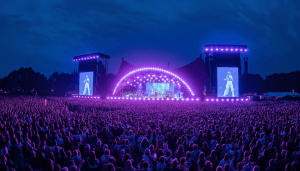
Roskilde Festival 2026 opens on 27 June with Gorillaz, The Cure, and Zara Larsson on the bill, but the festival does not publish an official, consolidated dataset that would allow a straightforward, year-by-year measurement of whether the line-up is weakening.
The question matters because Roskilde is widely regarded as one of Denmark’s largest cultural events. For internationals who have come to Denmark expecting world-class events, the festival is a test of whether the country can still pull global talent. But the story about a fading programme rests on a foundation that is difficult to verify without a ready-made, official line-up archive.
The Archive Problem
Roskilde Festival has been running since 1972 and markets itself as non-profit. That label matters because it positions the event as a cultural mission rather than a commercial machine. According to the official English site, the 2026 edition runs from 27 June to 4 July and names Gorillaz, The Cure, Zara Larsson, Aphaca, Addison Rae, and Wolf Alice among the acts.
What it does not provide is a unified, searchable database of past line-ups across years. Information is scattered across individual line-up pages and press releases. Without that baseline, the claim that the programme is weakening becomes a matter of perception rather than proof.

Roskilde Festival 2026: Comparison Is Everything
There is no ready-made, official count of how many acts were announced in each of the last five years. Compiling this would require manual counting from individual line-up pages and press releases. The promotional copy uses words like “expansive” to describe the 2026 bill, yet that is marketing language, not analysis.
For expats who have followed the festival over multiple years, the subjective sense that something has changed is real. But converting that feeling into a verifiable trend requires numbers that Roskilde has not made systematically available.

What the Data Would Show
A proper analysis would need a count of top-billed acts per year, a breakdown of genre and nationality, and a timeline of when each wave of announcements happened. It would also require ticket-demand figures and audience composition, including how many attendees came from outside Denmark.
That combination of data is not available as an official, consolidated dataset that allows easy longitudinal comparison. Some components, including dates and headliners, exist across Wikipedia entries and Roskilde communications, but no single source brings them together for direct comparison.

The Non-Profit Angle
Roskilde’s non-profit status since 1972 is a structural detail that shapes expectations. Commercial festivals chase maximum revenue and book accordingly. A non-profit model allows for different priorities, including cultural programming that might not maximise ticket sales.
That framing complicates any decline narrative because it suggests Roskilde might be choosing a different booking strategy rather than losing its ability to compete. The official Danish homepage lists the 2026 acts in shorthand as Gorillaz, The Cure, Zara Larsson, Aphaca, Addison Rae, Wolf Alice, and many others. The phrase “mange andre” is doing a lot of work in that sentence.
Without the full list and the historical comparison, it is impossible to say whether those many others represent depth or filler.

The Practical Test
For anyone deciding whether to buy tickets, the official site remains the best resource. It is available in English and provides the current programme and practical details. The 2026 line-up includes names that most European festivals would be happy to book.
Whether that represents decline depends entirely on what the baseline was. And there is no official, standardised way to track whether headliners shifted from global to Nordic or whether the genre mix narrowed. Doing so would require manual reconstruction and subjective categorisation. That gap is the real story here.