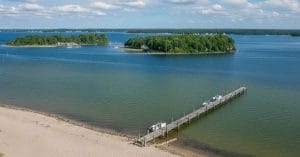
Ringkøbing Fjord’s beaches are drowning in rotting seaweed this summer, driving visitors away, while the municipality tries to protect a key tourism asset with a cleaning budget smaller than the cost of a used car.
As tonnes of decaying seaweed force locals to close windows and abandon once-popular bathing spots along Ringkøbing Fjord this August, Ringkøbing-Skjern Kommune is facing an uncomfortable question. How much should a rural municipality spend to keep beaches clean when the national coastal tourism industry generates billions? The answer in 2026 is stark: the entire strandrensning budget for fjord beaches this season is 25,000 DKK.
That figure is less than the price of a small family car. Yet coastal and maritime tourism across Denmark generated 16.5 billion DKK in gross value added and supported 32,537 full-time jobs as of 2019, the most recent year with published national data. West Jutland, including Ringkøbing-Skjern, attracts a disproportionate share of foreign tourists to Denmark. The disconnect between local cleaning budgets and the wider economic stakes could not be clearer.
Why the seaweed is winning
The beaches at Sorte Bakker, once crowded with families and internationals seeking a quieter alternative to Copenhagen-area beaches, have been almost deserted for weeks. Preben Jensen, a local resident, told TV Midtvest that he has lived there for five years. The first years people were happy and bathing, he said. But suddenly the beach emptied. He thought that would not do.

The cause is not pollution in the traditional sense. Biologists monitoring the fjord say the ecosystem has improved, with lower nutrient loads and clearer water leading to greater seaweed growth and more biomass washing ashore. Fisheries sector reports from June 2026 describe Ringkøbing Fjord as so healthy that very large amounts of seaweed now wash up on beaches, causing odour nuisance and poor access throughout the summer.
A 25,000 DKK band-aid
In late June the issue landed on the agenda of Ringkøbing-Skjern’s Plan and Traffic Committee. Chair Henrik Hammelsvang confirmed the 25,000 DKK budget and ruled out removing all seaweed. Economically it is not realistic, he said. The municipality has instead sanctioned a volunteer-led clean-up effort at Sorte Bakker, where Jensen and neighbour Niels Braüner bring a small excavator and manually clear tonnes of seaweed over many weeks.
By early August they expect to work through September. This volunteer arrangement, combined with micro-scale municipal clean-ups at a couple of access points, effectively sets the management model for summer 2026. It stands in sharp contrast to beach cleaning in other European countries. In the Netherlands, for example, coastal municipalities spent between 6,200 and 48,000 euros per beach kilometre per year as of 2019, several times what Ringkøbing-Skjern can afford for its entire fjord budget.
Health risks and absent warnings
Decaying seaweed mixed with blue-green algae blooms can release hydrogen sulphide and other gases. Danish Environment Agency guidance from 2024 warns that algae and decaying organic matter typically peak in July and August. Parents are urged not to let children play in scum accumulations or opaque green water and to watch for symptoms like skin irritation, headache, fever, nausea, and diarrhoea after exposure.

Official bathing water rules require municipalities to monitor water clarity and to warn bathers if algae reach problematic levels. Ringkøbing-Skjern must take at least four water samples per season. Yet for internationals living in the area, communication is often only in Danish. Many expats may be unaware of environmental reasons for the smell, health advice, or their rights to push for better maintenance and signage.
What internationals can do
Check Ringkøbing-Skjern Kommune’s website and bathing water pages, which must publish test results and advisories under EU rules. If information is only in Danish, use browser translation or ask Danish neighbours. Avoid water that smells strongly of decay or shows thick green scum. Keep children away from piles of rotting seaweed on the shore.
Contact the Plan and Traffic Committee or borgerservice to request clearer multilingual signage, more frequent targeted cleaning at key access points, or simple visual aids like red and green flags for algae conditions. Organised community clean-ups, coordinated with the municipality to avoid ecological damage, are a realistic stopgap while the political debate over budgets plays out.

A false victory
Supporters of limited cleaning argue that completely removing natural seaweed would be prohibitively expensive and environmentally questionable. Seaweed plays a role in coastal ecology and is a visible sign of a recovering fjord. Biologists emphasise that large seaweed masses indicate lower nutrient pollution and healthier plant growth, suggesting success in decades of environmental policy.
Residents counter that a healthy fjord with unusable beaches is a false victory, particularly when tourism and outdoor recreation are cited as future economic pillars for west Jutland. For internationals and younger families, the lack of clear English-language warnings and practical guidance can feel like being left to interpret smells and algal scum on their own. Jensen’s comment that we must not capitulate completely captures local frustration at what feels like municipal passivity.
Denmark has 4,605 kilometres of coastline, and coastal municipalities in remote west Jutland and the islands show the highest employment effect from coastal tourism according to 2019 national data. The stakes are real when local beaches become unusable. A small rural municipality with schools, social care, and infrastructure to fund cannot divert hundreds of thousands of kroner to cosmetic beach cleaning without cuts elsewhere. But the question remains whether Ringkøbing-Skjern is under-investing in a key asset compared with European peers.