Yes, Denmark is Danish, but the answer hides a richer story about identity, language, and a kingdom that stretches from Copenhagen to the Arctic. After years living here, I can tell you “Danish” means far more than a passport.
Is Denmark Danish? The Short Answer
Denmark is the homeland of the Danes, a people whose name has stuck to this corner of Northern Europe for at least 1,500 years. The country, its language, its flag, and its 5.95 million citizens are all categorically Danish. The Kingdom also includes Greenland and the Faroe Islands, where things get a little more complicated.
So if you’re asking whether Denmark is ethnically, linguistically, and politically Danish, the answer is a firm yes. If you’re asking whether everyone inside the Kingdom feels Danish, that is a different question. I’ll get to it.
Where the Word “Danish” Actually Comes From
Etymology of “Dane” and “Danish”
The word “Danish” traces back to the Old Norse tribal name Daner, recorded by the Roman historian Jordanes in the 6th century. He described the Dani as a tall people who had pushed the Heruli out of what is now southern Sweden and Jutland. The name likely means “flatlanders,” which fits perfectly given the geography.
By the Viking Age, “Danmark” appeared on the Jelling Stones, raised by King Harald Bluetooth around 965 AD. As documented by UNESCO, those runic stones are the birth certificate of the Danish nation.
Danskhed: The Idea of “Danishness”
Danes have a specific word for their national identity: danskhed. The concept was shaped in the 19th century by N.F.S. Grundtvig, a pastor and poet who built the folk high school movement after Denmark lost Norway in 1814.
Grundtvig argued that Danishness lived in language, song, and community, not just blood or borders. That idea still runs through Danish schools, churches, and politics today. You can feel it the first time you join a hygge evening and realise everyone is singing from the same battered songbook.
The Kingdom of Denmark vs Denmark Proper
“Denmark” can mean two things. There’s Denmark proper, the small country on the Jutland Peninsula and its islands. Then there’s the Kingdom of Denmark, called Rigsfællesskabet, which also covers Greenland and the Faroe Islands.

Greenland: Danish on Paper, Inuit at Heart
Greenland has been under the Danish crown since 1814 and gained home rule in 1979, with expanded self-government in 2009. Roughly 88% of Greenland’s 56,000 residents are Inuit, not ethnically Danish. They speak Kalaallisut, eat seal and muktuk, and elect their own parliament, the Inatsisartut.
The question of whether Greenland is truly Danish exploded back into headlines when Donald Trump renewed his interest in buying the island. Greenland’s Prime Minister Múte B. Egede responded that Greenland belongs to the Greenlanders, full stop. For more on this debate, see our piece on Greenland.
The Faroe Islands and Their Own Identity
The Faroe Islands sit halfway between Scotland and Iceland, 18 windswept rocks with around 54,000 people. Home rule arrived in 1948, and the Faroese have their own language, parliament called the Løgting, and even their own football team.
Most Faroese will tell you they are Faroese first and Danish second, if at all. They use Danish krone, fly the Merkið flag rather than the Dannebrog, and stayed out of the EU when Denmark joined in 1973.
A Brief History of How Denmark Became Danish
From Hunters to Iron Age Tribes
Humans arrived in what is now Denmark around 12,500 BC, following retreating glaciers. Farming took hold by 3900 BC, and bronze tools appeared by 1700 BC. By the Iron Age, Germanic tribes including the Dani were trading amber and slaves with the Roman Empire.
Runes appear in Denmark from around 200 AD, the first scratched signs of a written Danish identity. The Tollund Man, pulled from a Jutland bog in 1950, still wears the same calm face he wore 2,400 years ago.
When Danes Were Vikings
The Viking Age (793 to 1066 AD) put Denmark on the European map for good. Danish kings like Sweyn Forkbeard and Cnut the Great ruled an empire stretching across England, Norway, and parts of Sweden. Their longships reached Greenland, Newfoundland, Constantinople, and the Caspian Sea.
Vikings raided monasteries, yes, but they also founded cities like Dublin and York. They traded furs, walrus ivory, iron, and enslaved people across three continents. Today’s Danes love the legacy, minus the slavery part.
Christianity, Kalmar, and a Shrinking Map
Harald Bluetooth converted to Christianity around 965 AD and “made the Danes Christian,” as his runestone boasts. In 1397, Queen Margrethe I united Denmark, Norway, and Sweden in the Kalmar Union. Sweden walked out in 1523, and the rivalry has lasted ever since.
Denmark kept losing land. Skåne, Halland, and Blekinge went to Sweden in 1658. Norway was handed to Sweden in 1814 as a Napoleonic War punishment.
1864, Absolutism, and the Birth of Modern Denmark
Absolute monarchy arrived in 1660 and lasted until 1849, when Denmark adopted a democratic constitution. The 5th of June is still Constitution Day, and a public holiday for most workers.
Then came 1864, a national trauma. Prussia and Austria crushed Denmark and took Schleswig and Holstein. The country shrank by a third, and the slogan “what is lost outwards must be gained inwards” reshaped Danish self-image for a century.
20th Century: Occupation and the Welfare State
Denmark stayed neutral in World War I but was occupied by Nazi Germany from April 1940 to May 1945. The Danish resistance famously helped smuggle around 7,200 Jews to Sweden in October 1943.
After 1945, Denmark built the velfærdsstat, the welfare state that defines modern Danish life. Free healthcare, free university, generous parental leave, and high taxes form the package most expats either love or loathe.

Who Lives in Denmark Today?
Population and Demographics
Denmark had about 5.96 million residents as of 2024, according to Statistics Denmark (Danmarks Statistik). Around 86% are ethnic Danes, while roughly 14% have a foreign background. The largest non-Western groups come from Turkey, Syria, Lebanon, Iraq, Pakistan, and Somalia.
The population is ageing. There are more Danes over 60 than under 15, and birth rates sit at about 1.5 per woman. Without immigration, the population would shrink.
Language: The Real Gatekeeper
Danish is the official language, a North Germanic tongue closely related to Norwegian and Swedish. It has notoriously soft consonants and roughly 40 vowel sounds, depending on who you ask. Even Norwegians joke that Danish sounds like talking with a hot potato in your mouth.
English fluency in Denmark is among the highest in the world, ranked 4th by the EF English Proficiency Index. You can live here for years on English alone, but real belonging requires Danish. See our guide on whether you can live in Denmark without Danish.
Religion: Folkekirken and the Quiet Drift
Denmark’s state church is the Evangelical Lutheran Folkekirken, established in 1536 during the Reformation. Around 71% of Danes were members in 2024, down from 88% in 2000. Most attend church only for baptisms, weddings, confirmations, and Christmas Eve.
Islam is the second-largest faith with around 320,000 adherents, mostly in Copenhagen, Aarhus, and Odense. Catholic, Jewish, and Buddhist communities are small but historically rooted.
Denmark’s Geography: The Land of the Flatlanders
Jutland, Zealand, and Over 400 Islands
Denmark covers 42,933 square kilometres, making it slightly smaller than Switzerland. It consists of the Jutland Peninsula, the islands of Zealand and Funen, and roughly 406 named islands, of which about 70 are inhabited. Bornholm sits alone in the Baltic, closer to Sweden than to Copenhagen.
The land is famously flat. The highest natural point, Møllehøj in eastern Jutland, reaches a modest 170.86 metres. Glaciers from the last Ice Age shaped almost everything you see.
Coastline, Climate, and Why It Always Rains
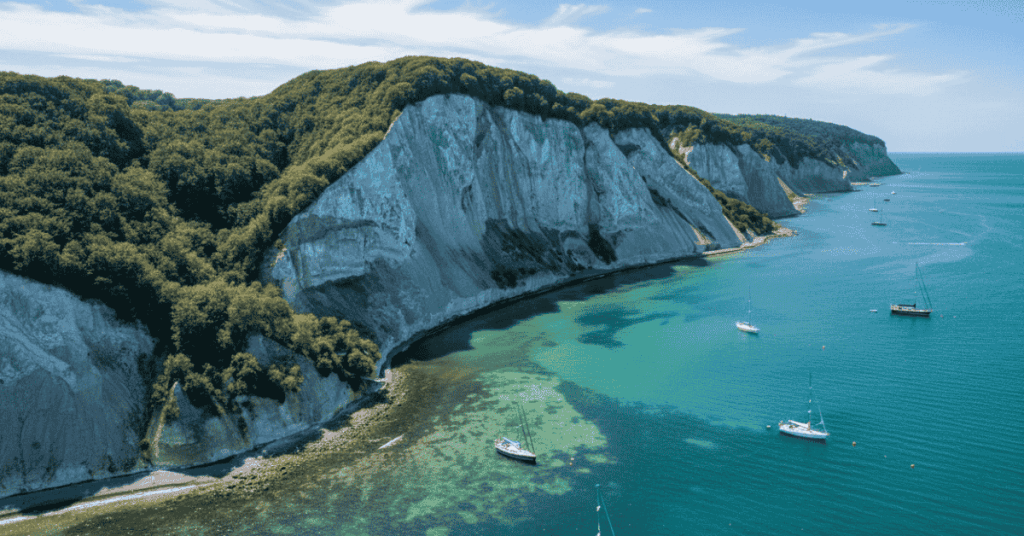
Denmark has 8,750 kilometres of coastline. Nobody in the country lives more than 52 kilometres from the sea. The chalk cliffs at Møns Klint and Stevns Klint, a UNESCO site, expose 70 million years of geological history.
The climate is temperate maritime, which is a polite way of saying grey and wet. Winters hover around 0°C, summers around 17°C, and rain falls on about 170 days a year. For a fuller breakdown, read our Denmark weather guide.
What Makes Danish Culture Danish
Hygge, Equality, and Janteloven
Danish culture revolves around three concepts that every expat eventually meets. Hygge is the cosy ritual of candles, coffee, and close company. Lighed, equality, runs through everything from tax brackets to how the prime minister cycles to work.
Then there’s Janteloven, the unwritten Law of Jante: don’t think you’re better than anyone else. It can feel suffocating to ambitious newcomers. For coping strategies, check our piece on Denmark culture shock.
Food: Smørrebrød, Rugbrød, and Salty Liquorice
Danish cuisine is humble, seasonal, and unapologetically heavy on rye bread. Smørrebrød, the open-faced sandwich, is the national lunch. Dinner often means roast pork with crackling (flæskesteg), frikadeller meatballs, or pickled herring.
Danes eat more sweets per capita than almost any other nation, and they have a complicated love affair with salmiak, salt liquorice that tastes like punishment to most foreigners. Try the Danish food classics before judging.
Design, Folkeskole, and Cycling Everywhere
Danish design, from Arne Jacobsen’s Egg chair to BIG’s twisting buildings, prizes function, light, and clean lines. Lego, born in Billund in 1932, is probably the country’s most successful export. The brand name comes from leg godt, meaning “play well.”
Children attend the folkeskole, a public school system that emphasises group work and quiet self-confidence over rote learning. And almost everyone cycles. Copenhagen has more bikes than residents, as our cycling guide explains.
Denmark’s Economy and Global Footprint
Denmark runs a mixed economy with a GDP per capita of around $68,000 in 2024, one of the highest in the EU. Pharma giant Novo Nordisk, maker of Ozempic and Wegovy, became Europe’s most valuable company in 2023. Maersk dominates global shipping, Vestas leads wind turbines, and Carlsberg pours beer in 150 countries.
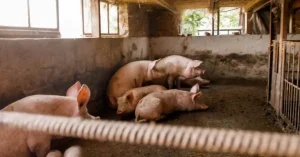
Agriculture still matters. Denmark produces enough pork to feed roughly three times its own population. The cooperative model, born from 19th-century farming crises, still underpins much of the dairy and meat industry today.
Why “Is Denmark Danish?” Matters Right Now
The question is no longer just academic. Trump’s renewed push to acquire Greenland in 2025 forced Copenhagen into emergency diplomatic mode. Prime Minister Mette Frederiksen had to defend the Kingdom’s integrity on global TV.
At the same time, Denmark’s strict immigration laws, including the so-called ghetto law, keep redrawing who gets to count as Danish. Living here as an expat, I see the tension every day. Danishness is famously welcoming and famously closed, often in the same conversation.
Quick Facts About Denmark
- Population: approximately 5.96 million (2024)
- Capital: Copenhagen, on the island of Zealand
- Currency: Danish krone (DKK), pegged to the euro
- Government: Constitutional monarchy and parliamentary democracy
- Monarch: King Frederik X, since 14 January 2024
- Parliament: Folketinget, 179 seats
- Official language: Danish
- National flag: Dannebrog, the world’s oldest continuously used national flag
- EU member: since 1973, with opt-outs on the euro and defence
- Realm territories: Greenland and the Faroe Islands

Frequently Asked Questions
Is Denmark Danish or Dutch?
Denmark is Danish, not Dutch. Dutch refers to the people and language of the Netherlands, a completely different country. The confusion is so common we wrote a separate piece on Danish vs Dutch.
What do you call a person from Denmark?
A person from Denmark is called a Dane. The adjective is “Danish,” used for the language, food, design, and culture. Non-citizens living here are called udlændinge, meaning foreigners or expats.
Is Denmark part of the EU?
Yes, Denmark has been a member of the European Union since 1 January 1973. It has opt-outs from the euro, EU defence policy, and some justice rules. The Danish krone remains the official currency.
Why is Denmark called Denmark?
The name “Denmark” comes from Danmark, meaning “the march of the Danes.” Mark is an old Germanic word for borderland or forest. The name appears in runic form on the Jelling Stones from around 965 AD.
Are Greenlanders and Faroese considered Danish?
Legally yes, culturally usually no. Greenlanders and Faroese hold Danish citizenship and EU-style rights within the Kingdom. Most identify primarily as Inuit or Faroese, with their own languages, parliaments, and traditions.
Which country did Denmark colonise?
Denmark colonised parts of present-day Ghana on the Gold Coast, holding forts like Christiansborg from 1661 to 1850. It also owned the Danish West Indies, sold to the United States in 1917 as the US Virgin Islands. Iceland was Danish until 1944.
Can Denmark adopt the euro?
Denmark has a formal opt-out from the euro, negotiated after the 1992 Edinburgh Agreement. Danes voted no to joining the eurozone in a 2000 referendum. The krone stays, pegged tightly to the euro at around 7.46 DKK.
What makes Denmark special?
Denmark ranks consistently in the top three of the World Happiness Report, with strong welfare, low corruption, and high trust. The country invented Lego, modernist furniture, and the concept of hygge. It also gave the world Hans Christian Andersen, Søren Kierkegaard, and Lars von Trier.
Is Danish a hard language to learn?
Danish grammar is relatively sim