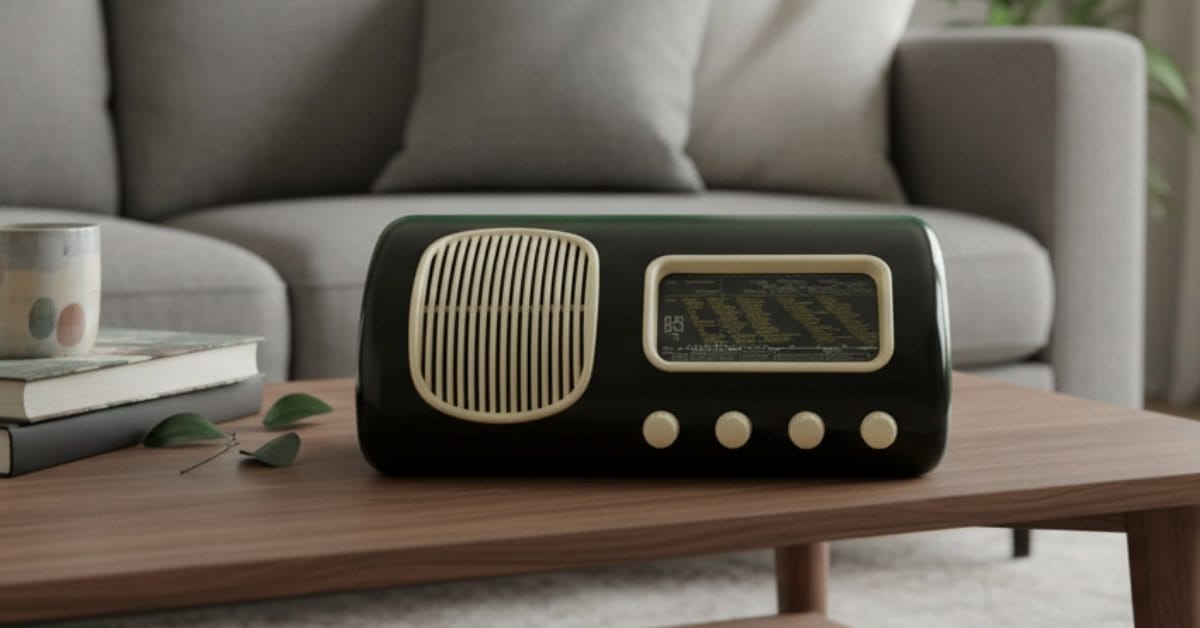
Curved, tactile and ahead of its time, the Beolit 39 radio by Bang & Olufsen transformed home electronics into interior design. Launched in 1939, its Bakelite shell, organic form and modernist spirit reflect the birth of Danish functional beauty — now a rare collector’s icon that still elevates contemporary Scandinavian spaces.
Key Points
- Introduction of the Beolit 39 Radio: Launched in 1939 by Bang & Olufsen, it revolutionized home electronics by blending functionality with aesthetic design, marking a milestone in Danish Design history.
- Designers Behind the Beolit 39: Created by Peter Bang and Svend Olufsen, the radio embodies their philosophy of combining technological excellence with elegant, modernist style.
- Material Innovation and Design Philosophy: Utilizing Bakelite for its durable, smooth form, the Beolit 39 features organic shapes and minimal decoration, exemplifying Danish functional beauty.
- Cultural and Technological Significance: More than a radio, it signified progress and modern living in Denmark, influencing industrial design with less than 2,000 units produced, now highly collectible.
- Contemporary Relevance and Collecting Appeal: The Beolit 39 remains a sought-after collector’s item and a stylish addition to modern interiors, symbolizing Danish minimalism, rarity, and heritage.
Where Danish Design and Functionality Met Innovation
In the early 20th century, Danish Design began carving a distinctive identity: a harmonious blend of simplicity, functionality, and elegance rooted in the traditions and values of Denmark. Amidst this burgeoning movement, a notable milestone was set in 1939 with the introduction of the **Beolit 39 radio**, a true trailblazer that redefined the way furniture and electronics coexisted in Danish households. Designed and produced by the renowned Danish company **Bang & Olufsen**, the Beolit 39 not only marked their debut in radio manufacturing but also pioneered the concept of home electronics as integral parts of modern interior design.
Rather than hiding technological devices behind doors or tucking them away in corners, Danish engineers and designers, led by **Peter Bang** and **Svend Olufsen**, envisioned a future in which electronics like radios would become **beautiful, tactile visual statements**, as worthy of attention as any piece of handcrafted furniture.
The Designers Behind Beolit 39: Peter Bang & Svend Olufsen
The Beolit 39 emerged from the creative ingenuity of **Peter Bang**, a dedicated engineer with revolutionary ideas, and **Svend Olufsen**, an aristocratic innovator from Denmark with a passion for design and broadcasting. Together, these two minds founded Bang & Olufsen in Struer, Denmark in 1925. Their company’s philosophy was grounded in combining **technological excellence** with **aesthetic appeal**, a tradition still upheld by Bang & Olufsen today.
Peter Bang, driven by a vision to build radios that could receive without dependency on external power stations, worked meticulously to ensure the technical performance of the Beolit 39 matched its looks. With the launch of this model, Bang & Olufsen not only designed a reliable, high-quality radio but also incorporated **modernist themes** into its visual style, drawing from the minimalist and functional principles of Danish Design.

Design Philosophy and Material Innovation
Almost mystical in its presence, the **Beolit 39** featured a radically different enclosure that stood apart from the wooden box radios common in the pre-war era. Utilizing **Bakelite**, a cutting-edge material at the time, the radio embraced both **form and function** in its construction. Bakelite was known for its durability, heat resistance, and flexibility, which allowed smoother, more curvaceous molding than traditional materials like wood or metal.
The Beolit 39 distinguished itself with **rounded organic shapes**, minimal decorative detailing, and a symmetrical front grille that displayed both elegance and timelessness. Measuring approximately **37 centimeters in width** and weighing close to **6.5 kilograms**, the unit was compact enough to fit in a modern Danish apartment, yet striking enough to act as a focal point in any room.
Its seamless form, refined knobs, and the prominent woven speaker grille epitomized the **functional beauty of Danish Design**—a design not driven merely by aesthetics, but by **practical needs and user-friendly interaction**. The use of Bakelite also offered an alternative to wood—an innovative decision that aligned with the modernist ideals prominent in Denmark during the 1930s and ’40s.
A Symbol of Cultural and Technological Progress
More than just a radio, the **Beolit 39** became a **cultural symbol in Denmark**, signifying technical progress, artistic excellence, and a shift toward modern lifestyle integration. This was a time when radios began entering common households, and Bang & Olufsen ensured that such devices would not compromise the **interior aesthetics** cherished by Danish homeowners.
Importantly, the Beolit 39 was also one of the world’s first radios to utilize Bakelite for the entire cabinet body—an innovation that set new standards for industrial design and influenced countless design philosophies across Europe.
Just over **1,500 units** were produced between 1939 and 1945, making the Beolit 39 not just a design milestone, but also a rare collector’s piece today. Its iconic status in Danish Design history is reinforced by its consistent representation in design exhibitions, museum collections, and among seasoned vintage collectors globally.
Why the Beolit 39 Still Matters
Today, the Beolit 39 endures as a respected part of **Danish Design heritage**, drawing admiration for its forward-thinking integration of technology and art. As a precursor to decades of Bang & Olufsen’s innovation, this radio underscores how **design and engineering**, when guided by a clear vision, can come together to create something enduring.
Whether admired for its shape, historical significance, or role in shaping modern technology, the Beolit 39 stands as a testament to **Peter Bang and Svend Olufsen’s genius**. Their goal—to create products that elevated both function and the aesthetic of everyday life—was truly achieved in this radio. The Beolit 39 remains not just a device of the past, but a living emblem of Denmark’s unmatched contribution to the global design landscape.

A Masterpiece of Mid-Century Danish Design Culture
The Beolit 39 goes beyond being an early radio—it stands as a highly sought-after collector’s item prized for its historical and aesthetic value. As a foundational piece in Bang & Olufsen’s legacy, it embodies the core principles of Danish design: simplicity, purposeful functionality, and subtle elegance. It expresses a Danish way of living that values calm, balance, and understated beauty in the home. Owning a Beolit 39 means owning a piece of that cultural philosophy.
In the late 1930s, people relied on radios as both information sources and cultural gathering points. The Beolit 39 redefined their place in the home by transforming the radio into a central design object rather than a purely utilitarian device. Its soft curves and refined craftsmanship allow it to blend naturally into the minimalist interiors favored in Danish homes, especially those shaped by the Functionalist movement.
With fewer than **2,000 original units** ever made prior to and during World War II, its rarity combined with intentional craftsmanship gives it a dual status: a design artifact and a vintage treasure embodying the roots of modern Scandinavian taste.
Reasons to Collect or Decorate with a Beolit 39
1. Iconic Representation of Danish Design and History
The Beolit 39 encapsulates one of Denmark’s most important periods in design evolution. It stands at the intersection of furniture and technology, marking a moment when our living spaces began integrating modern tools in aesthetically graceful ways. For those looking to invest in a truly iconic piece of **mid-century Danish design**, this one should top the list.
2. Beautiful Furniture Integration
Its dark, polished **Bakelite casing**, soft rounded edges, and symmetrical speaker grille are not only pleasing to the eye but blend seamlessly with other examples of **Scandinavian furnishings**—oak sideboards, teak chairs, and soft woolen textiles. Unlike more common retro radios, the Beolit 39 has the elegance and stature of a handcrafted art object, making it just as suitable for display in a living room or design studio as a classic Arne Jacobsen chair or a Poul Henningsen pendant lamp.
3. Investment in Rarity
Given its limited production and historical context, the Beolit 39 enjoys consistent demand among vintage collectors, design historians, and mid-century modern enthusiasts around the world. A well-preserved piece in working condition can fetch anywhere between **€1,200 and €3,500**, depending on originality and functionality—making it not only a statement of style, but also **a reliable investment** for the design-savvy buyer.

Perfectly Aligned with Contemporary Interiors
Many admirers of Nordic living will find the Beolit 39 an ideal complement to minimal, neutral-toned interiors. This radio represents a timeless form that fits confidently in both **traditional Scandinavian and contemporary eclectic spaces**.
While functional models do exist, many collectors display the Beolit 39 simply as a piece of furniture or sculpture—its design and form can carry a room’s ambiance even without being switched on.
Conclusion
The Beolit 39 radio by Bang & Olufsen stands as a landmark in the history of Danish design, uniting aesthetic brilliance with technological innovation during a pivotal era. By integrating home electronics into everyday interiors, this radio advanced consumer electronics and reshaped how people perceived such objects in their homes. Peter Bang and Svend Olufsen envisioned not merely a functional device, but a work of art for the modern home—an approach that perfectly reflects Danish principles of simplicity and elegance. Whether displayed as a rare collector’s item or used as a centerpiece in a design-conscious interior, the Beolit 39 continues to testify to craftsmanship, heritage, and visionary design.
Summary Recap
– Bang & Olufsen introduced the Beolit 39 in 1939 as its first radio, combining technological performance with aesthetic appeal.
– Designers Peter Bang and Svend Olufsen created the radio to express the interplay of functionality and elegance in Danish design culture.
– By using Bakelite as its primary material, the Beolit 39 set new standards for industrial design, with fewer than 2,000 units produced.
– Collectors prize the Beolit 39 as a mid-century design icon, with market prices typically ranging from €1,200 to €3,500, depending on condition.
– Buyers can find authentic examples on marketplaces such as Lauritz.com, Classic Radio, as well as platforms like eBay and Etsy.
FAQs
**1. Who designed the Beolit 39?**
The Beolit 39 was designed by the founders of Bang & Olufsen, **Peter Bang** and **Svend Olufsen**, who were pivotal in blending technical and aesthetic innovation.
**2. What makes the Beolit 39 unique compared to other radios of its time?**
It was one of the first radios to integrate Bakelite for its entire cabinet. A sleek design that was both functional and visually attractive, aligning with **Danish modern** principles.
**3. Why is the Beolit 39 considered an example of Danish design?**
Its use of clean lines, functional beauty, and innovative use of materials embody the **essential elements** of Danish design, focusing on simplicity and utility.
**4. What is the historical significance of the Beolit 39?**
As an early example of consumer electronics, the Beolit 39 marked a shift in product design, where such items began to be considered integral components of home decor, rather than just utility items.
**5. How can I verify the authenticity of a Beolit 39 before purchasing?**
Look for clear identifiers such as the manufacturer’s badge and check references on specialized collectors’ sites or consult with vintage radio experts for validation.
**6. Is the Beolit 39 still functional today?**
While many units are preserved as **collector’s items** and may no longer function, some have been restored to working condition. Restoration depends on the radio’s specific condition and components.
**7. How does the Beolit 39 fit into contemporary design schemes?**
Its timeless form and minimalistic aesthetic make it a standout piece in modern, Scandinavian-inspired, and eclectic interiors, complementing both classic and contemporary styles.
**8. Can the Beolit 39 be used as a practical radio today?**
Although it’s primarily a **vintage collector’s item**, some have been modified or restored with modern components to function as radios while maintaining their historic appearance.
**9. Where can I see the Beolit 39 on display?**
Design museums and exhibitions showcasing mid-century electronics, such as the Designmuseum Danmark in Copenhagen, often feature the Beolit 39 as a representative of an important era in design innovation.
**10. What materials were used in the construction of the Beolit 39?
Bang & Olufsen built the Beolit 39 primarily from Bakelite, using it for its smooth moldability and durability, and combined it with a metal grille and period-specific mechanical components.
The Beolit 39 endures as a celebrated icon, not just of Bang & Olufsen’s illustrious past but of Danish design at its finest, where form and function beautifully coexist.