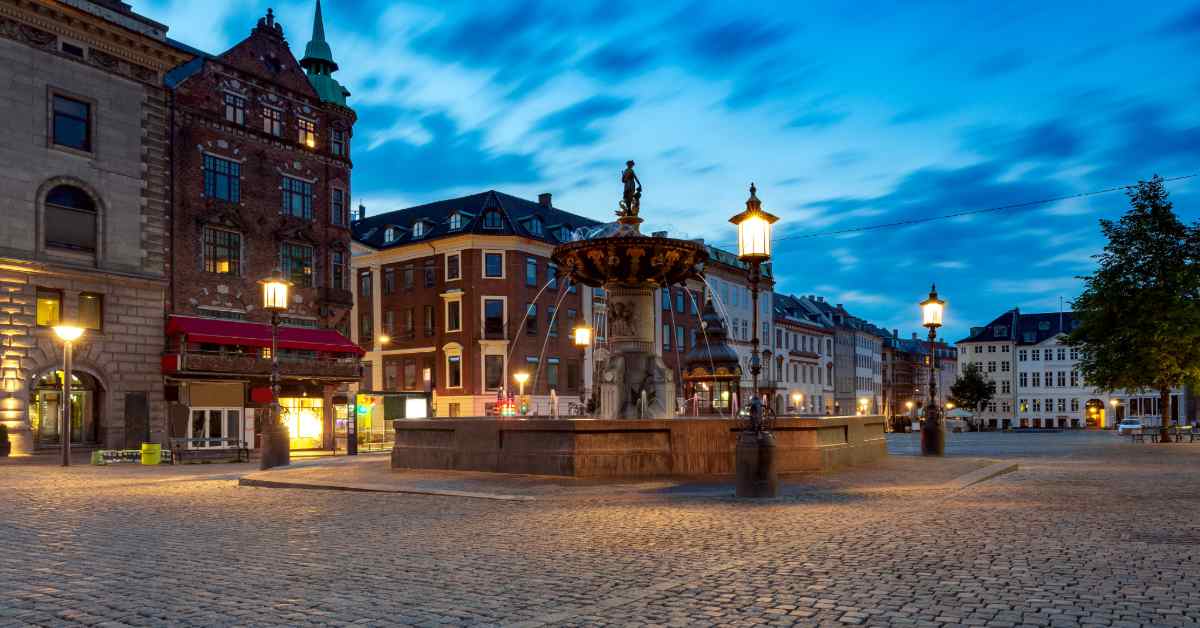
Gammel Torv is Copenhagen’s oldest square, a medieval marketplace turned pedestrian heart of the city. With its 1608 Caritas Fountain and neo-classical facades, it tells nearly nine centuries of Danish urban history in a single open space.
Why Gammel Torv Still Matters in Copenhagen Today
I have walked across Gammel Torv hundreds of times. It is one of those Copenhagen spots you cross without thinking, and then suddenly notice. The square sits dead in the middle of the city, on Strøget, between City Hall and Kongens Nytorv.
For expats arriving in Denmark, this is where the city’s medieval skeleton becomes visible. The cobblestones, the fountain, and the pastel facades are not staged for tourists. They are the working surface of a 900-year-old town that still uses the same square for the same reasons.
Gammel Torv or Gammeltorv: The Name Explained
You will see it spelled both ways. The official Danish toponym is “Gammeltorv,” written as one word. In English signage and travel writing, “Gammel Torv” is more common, with a space.
The name simply means “Old Market.” It distinguishes the square from its newer neighbour, Nytorv, the “New Market,” which sits immediately to the south. Together they form one continuous open space along Strøget.
A Short History of Gammel Torv
The square’s roots go back to the 12th century, when Copenhagen was still a modest fishing and trading town. According to Wikipedia’s entry on Gammeltorv, it is the oldest documented square in the city. Knowing this changes how you stand in it.
From Medieval Marketplace to Civic Heart
Merchants, fishermen, and farmers brought goods here from the surrounding region. Bishops and royal officials read decrees from this same patch of stone. The square was the place where governance, trade, and gossip all met.
In 1479, Copenhagen’s third city hall was built directly on Gammel Torv. The young capital’s political life happened here, not at the modern City Hall Square we know today. For nearly 250 years, this square was the administrative heart of the kingdom’s capital.
Christian IV and the Renaissance Rebuild
King Christian IV reshaped much of Copenhagen in the early 1600s. He rebuilt the city hall on Gammel Torv in 1610, giving it a Renaissance facade typical of his ambitions. The king wanted Copenhagen to look like a serious European capital.
His mark on the square is still visible today. In 1608, two years before the city hall rebuild, he commissioned the Caritas Well. It is the oldest fountain in Copenhagen, and it has not moved an inch since.
The Fires That Erased and Rebuilt the Square
Copenhagen burned three times in 80 years. The Copenhagen Fire of 1728 destroyed roughly 28% of the city’s lots, around 1,600 buildings. Nearly half of the medieval urban fabric was wiped out, including the Renaissance city hall on Gammel Torv.
The Copenhagen Fire of 1795 finished what the earlier blaze started. It began on 5 June at the navy’s old base at Gammelholm and swept through the inner city. Most of the buildings you see around Gammel Torv today were rebuilt after this disaster, in restrained neo-classical style.
The Caritas Fountain: The Soul of Gammel Torv
If Gammel Torv has a single icon, it is the Caritas Fountain in the centre. Erected in 1608 by Christian IV, it is the oldest fountain in the city. The sculpture depicts Caritas, the personification of Christian charity, holding a child with other children at her feet.
How a Royal Water Project Became an Icon
The fountain was not built for decoration. It was part of Copenhagen’s early water supply, drawing water from a pipeline at Emdrup north of the city. People filled their buckets here for centuries before modern plumbing arrived.
Christian IV used it to send a message. The figure of Charity, generously providing for children, told citizens that the king cared for his subjects. Even four hundred years later, that royal PR still works on visitors who pause for a photo.
The Golden Apples Tradition
Here is a detail most guidebooks miss. On the reigning monarch’s birthday, gilded brass balls, often called “golden apples,” are placed on the fountain’s water jets. The jets are turned up high, and the balls dance and spin above the spouts.
I have seen it twice. It is genuinely charming, and it draws small crowds of locals who pretend to be passing through. The tradition links King Christian IV’s Denmark to the reign of today’s royal family in a way few capitals can match.
Architecture Around Gammel Torv
The buildings framing Gammel Torv are mostly from the late 18th and early 19th centuries. They are the product of post-fire reconstruction, when neo-classical taste was sweeping Denmark.
The Danish Golden Age Look
Walk slowly around the perimeter and you will see the pattern. Three to five storeys, smooth plastered walls, evenly spaced windows, and modest cornices. The look is restrained, almost austere, but quietly elegant.
Architects like Johan Martin Quist and Andreas Kirkerup were behind much of this work. Their buildings shaped what we now think of as classic Copenhagen, and they did it under tight budgets after a national catastrophe. The result is one of Europe’s most coherent post-fire urban ensembles.
What Sits at Ground Level Today
Cafés, shops, and a few stubborn old institutions line the square. At Gammel Torv 20, in the historic basement, you will find Café Gammeltorv, a classic Danish lunch restaurant serving smørrebrød. It is the kind of place where the menu has not changed much in decades, and that is the point.
The shops are a mix of mainstream chains and quieter local businesses. The square avoids the full tourist-trap feel of Amagertorv further east along Strøget. There is still room here to sit without being herded.
Gammel Torv and Its Neighbours: Nytorv, Strøget, and Kongens Nytorv
The geography around Gammel Torv is the real story for anyone exploring central Copenhagen. The square is part of a sequence, not a stand-alone destination.
The Twin Squares: Gammel Torv and Nytorv
Gammel Torv and Nytorv are technically two squares. In daily life, almost no one tells them apart. They form one long open space across Strøget, divided only by the pedestrian street running through them.
Nytorv was carved out in the late 18th century to give the city a more orderly public space. Today it holds the imposing Domhuset, the old courthouse, which replaced functions that once happened on Gammel Torv. Standing at the join between the two, you see two distinct phases of Copenhagen’s history meeting at your feet.
Walking Strøget Through Gammel Torv
Strøget was pedestrianised on 17 November 1962. It was one of the first major shopping streets in Europe to ban cars, and the experiment worked spectacularly. The street runs about 1.1 kilometres from City Hall Square to Kongens Nytorv.
Gammel Torv sits roughly in the middle of this route. According to VisitCopenhagen, the summer atmosphere here feels “almost South European.” On a warm June afternoon, with the fountain running and outdoor seating spilling onto the cobblestones, I can confirm that description is accurate.
Visiting Gammel Torv: A Practical Guide for Expats
This is where I will be opinionated. Most guides treat Gammel Torv as a quick photo stop. It deserves more than that, but only if you visit it correctly.
How to Get There
The nearest metro station is Nørreport, about a 10-minute walk north. From Copenhagen Central Station, it is roughly a 15-minute walk through the western part of Strøget. Most expats I know simply cycle, and there is bike parking along the side streets.
Do not bother with a car. The square is deep inside the pedestrian zone, and central Copenhagen is hostile to drivers by design. If you are coming from Christianshavn or Nørrebro, the bike is faster than the metro.
When to Visit
Late May through early September is when the square is fully alive. Temperatures sit between 15°C and 22°C, the fountain is running, and the outdoor cafés are full. Try to arrive before 11am or after 5pm if you want photographs without crowds.
Winter changes everything. The square goes quiet, the light turns soft and blue, and on a snowy evening it looks like a 19th-century engraving. If you live in Denmark already, this is when you appreciate Gammel Torv most.
What to See in 30 Minutes
- The Caritas Fountain: Walk a full circle around it. The sculptural detail is worth the look.
- The Domhuset on Nytorv: Cross Strøget for the neo-classical courthouse, a key Danish Golden Age building.
- The post-fire facades: Notice how regular and harmonious they are. That is policy, not accident.
- Café Gammeltorv 20: Duck into the historic basement for traditional Danish lunch.
- The cobblestones: Look down. The patterns differ across the two squares.
Nearby Attractions Worth Adding
Gammel Torv works best as part of a longer walk. Within a few hundred metres you have St Nicholas Church, the Round Tower, and the university quarter around Fiolstræde.
Push east along Strøget and you will hit Amagertorv, Højbro Plads, and eventually Kongens Nytorv with Nyhavn just beyond. Push west and you reach City Hall Square. Gammel Torv is the pivot point in the middle of all of it.
What Gammel Torv Tells You About Living in Denmark
This is where I get personal. Gammel Torv is not just a square. It is a small lesson in how Denmark handles its past.
Public Space as a Democratic Habit
There is no entrance fee, no ticket booth, no roped-off VIP section. You can sit by the Caritas Fountain at 3am if you want, and no one will stop you. This is normal in Denmark, and it surprises many expats arriving from countries where public space has been quietly privatised.
The decision to pedestrianise Strøget in 1962 was about putting people, not cars, first. Sixty years later, you can see the result in any street vendor, busker, or family with a stroller passing through Gammel Torv. The square works because the city trusts citizens to use it well.
Heritage Without Theme Park Energy
Compare Gammel Torv to other European historic squares and you notice something. There are no costumed reenactors, no Disney-style signage, no aggressive ticketing schemes. The history is just there, plainly available, for anyone who looks.
That restraint is deeply Danish. The Caritas Fountain is one of the oldest royal monuments in northern Europe, and the city marks it with a single modest information sign. As an expat who has lived here for years, I have come to read that quietness as confidence rather than indifference.
Frequently Asked Questions About Gammel Torv
What is Gammel Torv?
Gammel Torv is the oldest square in Copenhagen, dating to the 12th century. It sits on Strøget in the historic Indre By district and forms one continuous open space with the adjoining Nytorv square.
How old is the Caritas Fountain on Gammel Torv?
The Caritas Fountain was built in 1608 by King Christian IV. It is the oldest fountain in Copenhagen and remains the centrepiece of Gammel Torv today. On the monarch’s birthday, gilded balls dance on its water jets.
Why are the buildings around Gammel Torv all from the same period?
Most surrounding buildings date from after the Copenhagen Fire of 1795. The fire destroyed huge parts of the inner city, and reconstruction followed a coherent neo-classical style. This created the harmonious facades visible today.
Is there a difference between Gammel Torv and Gammeltorv?
No, they refer to the same square. “Gammeltorv” is the official Danish spelling as one word. “Gammel Torv” with a space is the common English rendering.
What is the best way to reach Gammel Torv?
Take the metro to Nørreport, then walk south about 10 minutes through the pedestrian zone. From Copenhagen Central Station, it is a 15-minute walk east along Strøget. Cycling is fast, but cars are not allowed in the area.
Is Gammel Torv free to visit?
Yes. Gammel Torv is a public square, open 24 hours a day, with no entrance fee. Surrounding cafés and shops have their own opening hours.
What other squares are near Gammel Torv?
Nytorv is directly adjacent, with the old courthouse. Further east along Strøget you will reach Amagertorv, Højbro Plads, and Kongens Nytorv. Each represents a different chapter of Copenhagen’s urban history.
Are there guided tours of Gammel Torv?
Many walking tours of central Copenhagen pass through or start at Gammel Torv. Several focus specifically on the Caritas Fountain, the post-fire reconstruction, and the history of the city hall that once stood here.
Is Gammel Torv accessible for wheelchairs and strollers?
The square is fully pedestrianised and flat, but the surface is cobblestone. Wheelchair users and parents with strollers can navigate it, with some bumpiness. Surrounding cafés vary in their step-free access.
Final Thoughts on Gammel Torv
Gammel Torv is the closest thing Copenhagen has to a single page summary of its own history. Medieval market, royal stage, fire victim, neo-classical reconstruction, pedestrian icon. All of it in one open space you can cross in 90 seconds.
For expats settling into Danish life, this square is worth more than a single visit. Come back in different seasons. Watch how the city uses it on a Tuesday morning versus a Saturday afternoon. You will learn more about Denmark standing here for an hour than from most museums.