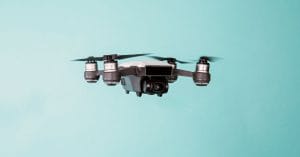
Danish soldiers fired live rounds at a mystery drone over a Jutland training area last September and never found a single piece of wreckage, according to a new classified Defence Command report that still cannot say who sent it.
The incident at Borris Skydeterræn saw troops engage a suspected drone at roughly 600 to 800 meters range and about 300 meters altitude. No debris was recovered. That detail appears only in the military’s own evaluation and local reporting, not in the national summaries most outlets are now running.
Defence Minister Jeppe Bruus confirmed on 19 June that his ministry has received the internal report on the September 2025 drone crisis. He told reporters the document confirms that real drone events took place. But the full text will be shared only with the parliamentary defence agreement parties. The public will get a brief summary in less than a week or two.
What actually happened last September
Between 22 and 25 September 2025, Denmark registered drone observations at at least four airports, including Aalborg, Esbjerg, Sønderborg, and Skrydstrup, plus multiple military sites. Civilian flights were delayed or diverted while airspace around affected airports was temporarily closed. The knock-on disruption hit passengers well beyond Denmark, especially transfer travelers.
The Defence Command issued operational updates acknowledging multiple simultaneous sightings. A police inspector told media on 23 September that a capable actor probably stood behind the overflights. Yet no state or non-state group has publicly claimed responsibility, and no physical drone has been shown.

I have covered Denmark for years, and this kind of vague official response is frustrating for anyone who relies on transparent information. Foreign residents working in aviation, logistics, or critical infrastructure deserve to know what risks they face and how the state will communicate in future crises.
The armed engagement that no one talks about
The Borris incident stands out because it escalated to live fire. Soldiers on exercise observed a lighted flying object, believed it might be a drone, and engaged with small arms over the training area. The object could not be identified afterward, and no wreckage was retrieved.
Defence officials say thermal cameras recorded several of the sightings, adding credibility despite the lack of hard evidence. The minister has emphasized that combination of witness statements and imagery is enough to classify incidents as real drone activity.
Yet the Danish Police’s own guidance on suspicious drones explicitly warns that many reports turn out to be planes, stars, or other celestial objects. That creates an uncomfortable contradiction: the authorities are simultaneously telling us most sightings are false alarms and insisting the 2025 events were genuine threats.
The classified details and who gets to see them
The Defence Command evaluation collates operational logs, radar and thermal imagery, and witness statements. Large portions are classified for reasons of national security and intelligence methodology. The defence agreement parties will review the full report before a redacted summary is made public.

That means parties outside the forligskreds, including some with large immigrant constituencies, will see only the summary. For internationals in Denmark, this raises questions about how transparent the state will be when security issues touch everyday life like air travel and jobs.
Denmark’s defence budget is being ramped up to reach 2 percent of GDP by 2030, from around 1.4 percent in 2022. A portion is earmarked for airspace surveillance and hybrid threat response. NATO data show Denmark’s per capita defence spending was roughly 1,040 euros per resident in 2024, compared with 940 euros in Sweden and 1,180 euros in Norway. Denmark already spends at a Northern European mid-high level while still facing basic drone surveillance gaps.
The economic and practical fallout
Denmark’s civil aviation traffic was about 33 million passengers in 2024, up from roughly 31.5 million in 2019. Any extended drone-related shutdown at major hubs like Copenhagen or Billund would now hit a larger traveling population than before the pandemic. There is no published breakdown of the September 2025 disruption by nationality or residency status.

The closest proxy is Statistics Denmark’s figure for foreign citizens resident in Denmark: around 540,000 people in 2025, about 9.2 percent of the population. Copenhagen Airport estimates that around 60 to 65 percent of its passengers are international or transfer travelers. That implies a clear majority of those inconvenienced by drone closures are either foreign visitors or Denmark-based residents traveling abroad.
The 2018 Gatwick drone disruption in the UK cost airlines and the airport an estimated 50 to 60 million pounds over two days. Adjusted to Danish conditions and passenger volumes, a comparable multi-day closure here could run into hundreds of millions of kroner.
What you should do if you spot a drone
The Danish Police advise anyone spotting a potentially illegal or suspicious drone to observe it carefully first. Rule out planes, stars, or other objects. Then document it with long, stable video or photos without zooming before calling the non-emergency number 114.

Callers will be asked to specify where and when they saw the drone, its approximate size, whether it had wings or rotors, visible lights and colors, and any nearby critical infrastructure. Authorities say people should err on the side of reporting, especially near sensitive sites. The police provide English-language information pages and can generally handle reports in English via 114.
Passengers affected by drone-related airport closures retain standard EU air passenger rights under EC 261/2004. In practice that means entitlement to rerouting or reimbursement. Compensation may be limited because drone incidents are likely treated as extraordinary circumstances, but this must be assessed case by case with the airline.