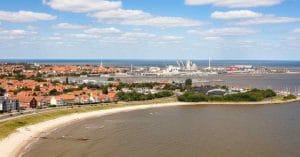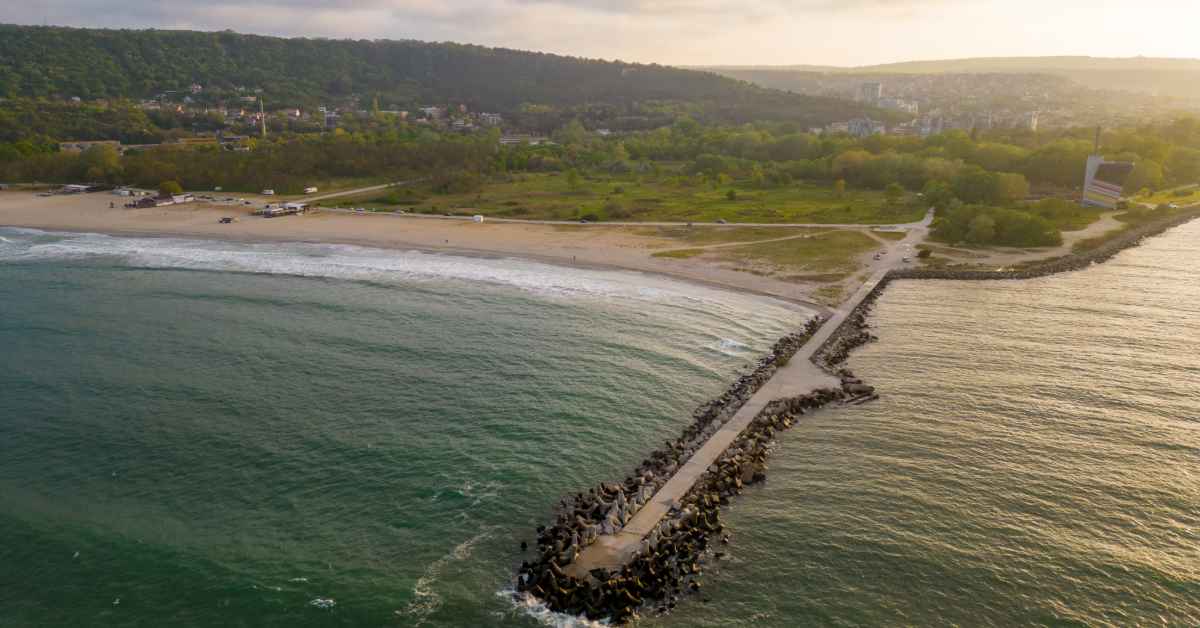
A major coastal protection project in the Danish Town, Helsingør, has sparked political debate over who should foot the bill, local taxpayers or the homeowners who stand to benefit the most. In Helsingør, the city currently pays for a multimillion-dollar shoreline reinforcement plan, but the upcoming local elections could change that.
Political Divide Over Rising Costs in Danish Town
In Helsingør, authorities have committed public funds to a substantial coastal protection initiative. The initiative aims to safeguard the city’s shoreline from severe weather impacts. The project is part of a broader collaboration with neighboring municipalities under the name “Nordkystens Fremtid” (North Coast’s Future). Locals hope the project will help protect their coast.
The centerpiece of the project is the initial placement of 1.7 million cubic meters of sand and 140,000 cubic meters of gravel to reinforce the coastline stretching from Hundested to Helsingør. The estimated cost for this work is 241 million Danish kroner – approximately $34 million. This massive undertaking is designed to form a buffer zone that absorbs storm energy and protects infrastructure and housing. It’s a big job meant to make the coast more secure.
Nevertheless, with a municipal election on the horizon, the decision to fund the project largely through public money has divided politicians. Critics argue that private property owners, especially those living near the coast, will benefit most from increased property values and therefore should contribute financially.

Impacts on Property and Residents
Christian Hoffmann, a resident of Ålsgårde and head of the local Coastal Protection Association, underscores the financial concerns for homeowners. Should policy shift after the election, residents could be asked to pay significant sums, up to $60,000 each, for their share of the project.
For Hoffmann’s property alone, which borders 56 meters of coastline, the personal price tag could reach $57,000. In total, the 7.7-kilometer section near Ålsgårde could cost taxpayers or residents over 55 million kroner ($7.8 million). He emphasizes that not all affected homeowners are financially prepared; many are retirees or families who inherited their homes.

A Shared Project With Different Rules
Nordkystens Fremtid is a rarely seen collaboration between the three Danish town municipalities: Helsingør, Gribskov, and Halsnæs. The aim is to protect roughly 50 kilometers of coastline from future storm surges and erosion. The project was born after devastating storms like Bodil in 2013, which caused an estimated 1.6 billion kroner ($226 million) in damages across the country.
Uniquely, each municipality has taken a different approach to funding. In Halsnæs, property owners closest to the shore are required to pay the full initial cost. In Gribskov, those homeowners cover 25 percent. Helsingør, by contrast, has decided to fully fund the initial outlay through its municipal budget.
Maintenance costs, however, are uniformly distributed across all three municipalities. Over the next 50 years, ongoing reinforcement with sand and stone is projected to cost 566 million kroner ($80 million), to be paid entirely by coastal property owners.

House Values and Public Investment
Independent studies by Danish researchers have shown that the project could significantly increase property values along the coast. One analysis estimated that the value of roughly 3,500 summer homes located within 300 meters of the shoreline would increase by a combined 1.8 billion kroner ($254 million) once the sand beaches are in place.
For full-time residences located within 50 meters of the new shoreline, the average property value could rise by as much as 8 percent. These projections have fueled criticism that public money is essentially subsidizing private wealth.
Supporters of the project argue that shoreline protection is a communal need. The mayor of the Danish town Helsingør, Benedikte Kiær, who supports full public funding, contends that the coast belongs to all citizens, and protecting it is comparable to other public infrastructure investments.
Decision Awaits After the Election
The future of who pays remains uncertain. The upcoming municipal election on November 18 could shift the political balance. The Social Democrats, the second-largest party, have signaled their intent to reverse the current model if they win control.
Meanwhile, some homeowners wait anxiously. Many fear that if municipal support is withdrawn, they will be burdened with high costs they cannot afford, and some may even be forced to sell their homes.
As climate risks increase, the balance between private gain and public responsibility will continue to test local governments across Denmark.