A powerful American billionaire has been touring European capitals warning about doomsday and the Antichrist. Peter Thiel, a tech mogul behind Donald Trump’s inner circle, exercises influence through money and networks while spreading visions of a world without democracy. Danish authorities use software from his surveillance company.
The Doomsday Prophet in Paris
A Biblical Warning at the French Academy
The man stood at the podium in a small hall where dark wood panels decorated the ceiling and walls. White marble busts and portraits of scientists looked down on the audience between three heavy chandeliers. The speaker got straight to the point. He told the crowd he was worried about the Antichrist.
He brought a PowerPoint presentation with him. On the screen, guests could see a verse from the Bible. The text read that no one knows the day or hour, not even the angels of heaven, nor the Son, but only the Father alone. Then the speaker explained that doomsday might be near and that he had seen signs in the Bible predicting when it would arrive.
Police Guard the Entrance
The scene took place at the French Academy in Paris on 26 January this year. Outside the building, riot police surrounded the four meter tall door leading into the hall. Officers tried to keep a crowd of about 100 demonstrators away from the doomsday preacher inside.
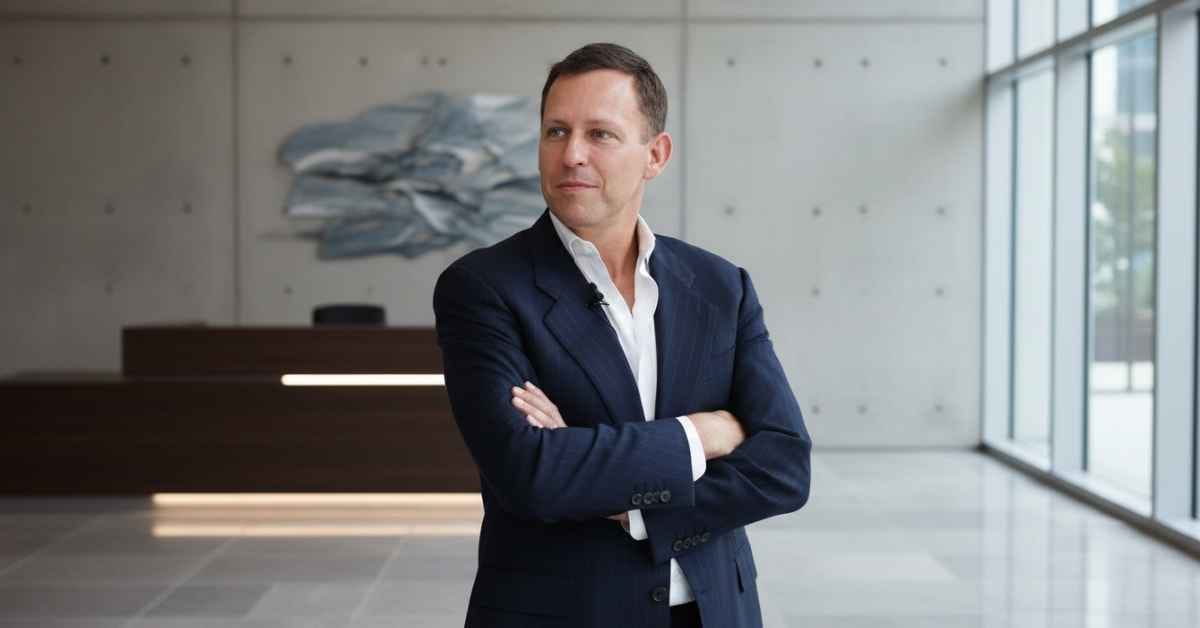
The man at the podium was Peter Thiel. He is a 58 year old billionaire considered by many to be one of the most influential people in Donald Trump’s America. He has a political, philosophical and religious vision of a world without democracy.
The Hidden Power Behind Trump
Money and Networks in the White House
Peter Thiel wrote in an essay in 2009 that he no longer believes freedom and democracy are compatible. The tech mogul thinks the Western world is in spiritual decline and has a vision for society where power revolves around big technological monopolies. Unlike Elon Musk, who believes roughly the same, Peter Thiel operates behind the scenes and makes his influence felt through his money and a large network of contacts in and around the White House.
He was the first tech billionaire to back Donald Trump as a presidential candidate in 2016. According to the media outlet Bloomberg, he has at least 16 of his former close associates placed in powerful positions in the American administration. He was also the money man behind USA’s vice president J.D. Vance, kickstarting his political career with a record donation of 15 million dollars in 2016.
Danish Connection Through Surveillance Software
Peter Thiel founded his fortune together with Elon Musk in the company PayPal. Since then he has earned big money through early investments in companies like Facebook and OpenAI. He currently ranks as number 40 on Forbes’ list of the world’s richest men. When not traveling around with his lecture about the Antichrist, Peter Thiel spends time as an investor while also serving as chairman of his company Palantir.
Palantir sells surveillance software. The company’s programs are used by USA’s controversial immigration police ICE. The software has also been sold to authorities in a range of Western countries, including Denmark, where police use the system. However, demonstrators in several European cities have protested against the use of Palantir technology, viewing it as a threat to privacy and civil liberties.
Early Years in Apartheid Territory
Childhood in a Uranium Mining Town
Peter Thiel was once an ordinary white boy in a rather extraordinary city in Africa. The town was called Swakopmund and is located in present day Namibia. When Peter Thiel lived there in the 1970s, it was occupied by South Africa. The Thiel family originally came from Frankfurt in Germany, but in 1971 Peter Thiel’s father got a job with the mining company Rio Tinto, which helped the regime in South Africa extract uranium from a giant open pit mine near Swakopmund.
As a four year old, Peter Thiel witnessed how South Africa’s racist Apartheid system worked in practice. South Africa was in the process of developing its own nuclear weapons, partly with uranium from the Rössing mine in Namibia where Peter Thiel’s father Klaus worked. The family did not live near the mine itself but in the port city of Swakopmund, which was founded by German colonists in 1892.
German Heritage and Nazi Symbols
Long after the two world wars, the city celebrated its German heritage for better and worse. In 1976, a journalist from The New York Times reported that it was still normal to greet with an outstretched arm and say Heil Hitler in Swakopmund. This was where Peter Thiel started school.
According to author George Packer’s book The Unwinding, students in Peter Thiel’s class were hit on the fingers with a ruler when they spelled wrong. The boy hated being forced to wear a uniform. He started playing chess and did well in school. In 1977, Klaus Thiel decided to take the family to the USA, where they eventually settled in Foster City, just south of San Francisco.
The Outsider at Elite Universities
Stanford and the Catholic Priest
Peter Thiel was an outsider from the beginning in America. He played elite chess and Dungeons and Dragons, was a fan of science fiction, and later claimed he learned the entire J.R.R. Tolkien trilogy The Lord of the Rings by heart. According to author Max Chafkin, who wrote the biography The Contrarian about Peter Thiel, he was bullied. One of his bullies planted signs with the text for sale on the lawn in front of the Thiel family’s home.
The young man still did excellently in school and was the person in his class who got the highest grades when he finished high school in 1985. He got into the elite university Stanford, where he also did not feel he fit in. According to Max Chafkin, Peter Thiel was disgusted by his fellow students’ partying excesses involving alcohol and pot. Instead of going to parties, Peter Thiel spent time with a Catholic priest.
Meeting the French Philosopher
Peter Thiel was raised Protestant but became friends with priest Arne Panula, who was a member of the powerful Catholic organization Opus Dei. The two agreed that Western civilization was under attack. However, the priest’s influence was overshadowed by another figure at the university. In his first years, Peter Thiel studied philosophy and met the French philosopher René Girard, who would influence him for the rest of his life.
René Girard’s theories deal with conflicts between people. According to René Girard, conflicts arise because we all want the same things as others. When tensions grow, the group finds a common enemy, a scapegoat. By blaming the scapegoat for all evil and chasing them away, peace and unity are created in the group again. At university, Peter Thiel now began to find possible scapegoats.
Building a Conservative Voice
The Stanford Review and Campus Wars
After finishing his initial philosophy studies, Peter Thiel began studying law. Alongside his studies, he started the satirical school newspaper The Stanford Review. The paper made fun of and criticized the university’s leadership and teachers who, in Peter Thiel’s opinion, were ruining education by promoting diversity, rainbow radicalism and other progressive causes.
He attacked the university for offering courses like black hair as culture and history about African Americans’ hair. Black fellow students have subsequently accused him of praising the apartheid regime in South Africa in front of them. One former classmate, Julie Lythcott Haims, wrote in 2016 that Peter Thiel said without any facial expression that apartheid was a solid economic system that worked efficiently and that moral questions were irrelevant. Peter Thiel later denied saying this, but another fellow student confirmed having a similar experience with him.
Rejection and New Directions
When Peter Thiel finished Stanford Law School in 1992, his big dream was to get a job as a personal legal assistant for a judge in the US Supreme Court. He was interviewed by two judges but was rejected. At the time I was crushed, Peter Thiel wrote about the episode in his book Zero to One. Instead, he tried his hand as a speechwriter and political influencer on the right wing of American politics. It was not particularly lucrative, and after a period as a stockbroker in New York, he got a bright idea in 1998 together with a group of former classmates.
The PayPal Fortune
Digital Money and Friction with Musk
The idea was to create a space for financial transactions that could not be regulated by the government. In other words, an anonymous foreign bank account that Thiel wanted to make available to everyone. The project was called Fieldlink but did not really succeed. In March 2000, the company merged with the company X.com, which also facilitated digital financial transactions.
One of the co founders was Elon Musk. According to author Max Chafkin, Peter Thiel and Elon Musk could not stand each other. Musk thinks Peter is a sociopath and Peter thinks Musk is a fraud and a braggart, Max Chafkin quoted an acquaintance of the two as saying. Elon Musk took over as director of the company from Peter Thiel, it changed its name to PayPal, and in 2002 the company was sold to Ebay for 1.5 billion dollars. Peter Thiel was now extremely rich.
The Gift from Igor
He left the company immediately but took important knowledge with him from PayPal. Back then, as now, fraud on the internet was a big problem. Peter Thiel had helped develop the system now known as Captcha. You have probably encountered it when trying to access websites where you are asked to read crooked letters, photos of cars or numbers to continue.
However, the most important thing Peter Thiel took with him was probably knowledge of the program Igor. It became the basis for his next big business venture. Igor was actually the nickname of a particularly annoying Russian hacker who tried to scam money from PayPal. PayPal programmers developed an algorithm to detect Igor’s scams. Such a program could be used for much more than finding Russian scammers if modified slightly. Terrorists can also be detected by special payment, calling or travel patterns.
Palantir and Government Surveillance
Creating a Digital Detective
After the terrorist attacks against New York and Washington in 2001, such initiatives came into high demand with American authorities. In fact, the US Department of Defense had tried itself and created the Total Information Awareness initiative, which trawled through phone bills and credit card transactions based on the same principles as Igor. However, American authorities had to shut down the initiative after protests from civil rights organizations.
The head of Total Information Awareness, John Poindexter, had met Peter Thiel and PayPal colleague Alex Karp already in 2001. I told them they had an interesting idea, John Poindexter told Wired magazine in 2012. After the sale of PayPal, John Poindexter helped Peter Thiel and Alex Karp create the company Palantir.
The Name from Middle Earth
The name comes from J.R.R. Tolkien’s trilogy The Lord of the Rings, where a palantir is a special crystal ball originally created by the good and innocent elves but which the Dark Lord Sauron has conquered and uses to monitor and corrupt the good forces remaining in the world. Alex Karp became director, Peter Thiel became chairman, and Palantir quickly began delivering programs to American intelligence agencies.
Meanwhile, billionaire Peter Thiel also spent time on many other things. For example, he invested in new promising companies in Silicon Valley, where in 2004 he bought 10.2 percent of Facebook for 500,000 dollars. After the purchase, Peter Thiel helped Facebook co founder Mark Zuckerberg become the undisputed leader of the company.
Revenge Against Gawker
The Outing and the Lawsuit
With the many millions and well placed investments, Peter Thiel became a celebrity in Silicon Valley. With fame came gossip. A rumor circulated that Peter Thiel was homosexual. The rumor was picked up by the popular blog Gawker.com, which on 19 December 2007 published the headline Peter Thiel is totally gay, folks.
The rumor was true, but the story made Peter Thiel absolutely furious. He said the outlet should be compared to terrorists, not writers or journalists. He told the media outlet PE Hub that he did not understand the psychology of people who want to kill themselves and blow up buildings. Then he hired lawyers who could help shut down Gawker.
The Hulk Hogan Case
It did not succeed right away, but when the outlet published a video of the famous wrestler Hulk Hogan having sex with one of his friends’ wives, Peter Thiel got what he needed. The case ran for years, and on 13 December 2016, Gawker ceased to exist. By then it was no longer a secret that Peter Thiel was in a relationship with former BlackRock deputy director Matt Danzeisen.
He also met regularly with sex offender Jeffrey Epstein. Emails between the two men published by the US Department of Justice show there were at least six meetings in New York from 2014 to 2016, and that they saw each other at Peter Thiel’s office in San Francisco and in his private home. In August 2015, they attended a dinner in Palo Alto, California together with other prominent tech figures such as Elon Musk, Mark Zuckerberg and LinkedIn founder Reid Hoffman, who Peter Thiel has been friends with since the two attended university.
Political Philosophy and Ideology
The Dark Enlightenment
By that time it was publicly known that Peter Thiel was probably the most ideological American tech billionaire and that he opposes government interference and democracy. In 2011, Peter Thiel had invested in blogger Curtis Yarvin and helped him become a sort of tech philosopher for the far right in the USA.
Curtis Yarvin is controversial because he was among those who regretted that mass murderer Anders Behring Breivik had not killed more left wing people during the attack on a social democratic youth camp on the Norwegian island of Utøya. Curtis Yarvin’s ideology, known as the dark enlightenment, rejects democracy and equality. Instead, Curtis Yarvin proposes replacing the state with a kind of corporate management where an autocratic director runs society efficiently through a centralized, authoritarian hierarchy.
Searching for a New Nation
Peter Thiel has been inspired by Curtis Yarvin but still lacks a place where the philosophy can be brought to life. Where on the globe can such a space be created? Peter Thiel pondered this already in 2009, when he could see three possibilities. Namely outer space, cyberspace and artificially created islands on the earth’s oceans.
He went so far as to invest a substantial amount in the company Seasteading Institute, which wants to develop floating micronations on the world’s oceans. But then another alternative appeared. Greenland. In recent years, Peter Thiel has invested massively in the company Praxis, which with 525 million dollars backing works to take over Greenland and build a high tech society on the island.
The Greenland Connection
A Digital Nation on Ice
As recently as 16 February 2026, the company’s director Dryden Brown wrote a piece in The Spectator magazine describing the members of the society he dreams should populate Greenland. According to him, they are people who oppose woke culture and who are interested in Greek literature, cryptocurrency and the New York art scene.
How much influence Peter Thiel has on the company and how much he is involved in the dispute over Greenland is not publicly known. However, Donald Trump has appointed Kenneth Howery, who is one of Peter Thiel’s old friends from the Stanford Review newspaper and PayPal, as USA’s ambassador to Denmark. The connection raises questions about American intentions toward the Danish territory.
Dreams of Immortality
The tycoon is not afraid to pursue ideas that to many will sound like utopias. For example, Peter Thiel wants to live forever, just like the elves in The Lord of the Rings. Why can’t we be elves, he told The Atlantic magazine in 2023.
He himself has plans to be frozen if he dies. He has made several investments in companies working to extend human lifespans. Meanwhile, he has bought a large land area in New Zealand where he is trying to build a place he can survive if his fears become reality.
Warning Europe About Doomsday