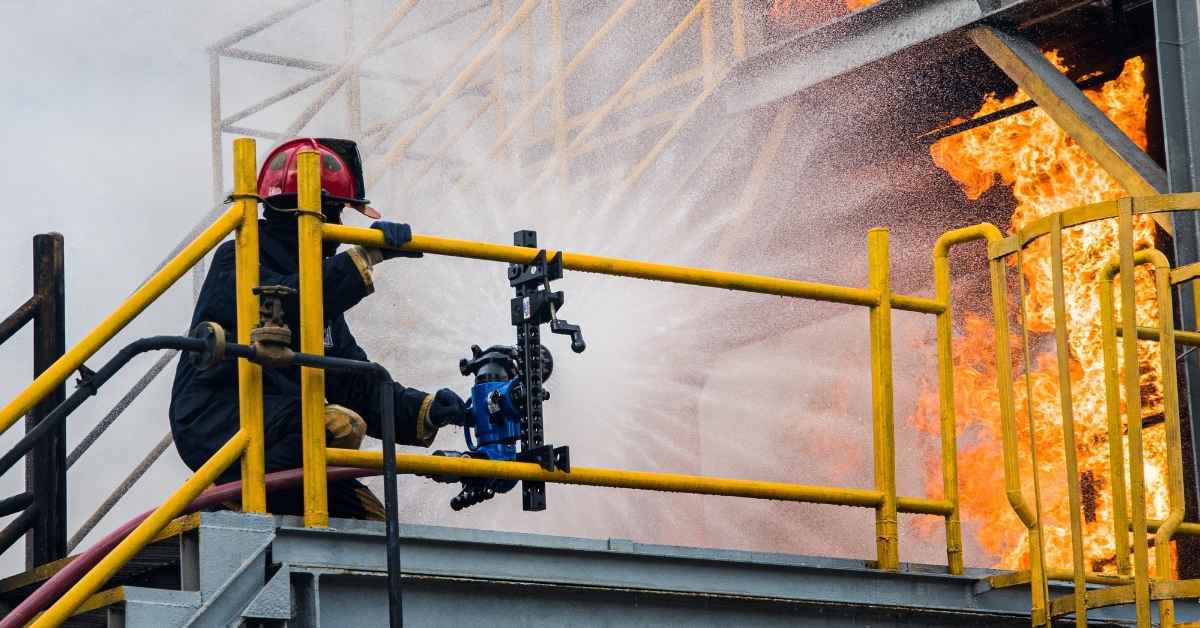
A warehouse fire at a harbour facility in Aarhus today raises important questions about whether Denmark’s port emergency framework can adequately handle a blaze near populated areas, and whether foreign workers and nearby residents have access to timely, understandable safety information.
The fire at an Aarhus harbour warehouse this afternoon triggered a layered emergency response that sets port fires apart from typical industrial blazes. According to Danish emergency management doctrine, serious harbour incidents are normally handled under a joint incident command between the municipal fire service and port authorities. As of the latest available reporting, authorities have not confirmed whether hazardous materials are involved, and all emergency-framework descriptions below reflect general practice rather than confirmed details of this specific fire.
Denmark’s largest container port, according to Port of Aarhus strategy documents, handles approximately 9 to 10 million tonnes of cargo annually, with traffic reported to have grown in recent years. That volume flows through warehouses sitting closer to homes and offices than many people realize. According to Statistics Denmark, around 8 percent of employed residents in Aarhus Municipality work in transport and warehousing, with the port identified as a major concentration. Statistics Denmark data on employment by citizenship and industry indicates that foreign nationals account for roughly 20 to 25 percent of workers in some logistics sub-sectors, meaning many internationals could potentially be affected by shift cancellations, overtime surges, or insurance complications from a major port disruption.
When the Harbour Burns, the Rulebook Changes
According to Danish emergency management doctrine, the Danish Maritime Authority is typically involved in harbour incidents where ship safety is at stake. If dangerous substances are involved, the incident can be handled as a chemical accident with specialized units and, in some cases, assistance from Beredskabsstyrelsen. According to a clause found in Danish harbour emergency plan documentation, operators must immediately collect information on the type and quantity of any dangerous substances stored and relay that information to the incident commander.

In serious port fire cases, authorities can deny ship movements, disrupt truck and train schedules, and issue air quality advisories. Aarhus Municipality’s planning documents indicate multiple SEVESO-regulated risk establishments in the harbour vicinity, meaning a serious warehouse fire is not treated as an isolated event. Beredskabsstyrelsen publishes annual statistics on interventions involving hazardous substances, with a concentration near industrial and harbour areas, according to national emergency reporting.
The Language Gap That Nobody Talks About
According to the latest official SEVESO inventory data, Denmark registers roughly 70 to 90 SEVESO establishments subject to special rules for preventing major accidents, significantly fewer than Germany’s more than 1,000. The Danish Working Environment Authority confirms that companies with dangerous substances are subject to special rules to prevent major accidents and limit their consequences.

The system has a practical weak spot that receives little attention. In many workplaces, safety briefings and emergency procedures are primarily delivered in Danish, which can leave information gaps for workers who do not speak the language well, according to Danish Working Environment Authority guidance on the requirement that employees must understand safety information. Some unions have raised concerns that warehouse and logistics staff, many of them foreign born, cannot fully grasp complex emergency protocols when instructions are not provided in an accessible language.
Internationals employed in logistics should request written safety instructions and emergency procedures in a language they understand, such as English, from their employer. Employers must ensure staff can understand safety information under Danish occupational safety rules. Workers can also ask to participate in fire drills and clarify evacuation routes and assembly points. In many municipalities, residents can consult local planning and risk documents to see whether nearby installations are classified under SEVESO rules, though these documents are generally in Danish.

Risk Corridors Where People Actually Live
Some residents and planning critics argue that Denmark’s ports have become risk corridors where warehouses, fuel tanks, and chemical facilities sit close to growing residential neighbourhoods. Harbourfront redevelopment brings new apartments and cafes within sight of storage buildings that may hold plastics, fuels, or industrial chemicals. According to planning and environment expert commentary, there is a growing concentration of risk establishments in harbour areas even as housing and recreational spaces move closer.
Industry sources highlight safety investments such as sprinkler systems, firebreaks between warehouse sections, and staff training, arguing these have reduced damage compared with older, unsprinklered buildings. They emphasize that fires, while serious, are part of the inherent risk of handling large cargo volumes. Denmark’s ports must remain competitive, they say, without overly restrictive rules that slow cargo flows.

According to cross-country emergency planning analyses, countries such as the Netherlands and Germany have more extensive public documentation and simulation exercises for port area disasters, sometimes including multilingual material, while Danish practice is more fragmented and locally driven. Multilingual emergency material remains limited in Denmark.
Today’s fire will test how well that decentralized system works when smoke is in the air and decisions must be made in minutes. For the many internationals who work in logistics or live in harbour cities like Aarhus, the answer matters more than any official plan.