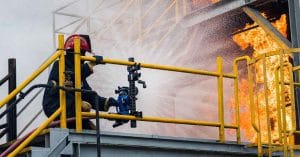
Denmark allocates tens of millions of kroner under a 2018 work-environment agreement to protect firefighters from soot and cancer risks, yet the same agreement contains no dedicated earmark for investigating possible breaches of EU working-time rules in municipal fire services.
The Employment Ministry’s 2018 agreement on firefighters’ work environment channels funding via Arbejdsmiljøforskningsfonden and other schemes to improve protections against soot-related cancer risks, including research and targeted hygiene initiatives. According to the published agreement text, it contains no specific provisions on working-time or mental-strain issues. That gap is now at the center of a growing controversy over what critics describe as rule-bending municipal fire services.
The 103-Shift Problem
Investigative reporting documented in 2024 shows some municipalities scheduling firefighters for 103 24-hour shifts per year. According to Piopio, that translates to roughly 53.7 working hours per week, about 12 percent above the EU 48-hour ceiling set by the Working Time Directive. The EU law also requires at least 11 consecutive hours of rest in each 24-hour period, with limited exceptions.
As reported by AMO-Uddannelse, Danish labour-law guidance states that after each 24-hour shift, workers must get 22 hours of rest. Violations of rest-time provisions can be punished with fines or, in special cases, imprisonment. According to critics, no publicly reported penalties have been imposed in the cases highlighted, and the schedules persist.
On-Call Time Counts as Working Time
According to Finans Danmark Arbejdsgiver, EU Court of Justice rulings have clarified that on-call duty at home can count entirely as working time if response obligations severely restrict the worker’s free time. Danish employer guidance notes that on-call duty at home can be counted as working time when tight response requirements significantly limit free time, a situation many firefighters with pagers and short response deadlines may fall under.
As documented in Danish Parliament’s Employment Committee, questions reference firefighters exceeding 48 hours weekly on average. Working-time compliance in emergency services has become a topic in parliamentary oversight and implementation discussions. Municipalities argue they need tight on-call systems to maintain rapid response capacity, especially in sparsely populated areas, and that hiring more full-time staff would be prohibitively expensive.
The Part-Time Loophole
According to career guidance published by ug.dk, most Danish firefighters work part-time or as volunteers, often holding another job alongside their fire service duties. Full-time firefighters officially work 37-hour weeks. Part-timers add on-call hours to their other employment, making total weekly hours harder to monitor and potentially much higher.
This flexibility helps municipalities keep costs down, but it also obscures compliance. No easily accessible national statistics were found that separately track total working hours for part-time and volunteer firefighters, creating a data gap that makes union allegations difficult to independently verify.
What Firefighters Can Do
Affected firefighters can request a formal review of their working-time records by their employer and union, citing both Danish labour law and EU case law on on-call duty. They can insist that any reduction in daily rest be compensated with additional rest in accordance with Danish rules. Where violations persist, as AMO-Uddannelse guidance states, breaches can result in fines or imprisonment.
Firefighters on 24-hour shifts should ensure their local agreements comply with rules overseen by Arbejdstilsynet, and can challenge arrangements through unions or complaints to the authority.
What Expats Should Know
Internationals relying on Denmark’s fire services can improve their own emergency readiness by learning the system. Call 112 for fires and life-threatening situations, 1818 for acute medical issues outside GP hours (note: primarily used in Region Hovedstaden), and 114 for non-urgent police matters. Download the S!RENEN app for real-time warnings and instructions in English when major incidents occur nearby.
According to the Danish Emergency Management Agency, the app uses a simple alert protocol: stop, read, react. It provides visual and text-based guidance that does not require Danish fluency. Municipal websites also host fire safety plans, often with visual aids, outlining how to evacuate and meet arriving crews.
The Bigger Picture
Denmark has invested in technological safety measures for firefighters. Those engaged in smoke diving use PASS alarms that automatically signal if they stop moving, improving survival rates in interior fires. The S!RENEN system pushes danger alerts directly to phones in affected areas. Yet these modern protections exist alongside staffing practices that may systematically overwork the people they are designed to safeguard.
The 2018 work environment agreement focuses on hygiene and cancer risk, including targeted inspections of cleaning procedures and handling of contaminated gear, and contains no specific provisions on working-time or mental-strain issues. Critics argue this leaves a significant gap in protections, especially as EU case law on working time continues to tighten.
For internationals living in Denmark, the combination means emergency response is often fast and technically sophisticated. Legal and parliamentary pressure is increasing, and municipalities may eventually have to adjust staffing models, potentially affecting response times, volunteer recruitment, and how expats can engage with or rely on local brigades.