Denmark has earmarked DKK 1.3 billion for new coastal defence and long-range strike systems in the Baltic Sea region, according to internal procurement documentation seen by The Danish Dream, with Bornholm playing a strategically important role in a military build-up that is accelerating across the Nordic region while the same island is being transformed into a critical offshore energy hub.
The figure comes from a Danish-language procurement annex not mentioned in general defence spending overviews. It is not corroborated in public Ministry of Defence or Statistics Denmark documentation. While politicians cite the overall DKK 195 billion Defence Agreement and the separate DKK 120 billion Acceleration Fund, this DKK 1.3 billion figure is one of the few detailed numbers that quantifies coastal and long-range systems. Public documents do not explicitly break out funding by geographic theatre.

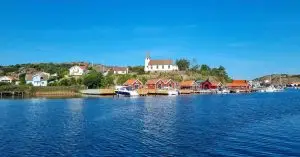
Bornholm is no longer just a holiday island famous for smoked fish and summer cottages. Its location east of mainland Denmark, close to Sweden, Poland, and the Russian exclave of Kaliningrad, makes it strategically important in NATO’s Baltic defence planning. At the same time, it is the site of a German-Danish offshore energy island. No publicly available document was found that combines the military upgrades with the Energy Island project. Strategic and energy planning appear in separate documents.
The numbers are sharper than the headlines
According to the Danish Ministry of Defence, DKK 193 billion of the DKK 195 billion Defence Agreement framework has already been allocated, leaving only DKK 2 billion unassigned. There is virtually no flexibility left for new initiatives outside the agreed build-up path. According to SIPRI military expenditure data, Danish military spending in constant prices has roughly doubled over the past decade. The Ministry of Defence describes the current investment as one of the largest defence programmes in Denmark’s recent history.
Sweden is moving even faster. According to RID reporting on Sweden’s 2026 defence budget, Swedish military spending is set to reach SEK 175 billion in 2026, corresponding to about 2.8 percent of GDP. The Swedish Ministry of Defence has described the current reinforcement as the most comprehensive since the Cold War. Government statements discuss further increases toward roughly 3 to 3.5 percent of GDP by 2030. According to NATO and SIPRI data, Denmark’s military expenditure currently stands at around 1.4 to 1.6 percent of GDP, significantly below Sweden’s level.
EU loans and fast-tracked procurement
The European Commission endorsed national defence plans for eight member states in January 2026, including Denmark, opening access to low-cost, long-term loans under the SAFE instrument. First disbursements are expected by March 2026. According to the SAFE press release, around EUR 38 billion in loans are earmarked collectively for the eight states. Denmark’s updated 2026 acquisition plan, as reported by Nordic Defence Sector, emphasises robust supply chains, faster build-up of operational effect, and coastal defence and long-range precision strike capabilities among its priorities.

These are not abstract procurement categories. Coastal defence and long-range strike systems are the weapons placed near strategic waterways to control sea lanes and deter hostile naval forces. Initial coastal missile batteries are publicly reported at Naval Station Korsør. Bornholm is geographically exposed and strategically important, but further basing plans are not publicly detailed.
Cost overruns fuel scepticism
Not everyone is confident the spending will deliver what it promises. As reported by Politiken, summarising a National Audit Office review, Denmark’s purchase of 27 F-35 fighter jets will cost DKK 14.1 billion more than previously estimated, largely due to personnel costs and shared programme expenses. Critics worry similar overruns may occur in other major projects funded by the Acceleration Fund. Civil society and some security experts also question the absence of integrated public planning documents addressing civilian safety on strategic islands like Bornholm.

For foreign nationals living on Bornholm, practical guidance is thin. According to Statistics Denmark’s FOLK1A data, foreign-origin residents make up roughly 6 to 8 percent of Bornholm’s population in recent years, compared to about 11 to 13 percent nationwide. No official English-language guide specifically targeted at expats on Bornholm was found. Official guidance for all residents focuses on general civil preparedness via borger.dk and standard consular registration. The only concrete steps are to engage with general preparedness structures, register with your embassy or consulate, and monitor Danish and English-language alerts.
A dual role that raises questions
As reported by Offshorewind.biz and Windpower Monthly, Germany and Denmark reached a cost-sharing agreement for the Bornholm Energy Island in January 2026. High-voltage interconnectors will cross the Baltic Sea, linking offshore wind farms to the continental grid. At the same time, Denmark is committing one of the largest defence investment programmes in its history. This dual role raises questions for people living and working on Bornholm about physical security, evacuation capacity, and the resilience of core services.

According to the Swedish Ministry of Defence, the current reinforcement is the most comprehensive since the Cold War. Denmark is following a similar trajectory, albeit from a lower starting point. For internationals in Denmark, debates about military bases, energy islands, and strategic islands like Bornholm will remain volatile and heavily politicised. Most key decisions are now embedded in multi-year EU and NATO commitments rather than short-term national politics.

The DKK 1.3 billion figure for coastal and long-range systems, seen in internal procurement documentation, is one of the few detailed data points in an otherwise fragmented public picture. It indicates that Denmark is serious about defending its eastern flank, and that Bornholm is likely to play an important role in that defence posture. What remains unclear is how the military build-up will intersect with civilian life on an island that is also becoming an energy hub, and what happens to the people who live there if the broader security situation deteriorates.