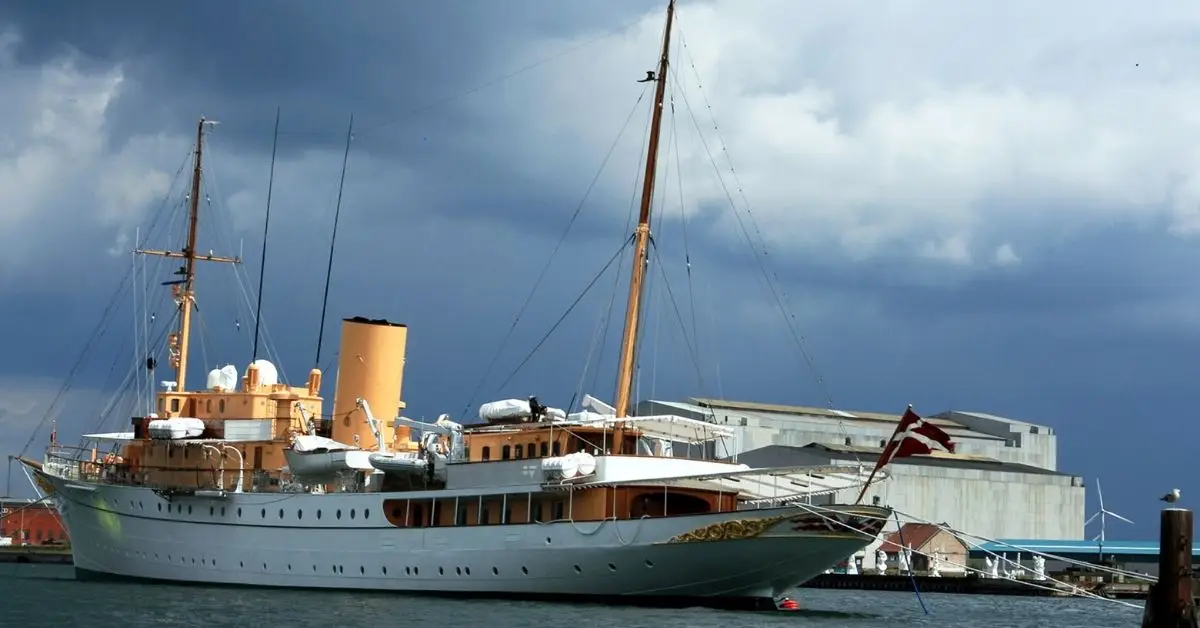
More than 70,000 tracked vessels pass through the Great Belt each year, but Denmark does not systematically register who is on board foreign luxury yachts sailing the same strategic chokepoint as oil tankers and naval convoys.
A foreign megayacht can glide past Christianshavn and anchor within sight of Amalienborg without Denmark ever knowing who is actually on board. The legal framework that makes this possible sits at the intersection of international maritime law and domestic indifference. While Danish authorities track vessel movements with extraordinary precision, they exercise almost no routine scrutiny of passengers aboard private yachts transiting territorial waters.
Strategic corridor, selective visibility
Denmark controls the only practical deep water gateway between the Baltic Sea and the North Sea. As the state pilot service DanPilot notes, the inner Danish waters are the primary access to the world’s oceans for Sweden, Finland, the Baltic states, northern Poland and Germany. That means any large yacht entering or leaving ports in those countries will almost inevitably pass through Danish straits.
The Danish Maritime Authority publishes AIS based traffic density maps showing the Great Belt and Øresund among the most congested sea lanes in Northern Europe. Tens of thousands of commercial vessels make the transit annually. Yachts are included in AIS traffic data but are not separately reported in public statistics.

For internationals living in Denmark, the sudden appearance of politically exposed billionaires’ vessels raises obvious questions. The legal reality is that foreign owned luxury yachts over 24 metres can transit Danish waters freely under the international right of innocent passage. Denmark does not require passenger manifests or crew lists solely because a yacht passes through its straits.
More environmental rules, same opacity
Over the past three to five years, the Folketing has tightened environmental and safety rules for ships in Danish waters. Bill L 104 from the 2023 to 24 session amended the Marine Environment Protection Act to regulate offshore CO₂ storage platforms and strengthen emergency response capacity at sea. Bill L 159 from 2024 to 25 established the new Marine Nature Fund to support environmental restoration.
None of these measures touch transparency about yacht ownership or passengers. Denmark now has more granular AIS coverage than ever, and hydrographic monitoring has become more sophisticated. The state knows exactly where each large yacht is at any moment. But those data are used for navigation safety and incident response, not public transparency or political vetting.

The gap is stark. Denmark’s 2023 national hydrographic report highlights nationwide traffic monitoring and reinforced cooperation between the Maritime Authority, Navy and pilot services. Yet there is no public register of which private foreign yachts are anchored off central Nyhavn on a given day, even though the same data would technically allow it.
Flags of convenience, invisible owners
Denmark had around 52,000 pleasure craft registered under national schemes in the mid 2010s. But the majority of large luxury yachts observed in Copenhagen and Danish straits today are foreign flagged, often under flags of convenience such as Cayman Islands or Malta. Statistics Denmark’s shipping and ports tables report tonnage and number of calls by port and ship type. Pleasure craft under certain sizes are often excluded or under reported. There is no breakdown by luxury yacht category.

For expats who assume Schengen or Danish border rules guarantee robust monitoring of who enters via sea, the reality is sobering. Border checks are risk based and selective for yachts, not systematic. Schengen rules allow coastal states to waive full checks for certain intra Schengen pleasure craft. That further limits routine scrutiny.
What you can actually find out
Individuals cannot easily obtain passenger lists or ownership details for a given yacht. But public AIS services allow anyone to identify a vessel’s IMO or MMSI number, flag state and recent route. If a yacht moors at a Danish port, harbour authorities will have operational data such as length, draught and berth allocation. Those bodies are subject to Danish access to documents rules, so journalists and the public can file FOI requests for non sensitive information.

The Danish Maritime Authority and DanPilot provide guidance on safety and reporting obligations, partly in English. If sanctions are suspected, citizens can cross check the yacht’s registered owner against EU sanctions lists. Enforcement is handled by Danish police and the Danish Business Authority. For expats living near harbours, practical advice is to channel concerns through local police or harbour authorities rather than confront crews directly.
The juxtaposition is uncomfortable. Denmark pursues a 70 percent emissions reduction by 2030 while tolerating high emission luxury traffic through some of the most strategically sensitive waters in Europe. Global studies estimate that large luxury yachts can emit several thousand tonnes of CO₂ per year, often more than the annual footprint of hundreds of average EU citizens. At national level the impact is negligible. Symbolically, in a country that prides itself on transparency and egalitarianism, the gap between technical visibility and legal invisibility is harder to justify.