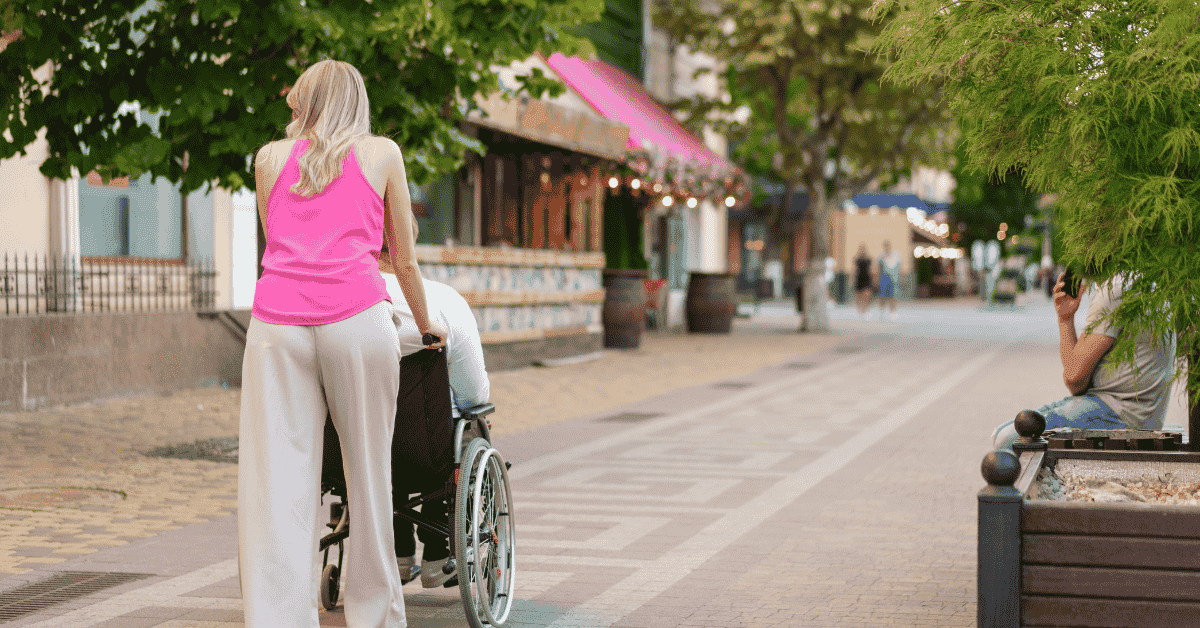
A young Danish woman severely injured in a car accident has spent years fighting to regain her independence. But now, she says, bureaucratic barriers have stolen the youth she dreamed of living.
A Sudden End to a Normal Teenage Life
Julia Fogh Henriksen was only fifteen when her life changed in an instant. On her way home from a minigolf tournament with her family in the summer of 2017, a violent traffic accident left her with a brain injury so severe that she spent months in a medically induced coma and on a respirator. Doctors weren’t sure she would survive. When she finally woke up, nothing was the same again.
After years of rehabilitation at specialized neurocenters, Julia slowly regained mobility and parts of her speech. But her hopes of returning to an ordinary youth were already slipping away. Now 24, she has spent most of her early adulthood in a care home in Brovst, a small North Jutland town far from her old friends and the life she imagined building in Aalborg, one of northern Denmark’s largest cities.
Struggling to Reclaim a Sense of Freedom
Julia currently lives at Poppelhuset, a residential institution for young people with acquired brain injuries. When she moved in back in 2021, the local government promised it would be temporary. Four years later, she is still there with no plan for relocation. The problem is financial: Jammerbugt Municipality refuses to pay for her move to a residential home in Aalborg because those options cost between 22 and 31 percent more than her current accommodation.
According to Danish law, individuals entitled to long-term care can choose their housing option, but municipalities can reject choices if they deem them “significantly more expensive.” For Julia, the price tag has become a wall she can’t climb. Her guardian argues that she should be assessed individually rather than reduced to a cost percentage. It’s a debate that mirrors broader concerns in Denmark about how local authorities balance budgets with citizens’ well-being. Experts have long warned that Denmark’s welfare system is stretched to its limits.

The Cost of Bureaucracy
Jammerbugt Municipality defines “significantly more expensive” as 20 percent above existing costs, a threshold Julia’s preferred options nearly all exceed. The case was appealed to Denmark’s national appeals board, which upheld the municipality’s decision. As a result, Julia remains isolated in Brovst, far from the friends, city life, and training facilities in Aalborg that motivate her recovery.
This decision highlights how welfare reform and municipal savings measures often prioritise budgets over individual development. Similar financial limits have also affected housing and care options across the country. For many, this has raised questions about whether local governments are honoring the human side of Denmark’s famed welfare state. Reports show that welfare cuts have led to rising concerns about homelessness and limited support for those with complex medical needs.
Fighting for a New Assessment
Both Julia and her guardian insist that her needs should be re-evaluated. Since her last official assessment in 2021, she has made notable progress. She can now prepare meals, make coffee, dress herself, and handle small daily tasks independently. But Jammerbugt officials have decided against a new medical review, stating that Julia’s condition is not “newly acquired” and that an updated evaluation is unnecessary.
For her, this feels like an administrative dead end. Without a new assessment, she cannot prove she requires less care or justify a move to a more independent living arrangement. The municipality has even informed her that it will no longer hold regular status meetings to monitor her progress and well-being—a key communication channel between residents and local authorities.
Dreaming of a Life Beyond Care Facilities
Julia grew up in Biersted, about twenty kilometers from Brovst, but says she has no attachment to the town. What she wants now is the vibrant energy of city life. Aalborg, with its cafes, public spaces, and social life, represents freedom and youth to her. It’s where she trains, where her friends live, and where she believes she could finally regain some of what the accident took away.
Her case also sheds light on the realities of long-term disability care in Denmark: even when recovery and independence improve, the system can still keep people locked in the same restrictive living situation. For those outside the welfare network, navigating local housing offers and budget caps can already be difficult. As resources tighten, it’s becoming increasingly complicated, as many foreign residents have discovered when trying to secure suitable housing under Denmark’s rules. These challenges are reflected in reports exploring how Denmark’s housing system treats newcomers.
A System That Needs Reassessment
Julia’s story is a reminder of how impersonal welfare administration can feel for citizens navigating trauma recovery. While Denmark’s welfare model is often cited as one of the most generous in the world, individual cases like hers expose how resource constraints and legal interpretations can limit personal freedom. Every adjustment to the system, even if minor, ripples through the lives of the people depending on it.
If municipalities continue to prioritize financial restrictions over humane flexibility, more citizens could find themselves caught in similar situations—where progress and self-reliance lead not to independence, but to bureaucratic standstill.

In the end, Julia’s hope of moving to Aalborg is about much more than location. It’s about reclaiming a sense of control over her future and proving that recovery should not be met with administrative barriers. Her struggle is both personal and symbolic, revealing how Denmark’s welfare reality often falls short of its ideal.
Sources and References
TV2 Nord – 24-year-old “trapped” in care home: “My youth has been taken from me”
The Danish Dream – Experts warn Denmark’s welfare system near breaking point
The Danish Dream – Welfare cuts spark homelessness concerns
The Danish Dream – Housing in Denmark for foreigners