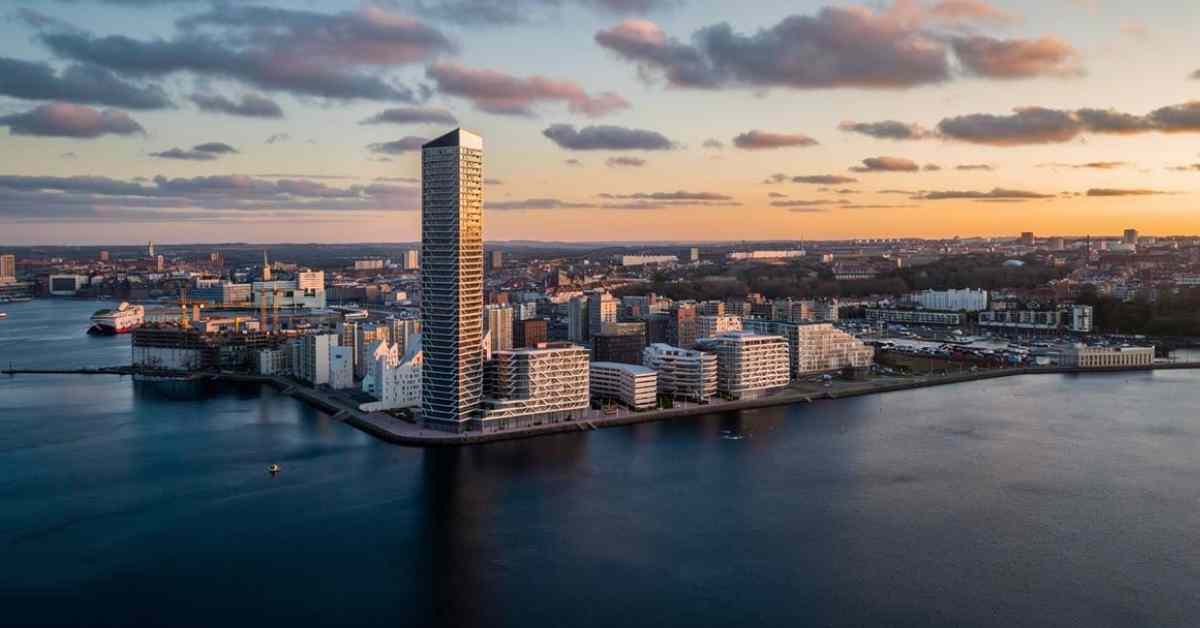
Aarhus’ new high-rise buildings are sparking heated debates among residents, politicians, and architects who criticize many recent developments as poorly designed and out of place. City Architect Anne Mette Boye welcomes the criticism as healthy scrutiny that keeps the city sharp, while calling for stricter quality standards to ensure future buildings are worthy of pride.
Public Backlash Against Urban Renewal
Renewal and change often meet with skepticism and debate. When the new addition is a heavy building rising hundreds of meters into the cityscape, residents don’t hold back their opinions.
The tall new buildings are ugly, they dominate the skyline, and they simply don’t fit in. These are just some of the many views on urban renewal in Aarhus that surface in public debate, local newspapers, on Facebook, and among voices in the city streets.
Architect Rie Øhlenschlæger, a member of the leadership in Arkitektforeningen Østjylland, agrees with the criticism Aarhus’ new skyline has received in recent years. She emphasizes the need to create buildings that will be considered good for many years, not structures that become the next generation of poor housing.

City Architect Embraces Criticism
Even City Architect Anne Mette Boye, one of the closest advisors to city council decision-makers, agrees with parts of the criticism directed at Aarhus’ new buildings. She acknowledges that many developments are simply not good enough because developers and architects haven’t been careful enough.
Anne Mette Boye became Aarhus’ new city architect in 2021. She explains that many of the new building projects that have faced opposition in recent years were planned and initiated 10 to 15 years ago.
Learning From Past Mistakes
Boye believes the city should learn from past errors and that residents’ criticism is more than welcome. The criticism of new buildings is healthy and keeps architects sharp, she says.
She is convinced that future buildings in Aarhus will be more thoughtful and fit better into the city’s life. However, clear requirements must be ensured so Aarhus gets high-quality construction that residents can be proud of, both now and in the future.

Notable Controversial Buildings
Several buildings have become focal points of debate in Aarhus. Arch House, formerly known as Unity, is one of the most criticized developments in recent times. Its placement next to the iconic water towers on top of Randersvej has been particularly controversial.
Prismet has been a tall dark landmark since its construction in 2001, where the two access roads Viborgvej and Silkeborgvej meet shortly before the city center. Meanwhile, Aarhus Ø has been in constant development for the last 10 years, with opinions about the tall buildings filling much of the public debate during that time.
Interestingly, Lighthouse, which is Denmark’s tallest building until Mindet is completed, has received praise from both residents and professionals despite its size. This demonstrates that architecture quality matters more than height alone.
Calls For Stronger City Architect Authority
Architect Rie Øhlenschlæger is positive about the city architect’s work and the architecture policy she has introduced for the future. She believes politicians should publicly commit to executing the adopted architecture policy at all levels.
Øhlenschlæger wants future building projects in Aarhus to be approved with architecture and city life at the center, not based on economic motives. Therefore, she wishes politicians would delegate some power to the city architect office, giving Boye the authority to put her foot down and say stop when necessary.
Democratic Balance
City Architect Anne Mette Boye agrees with the need to say no. Not all buildings are welcome in Aarhus, and the city must be skilled at setting requirements to get architectural gems, whether building new or transforming existing structures.
However, Boye doesn’t want absolute power. The final decision rests with politicians, and that’s how it should be in a democracy like ours, she explains. This approach respects democratic processes while maintaining professional standards.

The Challenge of Common Language
Architect and Health and Care Councilor for Radikale Venstre in Aarhus, Metin Lindved Aydin, supports Rie Øhlenschlæger’s criticism. He points out that it’s extremely difficult to formulate what is good and what is bad. The city council lacks a common language for architecture, and probably won’t get one.
He therefore believes the city architect’s role in advising politicians is extremely important. Politicians should give her the respect she deserves by voting according to her recommendations.
Balancing Authority and Democracy
As an architect, Metin Lindved Aydin has often dreamed of giving the city architect veto power, but as a politician he believes that’s too much authority. It’s difficult to place the city architect above the city council, he admits.
However, the city council could make a principle decision to always follow the city architect’s recommendations as a starting point. That would be a good guideline to lean on, he suggests.
Future Accountability
If the city architect doesn’t get more power, Rie Øhlenschlæger hopes residents will take action if they remain dissatisfied with urban renewal in the future. Citizens must simply fire politicians at the next election if they don’t properly follow up on the architecture policy, she says.
This perspective reflects broader national discussions about architecture quality and local implementation. Denmark recently launched a new national architecture policy in early 2026, featuring eight core dogmas aimed at enhancing architectural quality, sustainability, and local implementation. Kolding Kommune has pioneered local architecture policy ahead of the national rollout, prioritizing preservation over new construction.
The debates in Aarhus mirror discussions happening throughout Denmark about balancing growth with heritage, economic interests with architectural quality, and democratic decision-making with professional expertise. As cities continue to evolve and grow, these conversations will likely intensify, shaping the urban landscapes where Danes will live for generations to come.
Sources and References
The Danish Dream: Exploring Danish Architecture Copenhagen
The Danish Dream: Best Architects in Denmark for Foreigners