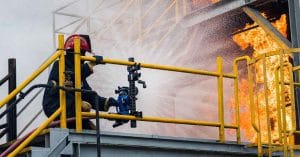
A house fire in central Svendborg on Wednesday afternoon forced evacuations across multiple streets in a municipality where the foreign national population has more than doubled in a decade, yet emergency alerts remain almost entirely in Danish.
Beredskab Fyn logged a formal fire dispatch at 14:44 on 8 July for a building on Vestergade in central Svendborg. As reported by Fyens.dk, heavy smoke spread over surrounding streets including the area near Johs. Jørgensens Vej. Police ordered residents to stay indoors and close doors and windows. Later updates confirmed that police evacuated nearby streets as a precaution, a standard response when authorities suspect hazards inside burning buildings.
The evacuations hit a city that has quietly become one of Denmark’s fastest-changing provincial towns. According to Statistics Denmark’s StatBank table FOLK1F, Svendborg had 3,391 foreign nationals in 2023, up from 1,634 in 2013. That is a 107 percent increase in ten years. Yet according to the Svendborg municipal emergency plan, which acknowledges rising diversity in the population, the plan contains no specific section on foreign-language communication.
What Internationals Miss When Smoke Fills the Street
Denmark issues emergency alerts through police social media, TV and radio interrupts, and the national siren system. According to the national civil warning regulation published on Retsinformation, alerts are generally issued in Danish, and it is each citizen’s own responsibility to stay informed via official channels.

That creates a real problem during a fast-moving evacuation. Instructions like “bliv indendørs, luk døre og vinduer” or street-specific evacuation orders can take hours to reach English-language news outlets. For the Svendborg fire, initial police updates and local media coverage were in Danish, with no official English-language guidance issued during the critical first hours.
Why This Matters Now
The fire occurred during the Danish Bridgefestival, which according to the Danish Bridge Federation runs from 4 to 11 July and draws participants from across Denmark and abroad to central Svendborg. Many stay in hotels and rentals near the city centre, exactly where the fire unfolded. That adds temporarily residing internationals to the pool of people who might not understand a rapid Danish evacuation order.

According to Statistics Denmark’s FOLK1F table, Svendborg’s largest foreign nationality groups include Germany, Poland, Romania and Syria. These residents, alongside EU workers and others with limited Danish, are among those most likely to miss instructions during a fast-moving incident in central neighbourhoods.
Broad Perimeters Are the New Normal
According to the Danish Emergency Management Agency’s national risk assessment, updated in 2023, urban fires combined with hazardous substances represent a priority scenario. When there is any suspicion of explosives, gas bottles or fireworks inside a burning building, emergency services set precautionary evacuation perimeters on a case-by-case basis covering the affected building and surrounding structures.
Svendborg has seen this before. In September 2023, a fire and explosion led police to evacuate multiple streets while they checked the property for explosives. A Fyns Police spokesperson explained at the time that when explosives are suspected in residential areas, perimeters can cover entire streets to minimise risk to residents and firefighters.
Some residents and business owners complain that evacuation zones feel excessive, causing avoidable disruption when explosives are ultimately not found. But emergency services argue that over-cautious evacuations are better than under-reacting. The national duty of care and liability makes broad cordons the default.
What Internationals Can Do
Practical steps exist, even if official multilingual alerts do not. International residents should bookmark the Fyns Police website and Beredskab Fyn updates. Browser auto-translate can turn Danish incident reports into rough but usable English in seconds. The national non-emergency number is 114, and Svendborg police station is at Tvedvej 2 for information on when evacuees can return home.
Registering a Danish phone number with your Borger.dk profile can improve the chance of receiving municipal alerts. According to DEMA guidance, keeping a battery-powered radio and following DR or TV2 is recommended in case of power cuts. DEMA also advises non-Danish speakers to use translation tools or ask neighbours to interpret basic commands during emergencies.

Compared with Copenhagen, where police increasingly share English social media posts during major incidents, smaller cities like Svendborg lag behind despite seeing a rising share of foreign nationals. According to Statistics Denmark and Eurostat, foreign nationals represent about 5.8 to 6 percent of Svendborg’s population, compared with roughly 8 to 9 percent nationally. The EU Civil Protection Mechanism, as updated in 2021 and published on EUR-Lex, encourages member states to consider language minorities in risk communication, but leaves implementation to national authorities.
The Gap Between Growth and Preparedness
According to Statistics Denmark’s FOLK1F data, Svendborg’s foreign national population more than doubled between 2013 and 2023 while the city’s overall population of around 58,652 remained broadly stable. That means the composition of the city has shifted faster than the emergency communication infrastructure has adapted.

Civil rights groups argue that reliance on Danish-language warnings disproportionately disadvantages non-Danish speakers. The Danish Institute for Human Rights has questioned whether this approach meets principles of equal access to safety information. Other EU countries offer models worth watching. Germany’s cell broadcast system and Italy’s IT-alert can send area-based messages in multiple languages, suggesting a potential model for Danish municipalities hosting major events like Svendborg’s Bridgefestival. Denmark has not adopted anything comparable. The question is whether a Danish-only system still works when foreign nationals have more than doubled in a decade.