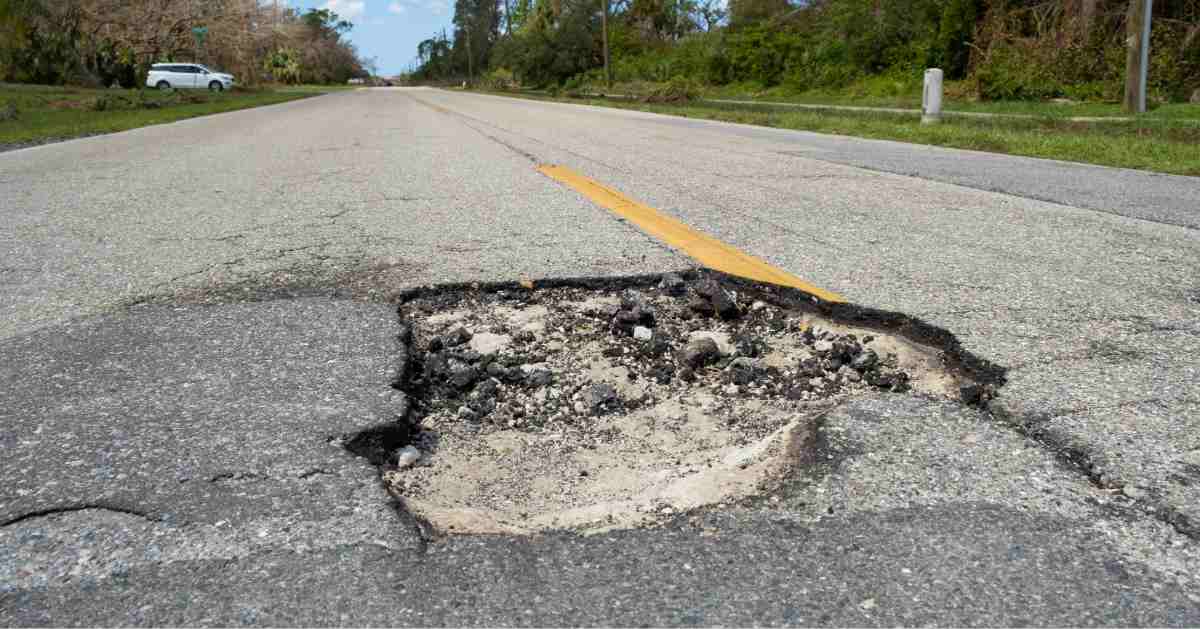
Danish municipalities are not automatically liable for sidewalk injuries. Practitioner guidance, drawing on case law, uses around 3 centimeters as an indicative benchmark, with holes and level differences under that size generally not considered unsafe as a starting point, but liability is always assessed case by case.
The rule sounds technical, but it matters every time someone trips on a Copenhagen sidewalk or catches a foot in a broken Aarhus paving stone. According to Vejloven, the public roads act, road authorities must keep public roads in the condition required by traffic’s type and size. In practice, that means a hole or height difference under roughly 3 centimeters is generally not treated as an unsafe condition.

That figure is not spelled out in Vejloven or any national regulation. As legal practitioners at Ret&Råd Advokater explain, the roughly 3 centimeter figure originates from case law and practitioner guidance, not from the public roads act itself. Practitioner benchmarks are intended to distinguish ordinary wear from conditions that are likely to be considered unsafe. For injured residents and visitors, though, the reality is stark. A defect that looks bad enough to cause a fall may still be too small to generate compensation.
When a Municipality Pays for Sidewalk Injuries
Liability turns on whether the defect is judged unsafe in the context where it appears. For example, legal advisers note that a small level difference may be judged differently depending on context, such as a quiet, well-lit residential lane versus a crowded, poorly lit shopping street. The legal test is always a concrete assessment of circumstances, not a fixed numeric rule. Minor defects are often judged to fall within ordinary wear, so claims involving small irregularities can be difficult to pursue successfully.
What to Do After a Fall
Ret&Råd Advokater advises taking photographs of the exact spot and its surroundings immediately after a sidewalk accident. Capture the full scene so the context is clear. Get names and phone numbers of witnesses who saw the fall. Report the incident to the municipality as soon as possible, creating a formal record. Seek medical attention and keep documentation of the injury.

As in other Danish compensation cases, the injured party must prove both the defect and that the municipality acted negligently. Without photos, the municipality can argue the defect was minor or did not exist. Without a medical record, the injury’s severity is harder to establish. In practice, undocumented claims are significantly harder to prove and often unlikely to succeed.
The Hidden Cost of Small Defects
The roughly 3 centimeter benchmark reflects a case-by-case legal standard, but real-world fall risk depends on more than measurement alone. Lighting, weather, footwear, age, and foot traffic all affect whether a small defect becomes dangerous. A shallow dip may be invisible in winter dusk or under snow and ice. An uneven joint can catch a heel or a pram wheel even when the measurement looks marginal.

For internationals, the system may differ from what they expect, especially if they come from countries where any visible defect on public pavement is widely assumed to create a claim. In Denmark, ordinary wear is tolerated, and municipalities are liable only where there is fault or neglect proportionate to the circumstances. That makes the immediate response to a fall critical. Document everything, report quickly, and do not assume the injury alone will be enough to win a claim.
A Question of Responsibility
Vejloven assigns sidewalk maintenance to the road authority, typically the municipality. According to property guidance from Bolius, private property owners are not responsible for maintaining the physical structure of public pavement in front of their buildings, though municipalities can require adjacent owners to clear snow and ice on nearby sidewalks. The division matters because injured pedestrians sometimes target the wrong party.

The municipality holds the maintenance duty, but liability depends on fault and the concrete circumstances of each case, not simply on whether a defect exceeds a particular size. Liability in Danish sidewalk cases reflects a broader policy choice: road authorities must meet their duty of care, but ordinary wear is expected. Whether that balance is fair depends on which side of a sidewalk fall you land.