Political observers agree that Denmark’s election campaign has begun in earnest, as parties roll out policy proposals and position themselves ahead of a vote that must be held by October 31, 2026. The Social Democrats have rebounded in polls, while the blue bloc parties face diminishing momentum.
Election Campaign Activity Intensifies on Christiansborg
Danish politics has entered a clear pre-election phase. Since the start of the year, a steady stream of political proposals has emerged from Christiansborg. The pattern accelerated this week when the Socialist People’s Party announced a demand that would reshape coalition negotiations after the next election.
SF Makes Bold Holiday Demand
On Wednesday, SF leader Pia Olsen Dyhr declared that restoring Store Bededag as a public holiday would be a condition for her party’s support of any new government. The abolished religious holiday has become a cultural flashpoint since the current government eliminated it to fund defense spending. Surprisingly, the Social Democrats did not reject the proposal outright, signaling potential flexibility in future coalition talks.
The timing of SF’s announcement reveals strategic positioning. Rather than waiting for an official election campaign period, the party is staking out territory on issues that resonate with voters who value traditional Danish customs. This move comes as polls show SF holding steady at around 11 percent support.
Competing Proposals from Across the Spectrum
The same day SF made its holiday announcement, the Danish People’s Party proposed cutting fuel taxes to lower prices at the pump. Meanwhile, the Social Democrats released a school reform proposal last week that the party itself labeled an election campaign initiative. The proposal would cap class sizes at 14 students in the youngest grades.
These uncosted proposals serve a clear purpose beyond immediate policy impact. They are designed to capture voter attention and define party priorities rather than to be negotiated into law before an election campaign. The government’s agenda of major reforms has largely been exhausted, creating space for parties to look ahead to the next mandate.
Expert Analysis Points to Active Campaign
Three political commentators surveyed by TV 2 agree that Denmark has entered campaign mode, though they differ on when Prime Minister Mette Frederiksen will formally call the election.
Helle Ib Predicts March Election
Political commentator Helle Ib stated flatly that the campaign is underway beyond dispute. She pointed to the Social Democrats’ school proposal as the definitive signal. According to Ib, launching such an initiative only makes sense if the election comes before summer rather than after the vacation period.
The atmosphere on Christiansborg reflects campaign intensity, Ib observed. Parties are polishing proposals, printing posters, and positioning themselves aggressively. Ib has marked early March dates in her calendar as likely election days, predicting Frederiksen will act after the food subsidy check passes its final parliamentary reading on February 26 but before the Easter holiday.
Jarl Cordua Expects Later Spring Vote
Jarl Cordua agreed that recent government agreements and party proposals demonstrate an active campaign. However, he argued that the emerging contest will prove expensive for public finances. If Nicolai Wammen continues as finance minister after the election, he will face difficulty funding promises like lower food VAT, school reforms, and restoring the public holiday.
Cordua noted that the blue bloc parties have the least interest in stoking election fever. Polling numbers offer them little optimism, and the momentum they enjoyed in autumn has weakened. For this reason, Cordua predicted the election will come later in spring rather than March, giving the Social Democrats time to let voters feel the effects of recent measures like lower electricity taxes and the food subsidy check.
Rune Stubager Sees Multiple Scenarios
Rune Stubager traced the campaign’s beginning to Mette Frederiksen’s New Year’s speech, which focused on high food prices and immigration issues affecting Social Democratic voters. The Greenland crisis then shifted polls more dramatically than even optimistic party strategists expected.
Campaign atmosphere pervades Christiansborg, according to Stubager. Politicians discuss possible dates, watch for signals, and rumors circulate about advertising purchases. Parties are meeting with sponsors to raise campaign funds. While Stubager declined to predict a specific date, he acknowledged that a pre-summer election appears most realistic since the coalition partners will struggle to agree on a new budget proposal due in August.
Polling Shows Shifting Landscape
Recent opinion polls provide context for the campaign calculations underway. The numbers explain why different parties have varying appetites for an early election campaign.
Social Democrats Rebound Strongly
A Voxmeter poll conducted from February 2 to 8 showed the Social Democrats at 22.5 percent support. A Megafon survey for TV 2 placed them at 22.7 percent with 41 seats, representing a gain of nine seats since early December. An Epinion poll for DR showed the party climbing from 16.5 percent in December to 21.6 percent in January.
These figures represent a significant recovery for a party that won 27.5 percent in the November 2022 election. The rebound gives Frederiksen’s party renewed confidence, though they remain below their previous electoral result. The improvement also reduces pressure for immediate action while creating opportunity for strategic timing.
Coalition Partners Face Mixed Results
The Moderates, who were dangerously close to the two percent threshold in December with just 2.2 percent support, have stabilized between 4.6 and 6.4 percent across recent polls. In the Voxmeter survey, the party gained three percentage points in just one month to reach 6.3 percent. This recovery moves them away from the existential threat of falling below the parliamentary threshold.
Venstre presents a contrasting picture. The Liberal Party has stagnated around 10.7 to 12 percent, declining in the most recent polls. As the only coalition partner consistently losing ground, Venstre faces the most difficult strategic position. An early election campaign offers little appeal when momentum points downward.
Constitutional Framework and Timing
The Danish constitution establishes the parameters within which Frederiksen must operate when choosing an election date.
Legal Requirements and Flexibility
Denmark’s Grundlov requires a parliamentary election at least every four years. Since Danes last voted on November 1, 2022, the absolute deadline falls on October 31, 2026. The prime minister holds sole authority to call an earlier election campaign, requiring only 20 to 21 days between the announcement and voting day.
This constitutional flexibility gives Frederiksen a significant tactical advantage. She can select timing that maximizes her party’s prospects while claiming to act in the national interest. No legal obstacle prevents a March election if she judges conditions favorable, nor does any requirement force her hand before autumn.
Strategic Considerations Around Timing
Several factors influence the timing calculation beyond poll numbers. The government wants voters to experience tangible benefits from recent initiatives before casting ballots. The food subsidy check, lower electricity taxes, and work tax cuts all need time to register with households.
Additionally, the coalition lacks agreement on major new reforms that would fill a legislative agenda through autumn. A new budget proposal would require difficult negotiations that could expose coalition tensions. These practical realities point toward a spring election, allowing the government to claim credit for completed initiatives while avoiding divisive future debates.
Historical Context and Precedents
Denmark’s recent electoral history provides perspective on the current situation and the choices facing party leaders.
General Election Results 2022
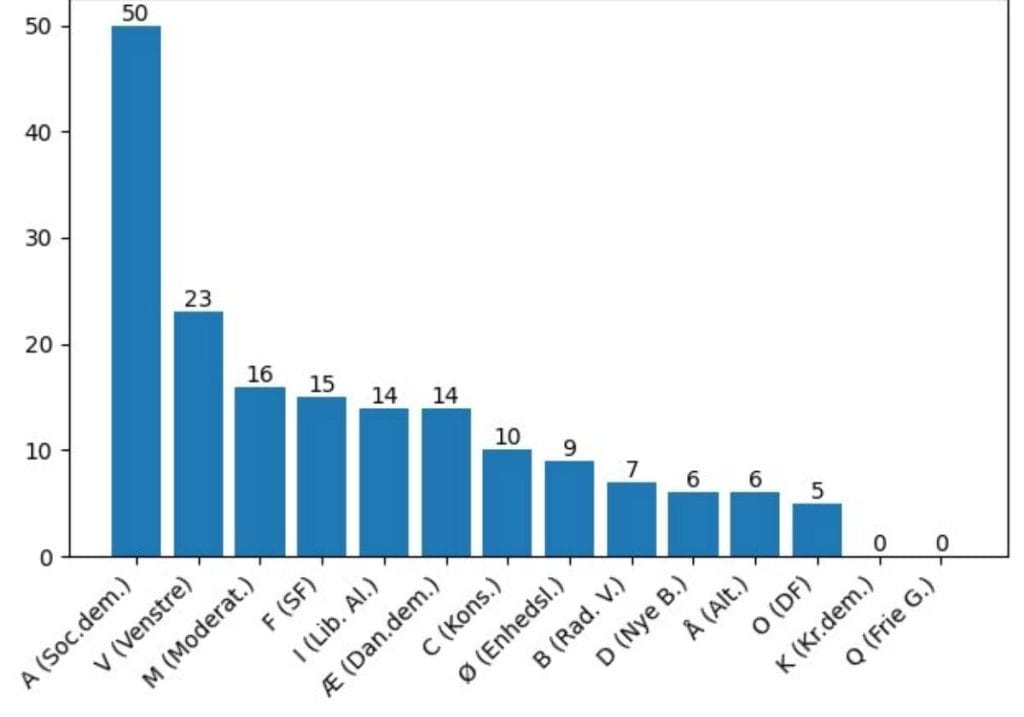
The 2022 Election and Coalition Formation
Frederiksen called the November 2022 election on October 5 of that year, giving about four weeks’ notice. Her Social Democrats won 27.5 percent but lost their governing majority. The subsequent coalition negotiations produced an unusual red-blue government combining Social Democrats, Liberals, and Moderates.
This three-party coalition represented a departure from traditional bloc politics. Lars Løkke Rasmussen’s Moderates, a new centrist party, gained significant influence despite winning only 5.5 percent of votes. The arrangement delivered stability but created tension over core issues where Social Democrats and Liberals traditionally disagree.
Shifting Political Dynamics
The current situation differs markedly from 2022. Then, Frederiksen faced pressure over her handling of the mink culling controversy during COVID-19. Now, her leadership has been bolstered by her prominent role during the Greenland crisis, when tensions with the United States over territorial issues elevated her international profile.
The opposition has fragmented rather than consolidated. The blue bloc includes several competing parties with different priorities, from the Danish People’s Party’s fuel tax cuts to Liberal Alliance’s free market agenda. This fragmentation complicates the formation of an alternative government even if the bloc wins more seats collectively.
Economic Security and Household Budgets
Cost of living concerns appear central to multiple party strategies. The Social Democrats emphasize their food subsidies and tax relief measures. The Danish People’s Party focuses on fuel prices. These appeals target middle and working class voters feeling squeezed by inflation despite Denmark’s relatively strong economy.
The emphasis on immediate economic relief contrasts with longer-term reform discussions. Parties are competing to demonstrate they understand household budget pressures and will act quickly to provide relief. The approach assumes voters will reward concrete benefits over abstract policy frameworks.
Cultural Identity and Traditional Values
SF’s Store Bededag proposal taps into debates about Danish identity and tradition. The abolished holiday has become symbolic of tension between economic modernization and cultural preservation. By championing its restoration, SF positions itself as a defender of Danish customs against what some voters see as excessive commercialization.
This cultural dimension intersects with ongoing immigration debates. Frederiksen’s New Year’s speech explicitly connected economic security with migration policy, appealing to Social Democratic voters concerned about cultural change. The combination of economic and cultural themes mirrors successful strategies from previous campaigns.
Sources and References
The Danish Dream: Mette Frederiksen’s Make or Break New Year’s Speech
The Danish Dream: Banking in Denmark for Foreigners Updated 2025
TV2: Det er indiskutabelt – valgkampen er i gang, siger kommentatorer
Faglig Senior
Wikipedia
Valg.im.dk
Venstre
Voxmeter
Wikipedia
Folketinget