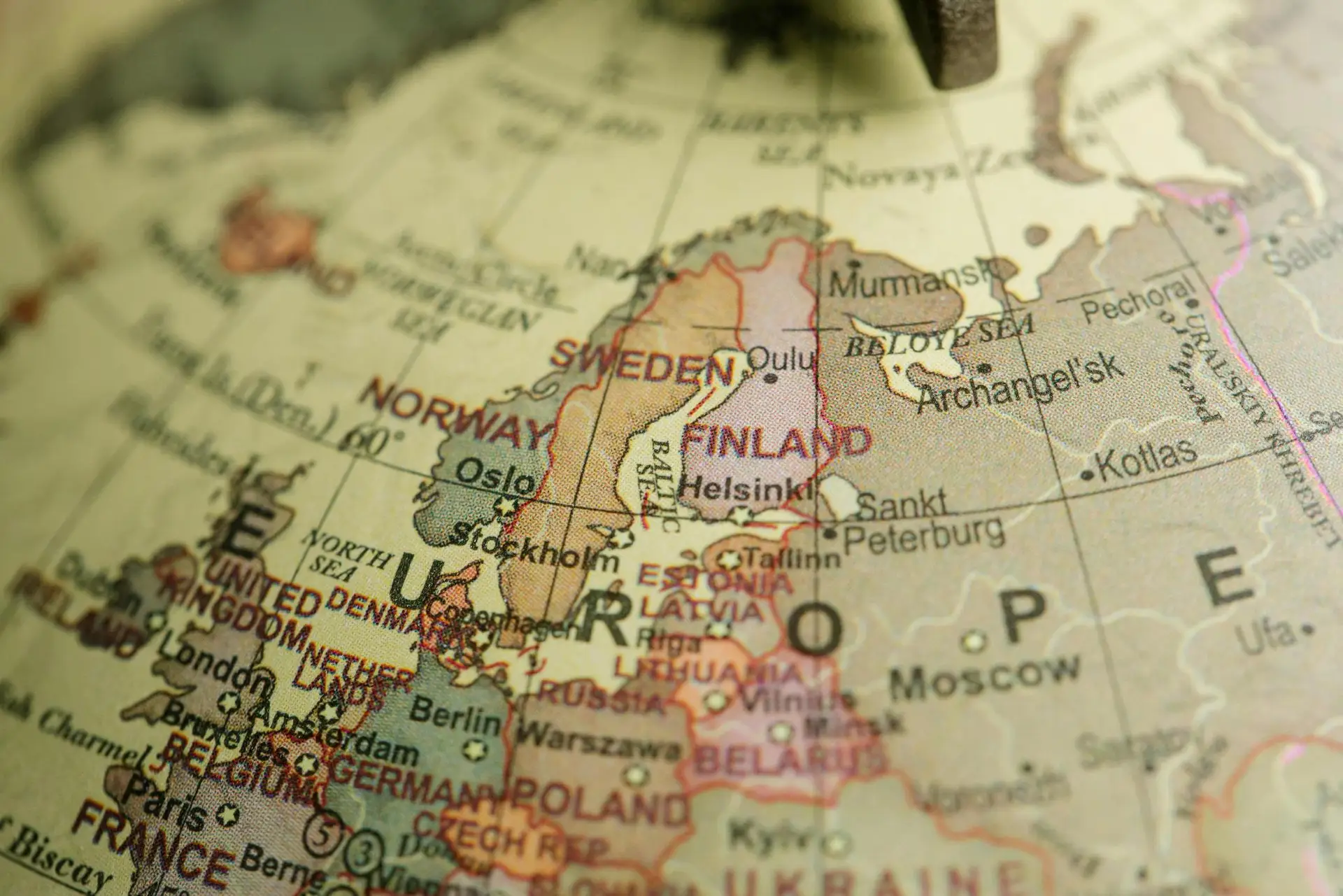
Europe and the United States cover nearly identical land areas of around 10 million square kilometers each, yet Europe packs in more than twice the population. Despite the similar geography, the two regions differ sharply in economic structure, population density, and historical development.
Land Area and Geographic Scale
The comparison between Europe and the United States reveals a surprising similarity in size. Both regions span close to 10 million square kilometers, though exact figures vary slightly depending on how boundaries are measured. Europe covers approximately 9.94 million square kilometers across 47 countries, while the United States spans 9.83 million square kilometers as a single nation. This makes Europe about 104,480 square kilometers larger, roughly the size of Iceland.
Distribution Across Countries and States
Russia dominates Europe’s landmass with 3.97 million square kilometers on its European side. At the other extreme sits Vatican City at just 0.49 square kilometers. The smallest European nation demonstrates the continent’s extraordinary political fragmentation compared to the United States.
Meanwhile, Alaska accounts for nearly 18 percent of total US land area at 1.72 million square kilometers. Rhode Island occupies just 4,002 square kilometers at the opposite end. The United States includes about 7 percent water in its total area calculations, affecting direct comparisons with Denmark and other European nations.
Perceptions and Map Distortions
Common map projections create misleading impressions of relative size. The Mercator projection often makes Europe appear smaller than it actually is compared to North America. In reality, the two regions occupy nearly identical spaces on the globe. This geographic near-equality surprises many people who assume the United States dwarfs Europe in physical extent.
Population Density Contrasts
Population distribution marks one of the sharpest differences between the two regions. Europe houses approximately 745 million people as of 2024, while the United States has around 342 million residents. This means Europe’s population exceeds that of the US by more than double despite their similar land areas.
Density Patterns and Urban Development
Europe averages roughly 118 people per square kilometer compared to just 36 in the contiguous United States. Russia leads European countries with about 110 million people living on its European side, representing 80 percent of the nation’s total population. Vatican City sits at the opposite extreme with approximately 825 residents.
California remains the most populous US state with over 39 million residents. Texas follows with 30 million and Florida with 22 million. Wyoming claims the smallest state population at around 581,000 people. These density differences drive contrasting approaches to urban planning and infrastructure across the Atlantic.
Implications for Development
Higher density in Europe supports extensive public transportation networks and compact city designs. The United States developed differently with more suburban sprawl and car dependency. These patterns reflect not just population numbers but also historical settlement patterns and cultural preferences. Density shapes everything from housing costs to environmental footprints in both regions.
Economic Size and Prosperity
The United States maintains a larger economy despite Europe’s population advantage. US nominal GDP reaches $28.78 trillion, surpassing Europe’s combined $24.22 trillion. This makes the European economy about 84 percent the size of its American counterpart, with a gap of approximately $4.6 trillion.
National and Regional Economic Leaders
California alone boasts a nominal GDP of $3.8 trillion, exceeding India’s entire economy. This single state economy surpasses Germany’s $3.85 trillion GDP, which leads Europe. The United States ranks as the eighth richest country globally with GDP per capita of $85,372. Luxembourg tops the world at $143,742 per capita, followed by other small European nations like Ireland and Switzerland.
Denmark consistently ranks among Europe’s wealthiest countries alongside Norway and the Netherlands. These smaller European nations achieve remarkable per capita prosperity despite limited land area. Their success demonstrates how economic performance depends on factors beyond geographic size or population scale.
Structural Economic Differences
The US economy benefits from unified markets and dominant technology sectors. Europe’s fragmentation into dozens of countries creates both challenges and opportunities. Multiple currencies, regulations, and tax systems complicate business but also drive innovation in specific sectors. Trade between European nations resembles interstate commerce in America, though with added complexity.
Travel Distances and Connectivity
Driving across either region requires similar time and distance commitments. The journey from Hammerfest, Norway, in Europe’s northeastern corner to Sagres, Portugal, in the southwest spans 5,490 kilometers. This route takes approximately 58 hours of non-stop driving through multiple countries.
American Cross-Country Routes
A comparable US journey from Seattle, Washington, to Miami, Florida, covers 5,311 kilometers. Drivers could complete this trip in about 48 hours without stops. The route stays entirely within one country and uses a single highway system. Alaska extends farther northwest than Seattle but requires driving through Canada, complicating direct comparisons.
Border Crossings and Infrastructure
European drivers cross multiple international borders on long trips despite the Schengen Agreement reducing barriers. Language changes, different traffic rules, and varied road conditions mark the journey. American drivers face more uniform conditions across state lines. Both regions maintain extensive highway networks that enable coast-to-coast travel, though the political geography differs dramatically.
Historical Development Timelines
The age difference between American and European political entities shapes modern comparisons. Some European countries trace their origins back millennia, with San Marino founded in 301 CE as the continent’s oldest nation. Denmark’s history extends to around 700-800 CE, while France emerged in 843 CE. These ancient roots contrast sharply with American youth.
American Territorial Expansion
The United States declared independence in 1776 with just thirteen states along the Atlantic coast. The Louisiana Purchase in 1803 roughly doubled the young nation’s size in its first major expansion. Florida joined through purchase from Spain in 1819, followed by Texas annexation in 1845, adding nearly 700,000 square kilometers.
The Oregon Treaty with Britain in 1848 brought present-day Washington, Oregon, and Idaho into American territory. Alaska and Hawaii became the final two states in 1959, adding 1.75 million square kilometers. This rapid expansion over less than two centuries created the modern United States from a small coastal strip.
European Border Stability
European borders evolved through millennia of wars, treaties, and dynastic changes. Most modern boundaries solidified in the 20th century after two world wars. The continent’s political fragmentation reflects complex ethnic, linguistic, and religious divisions. Recent changes like the Soviet Union’s collapse affected some borders, but core Western European nations maintained stability for decades.
Cultural and Political Diversity
The political structure separating one country from 47 creates profound differences. The European Union alone recognizes 24 official languages among its members. Across the entire continent, residents speak over 200 languages. This linguistic diversity reflects deeper cultural variations in customs, legal systems, and social norms.
Governance Structures
The United States operates under a single federal government with state-level variation. Europe lacks unified governance despite EU integration efforts. Each European nation maintains its own government, military, and foreign policy. This fragmentation complicates everything from trade negotiations to military coordination, though institutions like NATO and the EU provide frameworks for cooperation.
Cultural Implications
Americans share more common culture despite regional differences. Europeans navigate much greater diversity over similar distances. A drive across Europe means encountering completely different languages, cuisines, and traditions. This diversity enriches the continent but also complicates political unity. The contrast between American federalism and European confederation represents fundamentally different approaches to organizing similar geographic spaces.
Sources and References
World Atlas: Are the USA and Europe the Same Size?