No, there are no mountains in Denmark in the traditional sense. The country’s highest natural point, Møllehøj in Jutland, reaches just 170.86 meters, making Denmark one of the flattest nations on Earth.
I have lived in Denmark long enough to know one thing for certain. Danes have a complicated relationship with their own flatness. They will joke about it over a beer, then drive you three hours to climb a 147 meter hill they proudly call a “mountain.”
So, are there mountains in Denmark? The short answer is no. The longer answer involves glaciers, Vikings, ski slopes on power plant roofs, and a chalk cliff older than the dinosaurs’ extinction. Let me walk you through it.
Are There Mountains in Denmark? The Short Geographic Answer
Within Metropolitan Denmark, meaning the part of the kingdom that sits in continental Europe, there are no mountains. None. The land is so flat that the highest natural point, Møllehøj, reaches only 170.86 meters above sea level.
That is roughly half the height of the Eiffel Tower. According to the Wikipedia entry on Danish geography, the average elevation across the country is about 34 meters. Roughly 75 percent of Denmark sits below 100 meters above sea level.
For comparison, the highest peak in the broader Kingdom of Denmark, Gunnbjørn Fjeld in Greenland, towers at around 3,700 meters. But Greenland is autonomous, and most people asking this question mean Denmark proper.
What Counts as a Mountain Anyway?
Here is where it gets interesting. The U.S. Geological Survey notes that the distinction between hills and mountains is subjective. An old American convention used 1,000 feet, or 305 meters, of local relief as a threshold. That rule was abandoned in the 1970s.
Britannica defines a mountain as land rising at least 600 meters above its surroundings. By that standard, Denmark falls short by a wide margin. Danes know this. They call their tallest hill Himmelbjerget, which translates to Sky Mountain, with full awareness of the irony.
The Highest Points in Denmark: A Closer Look
Despite the lack of true peaks, Denmark has a small cluster of high points that locals visit with genuine pride. Most of them sit in Jutland, the continental peninsula. I have visited several of them, and I can confirm: it takes more time to find them on a map than to climb them.
Møllehøj: The Reigning Champion
Møllehøj sits in East Jutland, near Skanderborg, and holds the official title of Denmark’s highest natural point. It was crowned the winner only in 2005, after new surveys gave it the edge over its longtime rival Ejer Bavnehøj. As reported by The Best Viewpoints, the difference between the two is just 51 centimeters.
The summit itself is anticlimactic. It is essentially a field next to an old millstone, with a wooden marker. I once watched a German tourist laugh, take a selfie, and leave within four minutes.
Ejer Bavnehøj: The Former King
Ejer Bavnehøj reaches 170.35 meters and was considered Denmark’s highest point for most of the 20th century. It has a 13 meter commemorative tower built in 1924 to mark the reunification of Southern Jutland with Denmark. The tower gives you the elevation Denmark cannot.
Locals still treat it as the spiritual highest point. The signs, the parking lot, and the tourist infrastructure all favour Bavnehøj over its slightly taller neighbour.
Yding Skovhøj: The Cheater
Yding Skovhøj measures 172.54 meters, which technically beats Møllehøj. However, that height includes a Bronze Age burial mound on top. Strip away the human-made hill, and the natural ground sits at around 170.77 meters.
According to the Wikipedia entry on Yding Skovhøj, this is why purists exclude it from the title race. Denmark’s altitude rivalries are decided by surveyors with strong opinions.
Himmelbjerget: The “Mountain” Danes Actually Love
At 147 meters, Himmelbjerget near Silkeborg is shorter than the Jutland champions. But it rises sharply about 125 meters above Lake Julsø below, which gives it real visual drama. Per himmelbjerget.dk, this is the most visited hill in Denmark.
Until the mid 1800s, Danes genuinely believed Himmelbjerget was the country’s highest point. A 25 meter tower crowns the summit and offers views over the Silkeborg Lakes. The official portal denmark.dk calls it “the tiniest Mountain in the World,” which I find charming and accurate.
Aborrebjerg and Møns Klint: The Cliffs
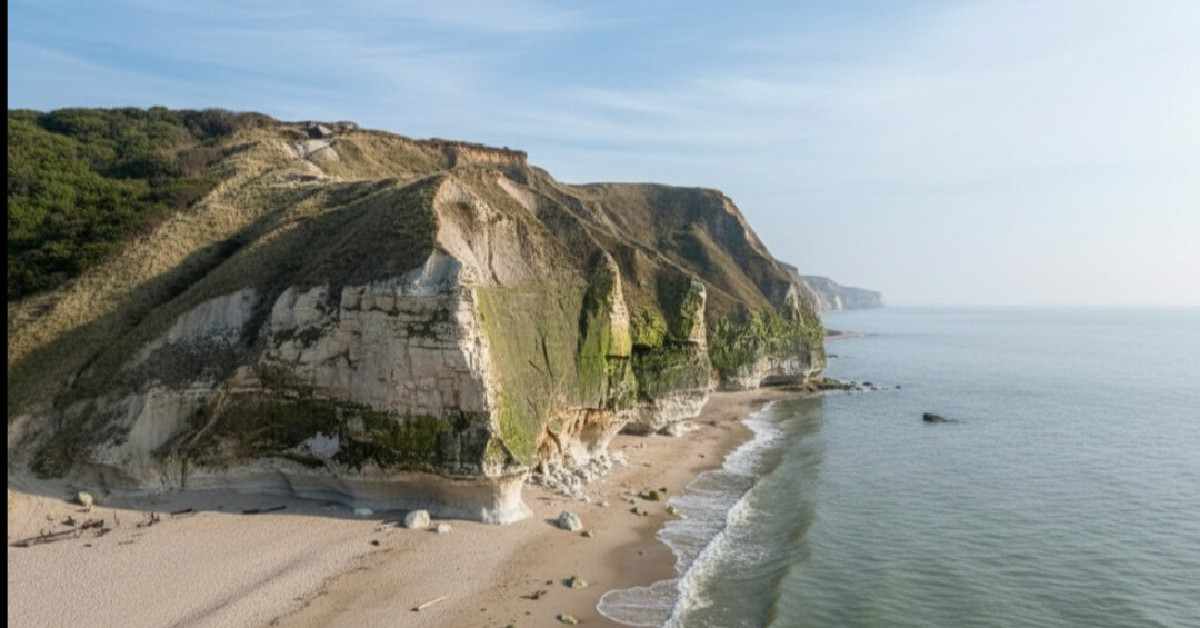
On the island of Møn, southeast of Copenhagen, you find Aborrebjerg at 142 meters. Right next to it lies Møns Klint, a stretch of 70 million year old chalk cliffs that plunge 128 meters straight into the Baltic Sea. This is the closest Denmark gets to feeling alpine.
The cliffs run about six kilometres along the coast. Walking the wooden staircases down to the beach is genuinely impressive. I have taken visiting friends here who left convinced Denmark “kind of” has mountains after all.
Rytterknægten and the Hidden Hills
On Bornholm, the Baltic island closer to Sweden than to Copenhagen, Rytterknægten reaches 162 meters. Bornholm is geologically older than the rest of Denmark, with granite bedrock that feels Nordic in a way Jutland never does. There is even a wooden lookout tower called Kongemindet on the summit.
Other notable hills include Svanninge Bakker on Funen, marketed locally as “the Funen Alps.” Denmark has roughly 170 hills over 100 meters tall. Calling any of them mountains stretches the word, but they make for excellent weekend walks.
Why Are There No Mountains in Denmark? Blame the Glaciers
Denmark’s flatness is not random. It is the direct result of repeated glaciations during the Quaternary period, the last 2.58 million years. Massive ice sheets advanced and retreated across the region, smoothing the terrain like a slow geological belt sander.
When the last ice retreated about 11,700 years ago, it left behind moraines, outwash plains, and tunnel valleys. The hills you see today are essentially piles of debris dropped by the ice. The Geopark Vestjylland documents how a clear glacial boundary still divides western Jutland’s flat plains from eastern Jutland’s hillier moraine landscape.
No Tectonics, No Peaks
Unlike Norway or the Alps, Denmark sits far from any active tectonic boundary. There has been no mountain building here for hundreds of millions of years. Whatever ancient relief once existed was ground down long before the ice ages began.
This is why neighbouring Norway has fjords and 2,000 meter peaks while Denmark has barley fields. The same ice carved both landscapes, but the underlying geology dictated very different results.
How Denmark’s Flat Landscape Shapes Daily Life
After years here, I can say with confidence that the lack of mountains defines Danish life in ways most expats only notice gradually. It touches everything from your morning commute to the national energy grid.
A Cycling Paradise by Default
There is a reason cycling in Copenhagen works so well. The terrain barely registers. The country has over 12,000 kilometres of dedicated bike paths, and on most of them you will not break a sweat.
I rode from Copenhagen to Helsingør last summer, a 45 kilometre trip, and the steepest hill was a highway overpass. Per Denmark Bike Tours, this gentle relief is precisely what makes the country one of the world’s top cycling destinations.
Wind Energy Without Obstacles
With no mountains to block the Atlantic winds, Denmark has become a global leader in wind power. Wind turbines now generate more than half of the country’s electricity in many recent years. The flat coastlines and shallow North Sea make offshore wind farms relatively easy to build.
Walk along the Jutland west coast and you will see turbines stretching to the horizon. It is not picturesque in a traditional sense, but it is functional and quietly impressive.
Climate Without Rain Shadows
Without mountains to disrupt weather systems, Denmark has a remarkably even temperate maritime climate. Rain falls steadily across the country, with no dramatic wet or dry sides. Summers stay cool, winters stay mild, and the wind never stops.
This evenness has a downside. The flatness also makes Denmark vulnerable to storm surges and rising seas. Coastal defences and dyke systems are a permanent line in the national budget.
Yes, Denmark Has Ski Resorts
This always surprises newcomers. Denmark has a handful of small ski areas with about 6.3 kilometres of slopes and 18 lifts in total, according to Skiresort.info. They are tiny by international standards, but they exist.
The most famous is CopenHill in Copenhagen, an artificial ski slope built on the roof of a waste-to-energy plant. It is the most Danish solution imaginable: no mountains, so we built one out of recycled garbage and called it architecture.
How the Flat Land Shaped Danish History
Denmark’s geography did more than dictate where you can ski. It shaped a millennium of political, agricultural, and economic decisions that still define the country today.
Vikings and the Sea
With no mountain barriers and over 7,300 kilometres of coastline, the Vikings had every reason to look outward. From the 8th to the 11th century, they used the sea as their highway, raiding, trading, and settling from Jutland to Newfoundland. The flat coast made shipbuilding easy and beach landings easier.
No part of Denmark sits more than about 50 kilometres from the sea. That fact has shaped Danish identity for over a thousand years.
Agriculture as National Strategy
Roughly 60 percent of Denmark’s land is farmed, one of the highest ratios in Europe. The fertile glacial soils, combined with mild weather and no rocky highlands, made the country an agricultural powerhouse. Pigs outnumber humans by nearly two to one.
This is why Danish bacon, butter, and cheese became global exports. The land had no gold or coal, so Danes optimised what they had: dirt and grass.
Cities, Trade, and Connectivity
Flat land made bridges, roads, and railways straightforward to build. The Great Belt Bridge and the Øresund Bridge connect the country’s islands seamlessly. Copenhagen grew into a Baltic trade hub partly because there was nothing standing in the way.
Where to See Denmark’s Best “Mountain” Landscapes
For expats who miss real elevation, Denmark offers a few honest substitutes. None will challenge a hiker who has tackled the Alps, but they provide a needed change of pace.
Søhøjlandet: The Lake District
The Søhøjlandet around Silkeborg is Denmark’s most concentrated hill country. Explore nature here and you find forested ridges, deep lakes, and the cluster of high points that includes Himmelbjerget and Yding Skovhøj. The official tourism board calls it Denmark’s only true mountain landscape.
Trail networks weave through the area. You can hike or paddle for days without crossing a major road.
Møns Klint and Bornholm
For dramatic verticality, head to Møns Klint or Bornholm. Both deliver real cliffs, real views, and real geological history. Bornholm in particular feels like a piece of Sweden that drifted south.
Rebild and Northern Jutland
Up north, Rebild National Park and the moraine plateaus of Rold Skov offer Denmark’s largest forest and surprisingly varied terrain. Hanstholm on the northwest coast adds wild dunes and bunker ruins to the mix.
FAQs About Mountains in Denmark
Are there any real mountains in Denmark?
No, there are no mountains in Denmark by the standard global definition. The highest natural point, Møllehøj, reaches only 170.86 meters. Most geographers classify everything in Denmark as hills, not mountains.
What is the highest point in Denmark?
Møllehøj in East Jutland is the highest natural point at 170.86 meters above sea level. Skamlingsbanken is the highest point in Southern Jutland. The highest point in the whole Kingdom is Gunnbjørn Fjeld in Greenland at about 3,700 meters.
Why does Denmark have no mountains?
Denmark sits far from any active tectonic plate boundary, so no mountain building has occurred here in hundreds of millions of years. Repeated glaciations during the Ice Age also flattened the existing terrain. What remains are moraine hills left by melting glaciers.
What is Himmelbjerget and is it really a mountain?
Himmelbjerget, meaning “Sky Mountain,” is a 147 meter hill near Silkeborg. It is not a mountain by international standards. Danes call it one anyway, partly out of affection and partly out of irony.
Can you go skiing in Denmark?
Yes, but barely. Denmark has small ski areas totalling about 6.3 kilometres of slopes. The most unusual option is CopenHill in Copenhagen, an artificial slope on top of a power plant.
How does the lack of mountains affect Danish life?
The flat terrain enables Denmark’s world-leading cycling culture, supports massive wind energy production, and makes the country highly vulnerable to rising seas. It also drives a thriving agricultural sector that uses 60 percent of the land. Read more popular facts about Denmark here.
Are there mountains in Greenland, which belongs to Denmark?
Yes. Greenland is part of the Kingdom of Denmark and contains serious alpine terrain. Gunnbjørn Fjeld at around 3,700 meters is the highest peak north of the Arctic Circle.
Final Thoughts From an Expat
After years here, I have made peace with Denmark’s flatness. You do not come to this country for vertical drama. You come for the sea, the cycling, the long summer evenings, and the strange charm of climbing a hill called Sky Mountain that takes twenty minutes to summit.
The question “are there mountains in Denmark” has a clear factual answer: no. But the more interesting question is what Denmark built instead. Wind farms, bike paths, dairy empires, and a quiet pride in a 170 meter cornfield. That, to me, is more Danish than any mountain could ever be.