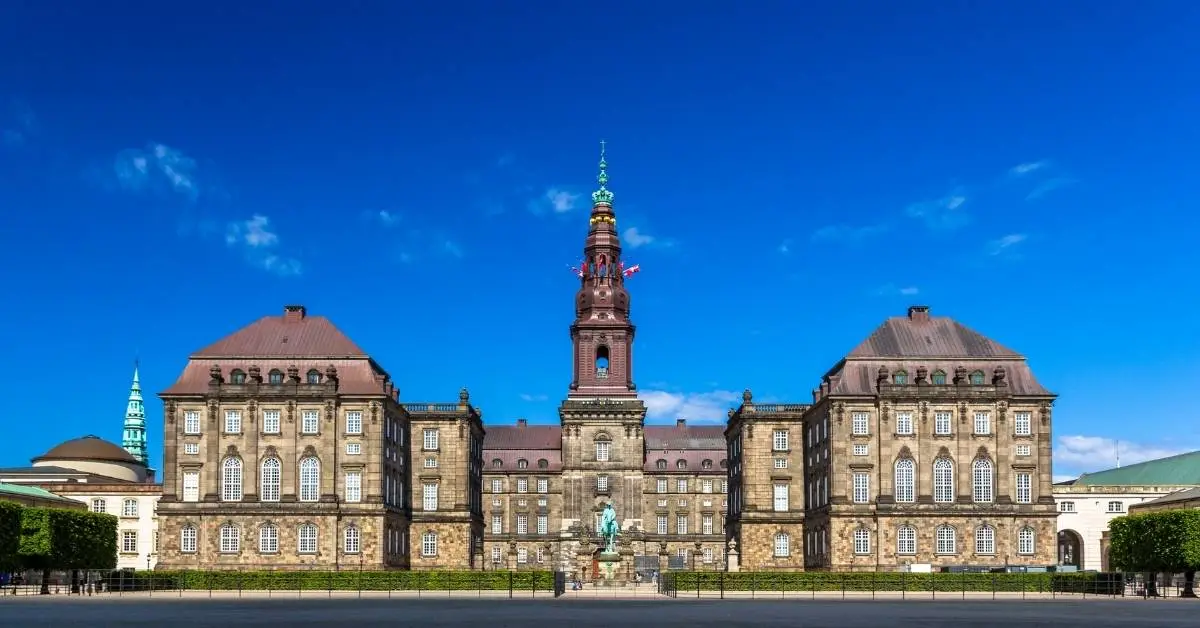
A Danish party leader with a seat on Parliament’s European Affairs Committee has appeared in a campaign video for a fringe Montenegrin politician who advocates leaving NATO and halting EU membership, filmed inside Christiansborg this week.
Morten Messerschmidt, leader of Dansk Folkeparti, personally guided Vladislav Dajković through the Folketing on Monday and told him to “go win” on camera. Dajković posted the Instagram clip on Tuesday, framing it as an endorsement for his anti-Western platform. Within 24 hours the video drew tens of thousands of views, far exceeding the reach of his actual voter base back home.
The choice of guest is remarkable. Montenegro’s official parliamentary records show that Dajković’s party, Slobodna Crna Gora, won just 0.86 percent of the national vote in the June 2024 election and secured zero seats. He describes his party as Montenegro’s “only pro-Russian and anti-NATO” political force. In August 2025 he greeted Russian foreign ministry spokesperson Maria Zakharova with the words “Glory to Russia,” and in December 2023 he declared that freedom is not found in the West but “where the sun rises, in Russia.”
The NATO angle
Montenegro joined NATO in 2017 as the alliance’s 29th member state. Dajković campaigns openly to reverse that decision and to stop his country’s EU accession process. For a Danish politician to offer what looks like encouragement to such a candidate, inside the building that houses Christiansborg itself, has triggered sharp criticism across party lines this week.
Denmark has committed roughly 20 to 25 billion kroner in military, financial, and humanitarian aid to Ukraine since 2022, according to successive government packages. That works out to about 1,000 kroner per resident per year, or roughly 80 to 85 kroner per month for each person living in Denmark, internationals included. The current defence agreement aims to lift Denmark’s military spending to 2 percent of GDP by 2030, up from about 1.4 percent in 2021. For a median household with disposable income around 420,000 kroner a year in 2023, the most recent year with published figures, the planned increase corresponds to roughly 4,000 to 5,000 kroner per household per year redirected toward defence.
Campaign material inside Parliament
Unlike past controversies about Messerschmidt’s Russia-related statements, this incident involves physical access to the Folketing being used as a campaign backdrop. House guidelines emphasise that official premises should not be exploited for partisan material without consent, though enforcement relies on norms rather than formal sanctions. Other Danish politicians now argue that appearing in Dajković’s video amounts to “participating in a campaign against NATO” rather than neutral dialogue.
The symbolism matters. Denmark’s broad parliamentary majorities regard Russian aggression as the main security threat and NATO cohesion as vital to European defence. Denmark’s role in planning support for Ukraine, training Ukrainian soldiers, and supplying F-16 fighter jets reflects that consensus. A fringe pro-Russian politician using a Danish party leader and the Folketing as visual legitimisation is seen by critics as aiding influence operations aimed at weakening alliance unity, especially in the Balkans where NATO’s newer members face disinformation and political pressure.
The expat dimension
Dajković framed his Copenhagen visit as outreach to Serbs living in Denmark. Statistics Denmark figures from 1 January 2025 show about 915,000 residents were immigrants or descendants of immigrants, roughly 15 to 16 percent of the population. Of these, approximately 30,000 to 35,000 came from Balkan countries including former Yugoslav states, though Montenegrin citizens are not published as a separate category. For internationals in Denmark, particularly those from other NATO or EU states, the episode raises questions about whether all Danish parties fully align with the country’s collective defence commitments.
Messerschmidt’s defence
Messerschmidt has previously called Putin’s regime a “rædselsregime” and distanced himself personally from Russian actions, which provides him with a record to claim consistency in opposing aggression. Supporters argue that meeting foreign politicians, even controversial ones, is part of legitimate political dialogue and does not imply blanket endorsement. They add that Denmark’s democratic tradition encourages open debate and that restricting whom party leaders can meet would set a worrying precedent.
Critics counter that this was not a closed-door meeting but a public campaign video explicitly promoting a pro-Russian platform in a NATO member state. The audience for such content has grown since the pandemic. Nordic research on social media and isolation shows that online transnational political communities have become more important since COVID-19 lockdowns, and a recent Danish longitudinal study found that social media addiction is associated with higher risks of loneliness and social isolation in Denmark. That digital landscape helps explain how an obscure Montenegrin politician can quickly gain visibility through viral clips featuring Western politicians and prestigious locations.
What internationals can do
For residents concerned by this controversy, foreign and security policy in Denmark is made through the Folketing’s Foreign Affairs Committee and cross-party defence agreements, not fringe campaign videos. The government publishes foreign policy and defence strategies in English summaries. Concerned internationals can contact MPs directly, join parties with clearer pro-NATO and pro-Ukraine platforms, or engage through civil society organisations working on democracy and disinformation in the Balkans and Eastern Europe.
Montenegro remains a NATO member and EU candidate regardless of Dajković’s rhetoric. Official information is available from NATO’s public diplomacy materials and EU accession progress reports. Those worried about Russian influence can follow guidance from the Danish Centre for Cyber Security, which regularly warns about foreign operations and advises on critical media literacy.