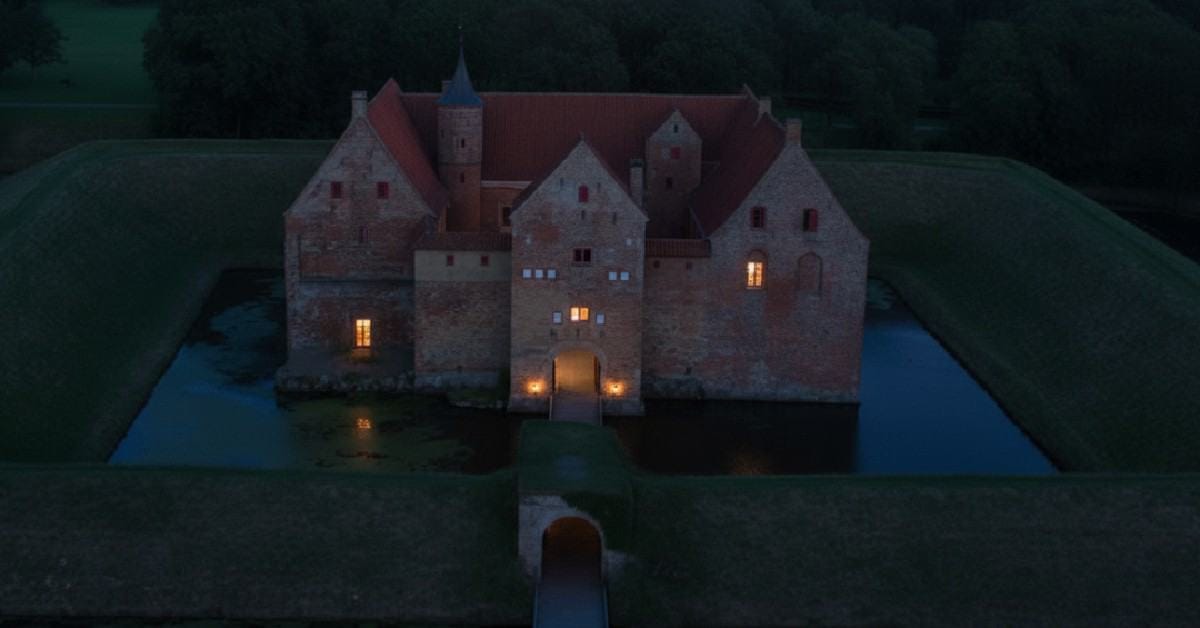
A home-made medieval castle in suburban Aalborg has hit the market at 2.5 million kroner, at a noticeable discount to recent detached-house sales in Gistrup, exposing how Denmark’s mortgage and planning systems penalise even locally beloved oddities.
Casa Del Renaissance sits behind a high stone wall on a quiet street in Gistrup, complete with towers and a moat-style feature. Owner Peter Hvid spent 21 years turning a catalogue parcelhus into a knight’s fortress, hosting Halloween events for neighbourhood children and drawing hundreds of curious visitors. He now plans to move closer to central Aalborg, and the castle faces the market’s blunt calculus.
The 2.5 million kroner asking price may sound steep for suburban north Jutland. According to sales data from the Danish Sales and Assessment Register, the median transaction price for detached houses in Aalborg municipality reached 3.4 million kroner in recent quarters. The castle’s asking price sits noticeably below that benchmark, a gap estate agents attribute to the property’s singular character.

When fantasy meets the realkredit algorithm
Denmark’s mortgage banks largely use automated valuation models as a starting point, calibrated on thousands of standard detached homes. Thick stone walls, medieval turrets and a moat do not appear in the training data. The result is caution. According to Finanstilsynet guidance on mortgage valuation, lenders treat extreme personalisation as resale risk, often requiring higher down payments or lower loan-to-value ratios. In practice, that means fewer buyers can borrow enough to close the deal.
The property’s 2022 energy label underscores the trade-off. According to the Energistyrelsen energimærke report for the property, Casa Del Renaissance carries above-average energy consumption compared with standard homes of similar size in the area. Medieval aesthetics and reduced insulation carry a measurable running-cost penalty that will show up in every prospective buyer’s utility calculation.
No legal protection for suburban landmarks
Peter Hvid obtained building permits for each addition, from the first boundary wall in 2005 through successive towers and gangways over the next decade. According to Aalborg Kommune’s building case archive, the castle structures were approved as alterations to an existing detached house within local-plan height limits. Yet none of those permits create any obligation on a future owner to keep the castle standing.
Denmark’s heritage system focuses overwhelmingly on older urban buildings and manor estates. Single-family homes in post-war suburbs are almost never granted listed status. According to Statistics Denmark’s BOL101 data, detached and semi-detached owner-occupied houses dominate Gistrup, the classic parcelhus belt that anchors Danish suburbia. But cultural-value legal tools stop at the city limits.

Aalborg has not adopted a conservation local plan for the neighbourhood. That means a buyer who wants a blank slate can apply to demolish the castle, rebuild a standard villa and face no regulatory obstacle beyond normal safety and footprint rules. Peter himself acknowledges this openly. The next owner could erase two decades of work in a matter of weeks.
What the listing does not say
The estate agent’s mandatory national listing registration includes property ID, official living area and energy class. There is no field for moat or watchtower. The language of Denmark’s housing backbone is designed for uniformity, not unicorns. Automated systems treat Casa Del Renaissance as a detached house with above-average energy consumption and note its distance from Aalborg centre.

According to Eurostat housing statistics, Denmark has one of the highest shares of households living in detached or semi-detached houses in the EU, making the suburban owner-occupier model central to the national housing story. Yet that same system’s reliance on standardised valuation and tight planning norms makes it inhospitable to dramatic individual statements.
The discount tells the story
Detached-house prices nationally have climbed substantially over the last five years, according to Statistics Denmark’s BOL103 data. Highly personalised homes occupy a statistical shadow zone. Transaction data is sparse because each is unique and many change hands privately to avoid public scrutiny. Estate agents disagree among themselves whether architect-designed villas command premiums or suffer discounts. Systematic evidence does not exist.
What is clear from Gistrup is that the market is pricing caution into this sale. The gap between Casa Del Renaissance and comparable standard houses nearby is not enormous. But it is real and it is measurable. Banks see higher risk. Buyers see fewer financing options. Neighbours see a beloved local landmark with no guarantee of survival.

Lessons for internationals considering their own projects
According to Statistics Denmark tables FOLK1A and BOL101, foreign-born residents in Aalborg municipality are markedly less likely than Danish-born residents to live in detached houses, clustering instead in city-centre flats rather than suburban parcelhuse. Those who do venture into owner-occupied suburbia and contemplate major conversions face the same dynamic Peter Hvid now encounters at sale time.
The practical advice is straightforward. Request the full building-case file from the municipality before making an offer. Speak to a mortgage lender’s valuation team early to understand how unusual features will affect borrowing capacity. If planning a conversion, book a pre-application meeting with municipal planners. Aalborg and several larger Danish municipalities offer English-language planning guidance. Commission an updated energy label after major work to avoid surprises at resale.

And recognise that in Denmark, unlike parts of Germany or the Netherlands where local design codes give planners aesthetic veto power, suburban fantasy homes exist at the pleasure of social norms and market tolerance. Legal protection requires political will to adopt a conservation local plan, a process that has succeeded in a handful of post-war villa neighbourhoods in Gentofte and Aarhus, according to Slots-og Kulturstyrelsen, but remains rare. For now, Casa Del Renaissance stands as both a monument to one man’s vision and a quiet lesson in the limits of individualism within Denmark’s carefully standardised housing regime.