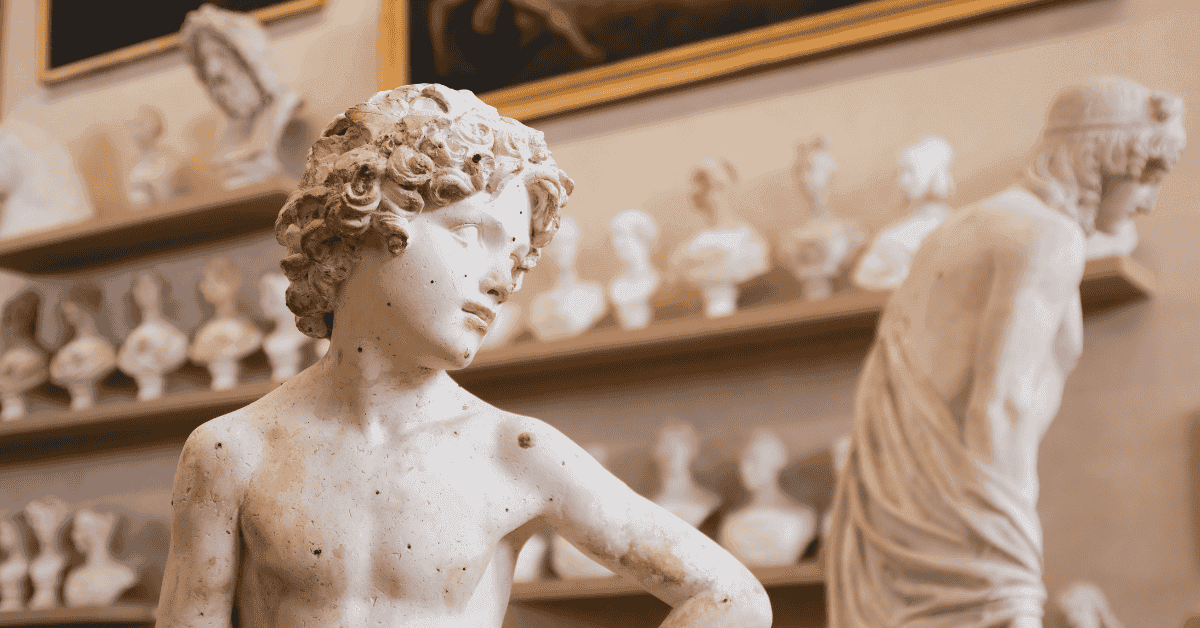
Bertel Thorvaldsen didn’t invent neoclassicism, but he gave it a face. Or rather, he carved it in marble—stoic, idealized, and unmistakably monumental. Born in Copenhagen in 1770, this Danish sculptor rose from modest beginnings to become one of the most celebrated artists in 19th-century Europe.
His statues of Christ and the apostles, his mythological heroes, his marble reliefs—each was part of a broader ambition: to revive the ideals of classical antiquity without turning them into museum pieces. He spent most of his life in Rome, but Denmark claimed him in the end. A national icon, literally immortalized in his own museum next to Christiansborg Palace.
From the Workshop to the Academy
Albert Bertel Thorvaldsen was born on November 19, 1770, in Copenhagen. His father was a wood carver from Iceland who had settled in Denmark. His mother was Danish. That mix—Nordic roots, Danish upbringing—would later become part of the myth around him. But the facts are straightforward. He grew up poor and started helping his father with carving at a young age. He entered the Royal Danish Academy of Fine Arts at just eleven. That early start gave him two things: technical skill and a network. By 1793, he had already won the academy’s gold medal.
That medal came with a prize that changed everything: a travel stipend. In 1797, Thorvaldsen left Copenhagen and arrived in Rome. At the time, Rome wasn’t just a destination—it was a proving ground. If you wanted to be a serious sculptor, you went there. He arrived in March 1797 and stayed for most of the next forty years.
Success in Rome
Thorvaldsen didn’t find instant success in Italy. He studied, copied, and lived frugally. For years, he quietly developed his own take on neoclassical sculpture. While other artists were leaning into theatrical flourishes, Thorvaldsen focused on calm, clear lines and restrained gestures. He read the art historian Johann Joachim Winckelmann and absorbed his theories about noble simplicity and quiet grandeur.
His breakthrough came in 1803 with Jason with the Golden Fleece. That statue was Thorvaldsen’s first major commission, backed by British collector Thomas Hope. It launched his international reputation. It was also the moment he started being compared to sculptor Antonio Canova, the other giant of the neoclassical period. Thorvaldsen lacked Canova’s sensuality, but he had something else—clarity, proportion, and a hard-edged reverence for antiquity.
His studio in Rome became a hub. He received commissions from the Vatican, Napoleon’s relatives, and from monarchs and aristocrats across Europe. His specialty was marble, cast bronze, and relief. He produced a self-portrait, busts, and monumental series like the Alexander the Great’s Entry into Babylon, a 20-meter marble frieze that stitched myth and history together in painstaking detail.
The Return to Denmark
Thorvaldsen returned to Denmark in 1838, greeted like a conquering hero. He was 67 years old and had spent most of his life abroad. But Denmark wanted him back, and he gave them a final act worthy of his name.
One of his biggest local projects was a series of statues for Vor Frue Kirke—the Church of Our Lady in Copenhagen. The Christus statue and the Twelve Apostles remain some of the most visited works of art in the country. Quiet, almost minimalist, the Christus has been reproduced endlessly. Copies appear in churches across the world and even at Temple Square in Salt Lake City.
Thorvaldsen died in 1844. Four years later, the Thorvaldsen Museum was erected in his honor—right next to Christiansborg Palace. The museum in Copenhagen was the first in the world dedicated to a single artist. It holds not only his completed works, but also models for all his sculptures, a collection of works of art he owned, and even his tomb, set in the courtyard.
Conclusion About Albert Bertel Thorvaldsen
Thorvaldsen wasn’t tortured or tragic. He didn’t reinvent sculpture, but he gave it continuity. His work connected ancient ideals to modern Europe. He proved that even in an age obsessed with progress, there was power in restraint.
He was also deeply Danish. Not in a nationalistic way—he spent most of his life in Rome, after all—but in the way his work balances confidence and humility.
Today, you can see his influence in Copenhagen, in Rome, and even in New York’s Central Park, where a bronze copy of his Self-portrait stands on 97th Street near Fifth Avenue. He’d created the plaster model for the Self-portrait in June 1839.
Summary
- Humble origins: Born in Copenhagen in 1770, Thorvaldsen trained early and rose from poverty through raw talent and marble.
- Roman breakthrough: His 1803 sculpture Jason with the Golden Fleece launched his reputation across Europe and cemented his place in neoclassical art.
- Master of restraint: Unlike his contemporaries, Thorvaldsen emphasized proportion, calm, and clarity in his classical revival.
- National return: After decades abroad, he came home to sculpt the iconic Christus and apostles for Copenhagen’s Church of Our Lady.
- Lasting tribute: The Thorvaldsen Museum, which is also home to his art and tomb, was Europe’s first museum dedicated to a single artist.
Frequently Asked Questions
Who was Bertel Thorvaldsen and why is he significant?
Bertel Thorvaldsen was a Danish sculptor born in Copenhagen in 1770, renowned for shaping neoclassical sculpture with his monumental, idealized marble works, which revived classical ideas without turning them into museum pieces.
What were the main artistic influences and styles for Bertel Thorvaldsen?
Thorvaldsen was influenced by Johann Joachim Winckelmann’s theories of noble simplicity and quiet grandeur, focusing on calm, clear lines, restrained gestures, and a reverence for classical antiquity, in contrast to the more theatrical styles of his contemporaries.
What are some of Bertel Thorvaldsen ’s most famous works?
His notable works include statues of Christ and the apostles, the mythological Jason with the Golden Fleece, and the marble frieze Alexander the Great’s Entry into Babylon, as well as his self-portrait in bronze.
What is the significance of the Bertel Thorvaldsen Museum in Copenhagen?
The Thorvaldsen Museum, established in 1844, is the first museum in the world dedicated to a single artist, housing his sculptures, models, personal collection, and his tomb, celebrating his legacy.
How did Bertel Thorvaldsen influence art beyond Denmark?
Thorvaldsen’s classical style and emphasis on restraint influenced European sculpture, and his works are still seen worldwide, including in Rome, Copenhagen, and on New York’s Central Park.