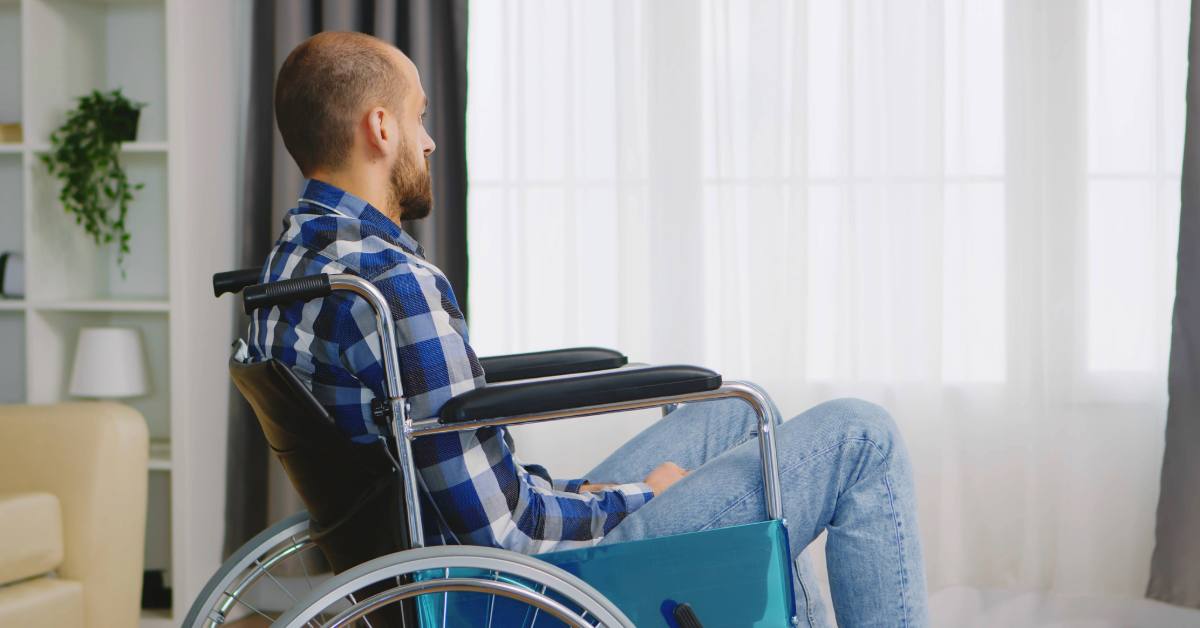
As a Danish man prepares to drive his chin‑controlled wheelchair 2,200 kilometers to Italy this week, new figures reveal that falls now cause more than half of all traumatic spinal cord injuries in Denmark — yet foreign residents who suffer such accidents effectively disappear from official statistics.
The journey, starting this week, traces back to a 1999 bathing bridge accident that left the driver tetraplegic. His story highlights a growing risk that hits internationals just as hard as Danes, but with far less visibility in the data.
In 2024, 2,066 people were living with a spinal cord injury in Denmark, according to the Danish Spinal Cord Injury Register. That is up from 1,945 in 2019, a 7.1 percent increase. But no Danish register tracks how many of those people are foreign nationals, despite the fact that 15.9 percent of Denmark’s population now has an immigrant background.

Falls overtake traffic as the leading cause
The shift in injury patterns is stark. Falls caused 56 percent of new traumatic spinal cord injuries in 2024, up from 48 percent in 2019. Traffic accidents dropped from 25 percent to 18 percent in the same period. That puts Denmark at the high end of fall‑related injuries compared with other EU countries, where traffic still accounts for 30 to 40 percent of cases.
There were 94 new traumatic spinal cord injury cases in Denmark in 2024, down from 112 in 2019. Sports and leisure accidents made up 12 percent, violence 6 percent, and other or unknown causes the remainder. Shallow‑water diving and bathing bridge incidents appear repeatedly in prevention campaigns, but there is no national programme targeting foreign residents specifically.
A system built for citizens
Anyone legally residing in Denmark with a CPR number can access free hospital care and specialised rehabilitation at centres like Rigshospitalet and Hammel Neurocenter. The problem is what happens after. Non‑EU nationals on work permits who lose their jobs after a catastrophic injury face a difficult choice: stay on benefits or return home mid‑rehabilitation. Higher income and self‑sufficiency requirements introduced in 2025 make permit renewal harder if you cannot return to work quickly.

The lifetime public cost of a high cervical spinal cord injury was estimated at 10 to 13 million kroner in a 2023 health economics analysis. That equals roughly 330,000 to 430,000 kroner per year per person, well above the average Danish gross monthly wage of 46,800 kroner. Yet Denmark’s registry captures injury level and cause, but not nationality or country of birth.
Data gaps leave expats invisible
The Danish Spinal Cord Injury Register includes all residents at the time of injury, irrespective of nationality. But because it does not record citizenship or origin, an expat engineer injured at a Copenhagen bathing bridge is statistically identical to a Danish‑born resident. If spinal cord injury prevalence mirrors population shares, roughly 320 to 330 of the 2,066 people with such injuries would be immigrants or their descendants. That is an inference, not an official figure.
Integration policy updates in 2025 and 2026 stress early employment and language learning for newcomers. They contain no dedicated provisions for expats who become long‑term disabled while in Denmark. According to a May 2025 report by the Danish Bar Association, the welfare state works reasonably well for those born in Denmark who become disabled. It is much more complicated if you moved here for work and your residence permit depends on that job.

Prevention advice rarely reaches internationals
Municipalities around Copenhagen and North Zealand tightened safety inspections on bathing jetties in 2023 through 2025 after several incidents. DMI and the Danish Coastal Authority have strengthened warnings about shallow water, unstable piers and storm damaged bridges in their 2025 and 2026 summer advisories. These notices are mainly in Danish and rarely target international residents.
For those already here, proper registration is the first line of protection. That means a valid residence permit or EU registration, a CPR number, and a yellow health card. After a serious injury, notify your employer immediately. Contact the Danish Labour Market Insurance if the accident was work related, to secure occupational injury compensation. Non‑work injuries may still be covered under private travel or accident insurance.
Where to turn for help
International Citizen Service centres in Copenhagen, Aarhus, Odense and Aalborg offer one stop guidance on registration, benefits, job activation and local support in English. The Danish Agency for International Recruitment and Integration provides English language guidance on how illness or disability can affect permits. LifeInDenmark.borger.dk explains healthcare, social benefits, and settlement rules for foreigners.
Sweden’s national register reported approximately 2,800 people living with spinal cord injuries in 2023, in a population 60 percent larger than Denmark’s. That suggests Denmark has a relatively high prevalence per capita. Yet Sweden makes it easier for non‑EU nationals who acquire disability in country to obtain long‑term residence permits, whereas Danish law relies more on general hardship clauses and discretionary assessments.

A journey that forces the question
The 2,200 kilometer wheelchair journey starting this week is a story of determination. But it also asks a harder question: who gets counted when life changes overnight? Denmark combines very strong post injury support with strict front end immigration controls. For the growing number of internationals who live and work here, that tension becomes visible only when something goes wrong. And by then, you are already navigating two systems at once, often without a map.