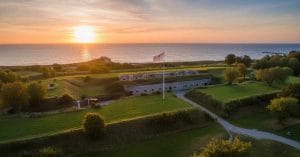
Valdemar’s Castle, Denmark’s largest private residence and only former royal palace still in private hands, has reopened on the island of Tåsinge as an unexpected destination for international contemporary art.
I first visited Valdemar’s Castle on a bicycle. The ride from Svendborg across the old bridge to Tåsinge is one of the loveliest in Denmark. You round a bend, the trees part, and suddenly there it is, all baroque symmetry and white walls against the water.
For expats living here, the castle is one of those places that locals mention casually, as if every country has a 17th-century royal palace tucked away on an island. It does not. Valdemar’s Castle is genuinely unusual, and after its recent transformation, it has become even more interesting.
The History Behind Valdemar’s Castle
The castle was commissioned by King Christian IV, the most building-obsessed monarch in Danish history. He reigned for 59 years, the longest of any Danish king. Almost every famous old building in Copenhagen has his fingerprints on it.
Construction ran from 1639 to 1644, designed by the Flemish-Danish architect Hans van Steenwinckel the Younger. The castle was intended for the king’s son, Count Valdemar Christian, born of the king’s morganatic marriage to Kirsten Munk. Valdemar Christian, however, never actually moved in.
A Castle Wrecked by War
The 17th century was rough on Denmark. The wars with Sweden, particularly the catastrophic invasions of the 1650s, left much of the country devastated. According to Bruun Rasmussen, the castle suffered extensive damage during this period.
Swedish troops occupied the building, looted it, and left it in ruins. For years afterwards, Valdemar’s Castle sat empty, a half-finished royal project nobody knew what to do with. Then came Niels Juel.
The Naval Hero Who Saved the Estate
Admiral Niels Juel is one of those names every Danish schoolchild learns. He commanded the Danish fleet at the Battle of Køge Bay in 1677 and demolished the Swedish navy. The crown rewarded him with prize money from the captured warships.
Juel used that money to buy Valdemar’s Castle in 1678. He then rebuilt it in the new baroque style fashionable across European courts. As reported by VisitDenmark, his renovation gave the castle the appearance visitors still see today, more than three centuries later.
Eleven Generations Under One Family Roof
What makes Valdemar’s Castle truly singular is its ownership story. The Juel family has held the property for roughly 350 years, across eleven generations. According to the official castle website, it remains the largest private home in Denmark.
It is also, remarkably, the only royal palace in the country still in private hands. Every other royal residence belongs to the state or the monarchy. This single fact tells you a great deal about Danish history and the strange durability of certain aristocratic families.
The Transition to a New Generation
Lensbaron Niels Krabbe Iuel-Brockdorff took over the estate from his father in 1971. He represented the tenth generation of Juel stewardship. He ran the castle as a museum and historical attraction for decades.
In 2022, ownership passed to Louise Eleonora Kathleen Iuel-Brockdorff Albinus, the eleventh generation. Per the castle’s own materials, she has steered the property in a dramatically new direction. The transition was not without controversy.
The Auction That Stripped the Walls
Bruun Rasmussen auction house held a major sale in 2022 called “The Sweep of History from Valdemar’s Castle.” Centuries-old family heirlooms, paintings, furniture, and decorative objects were sold off. For heritage enthusiasts, it was a painful moment.
The auction reflected a family dispute and a strategic decision to reimagine the castle’s future. The interiors that visitors see now are different from those that defined the estate for generations. Whether you see this as loss or renewal depends on your point of view.
Valdemar’s Castle Reborn as a Contemporary Art Venue
In May 2025, Valdemar’s Castle reopened to the public with an entirely new identity. It is now a venue for international contemporary art, with exhibitions running each summer from May to September. The transformation made headlines in Wallpaper Magazine, which is rare coverage for a Danish provincial estate.
I find this reinvention fascinating. Plenty of Danish manor houses are quietly fading, opened a few weeks a year for tourist photos. Valdemar’s Castle has chosen a different gamble entirely.
Baroque Meets Postmodern
The curatorial idea is to place contemporary art directly inside the castle’s historical rooms. Gilded baroque interiors become backdrops for sculptural, conceptual, and interdisciplinary works. The inaugural season featured pieces by artists including Jiří Georg Dokoupil, whose soap bubble paintings hung among original ancestral portraits.
The friction between centuries is the entire point. As noted by Wallpaper, the dialogue between gilded surroundings and contemporary works gives both registers new meaning. It also gives Danes and expats a reason to actually engage with the place, rather than treat it as a museum diorama.
Season Two and What Comes Next
Season Two opened on Saturday, 23 May 2026, with a weekend of live events. The castle is open daily through mid-September. Programming includes exhibitions, performances, and curated visits across the estate.
For expats who arrived recently, this is a chance to experience one of Denmark’s rare living cultural reinventions. You are not just visiting a historical site, you are walking through an active artistic experiment.
Visiting Valdemar’s Castle: Practical Information
The castle sits at Slotsalléen 100, 5700 Svendborg, on the island of Tåsinge. Getting there is half the pleasure. From Svendborg, the town on Funen across the strait, you can cycle, drive, or take a bus.
If you are coming from Copenhagen, the train to Svendborg takes about two and a half hours. From there, it is a short hop to Tåsinge. The island itself is small, but it rewards a full day of exploration.
Opening Hours and Tickets
The castle is open daily during exhibition season, roughly late May through mid-September. According to the official site, tickets cost 90 DKK for adults, 45 DKK for children aged 4 to 12, and entry is free for children under 4. Book online to avoid queues during summer peak.
The castle is closed outside the May to September window. Plan accordingly, because turning up in November is one of those expat mistakes you only make once. There are no winter ghost tours here.
What to See on the Grounds
The estate covers extensive parkland with ponds, woods, and grazing deer. Birdlife is abundant, and the gardens are well kept rather than formal. Bring a packed lunch or eat at the on-site café.
The Slotskirke, the castle church, sits beside the main building. It is still in active use for services and weddings. Walking the grounds takes about an hour at a relaxed pace.
Why Valdemar’s Castle Matters to Expats in Denmark
You can read all the Danish history books you like, but understanding this country requires standing inside its buildings. Valdemar’s Castle compresses 400 years of Danish power, war, family wealth, and cultural reinvention into one address. You absorb more from a single afternoon there than from weeks of reading.
The castle also tells a quieter story about how Denmark handles aristocracy. Most countries have either abolished their noble class or fossilised it. Denmark has done something stranger, allowing old families to run their estates as ongoing private enterprises.
A Different Kind of Heritage Site
Most expat castle visits in Denmark involve Hvidkilde Castle, Kronborg in Helsingør, or Frederiksborg in Hillerød. Those are state-run and curated for mass tourism. Valdemar’s Castle feels different because it is.
The pace is slower, the crowds smaller, the art programme more risky. If you want to escape the Copenhagen tourist circuit, this is the move. Pair it with a visit to Hvedholm Castle or the nearby island of Langeland.
The Funen Connection
Funen is sometimes called Denmark’s garden island. According to Travel Pulse, the region contains more than 120 castles and manor houses. Valdemar’s Castle is among the most significant of them.
If you are based in Copenhagen and looking for a weekend trip, this part of Denmark is criminally underused by expats. Pair the castle with the Funen Art Museum in Odense for a complete art-and-history weekend.
Frequently Asked Questions About Valdemar’s Castle
When was Valdemar’s Castle built and by whom?
Valdemar’s Castle was built between 1639 and 1644 by King Christian IV. It was commissioned for his son, Count Valdemar Christian, from whom the castle takes its name. The architect was Hans van Steenwinckel the Younger.
Who owns Valdemar’s Castle today?
The current owner is Louise Eleonora Kathleen Iuel-Brockdorff Albinus, the eleventh generation of the Juel family. The family has held the castle for around 350 years. It is the only former royal palace in Denmark still in private hands.
When can you visit Valdemar’s Castle?
The castle is open daily from late May through mid-September each year. Season Two of its art programme opened on 23 May 2026. The site is closed entirely outside this summer window.
How much does it cost to visit Valdemar’s Castle?
Adult tickets cost 90 DKK. Children aged 4 to 12 pay 45 DKK, and entry is free for children under 4. Tickets can be booked online through the official Valdemar’s Castle website.
What is special about Valdemar’s Castle now?
Since 2025, the castle hosts international contemporary art exhibitions inside its baroque interiors. It is the only Danish royal palace in private ownership. The combination of historical setting and contemporary curation makes it genuinely unusual in Europe.
How do I get to Valdemar’s Castle from Copenhagen?
Take the train from Copenhagen to Svendborg, which takes around two and a half hours. From Svendborg, drive or cycle across the bridge to Tåsinge. The castle is signposted from the main road.
Is Valdemar’s Castle worth visiting for expats?
Yes, particularly if you want to escape the standard tourist circuit. The castle offers a deeper, slower experience than larger state-run sites. It also rewards visitors interested in contemporary art and Danish aristocratic history.