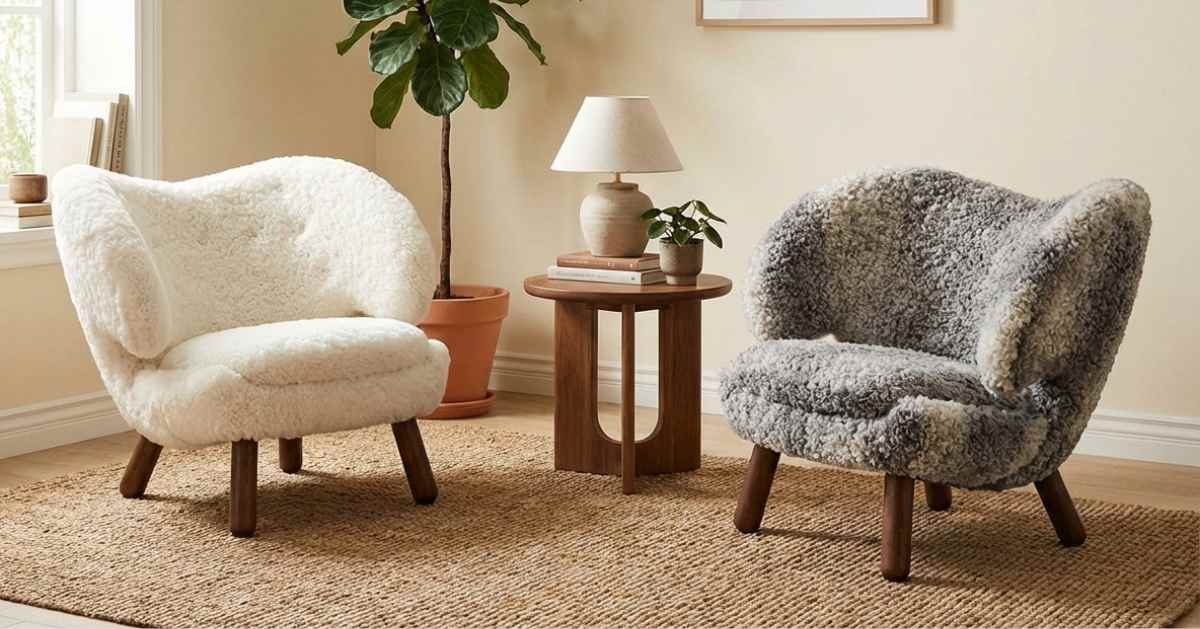
The Pelican Chair by Finn Juhl is a sculptural masterpiece of Danish design, created in 1940 as a bold departure from strict modernism. With its organic, wing-like form and enveloping comfort, the chair blurs the line between furniture and art.
Key Points
- The Pelican Chair: An Icon of Danish Design: Designed by Finn Juhl in 1940, this sculptural chair exemplifies Danish design by merging functionality with artistic organic forms.
- Finn Juhl: Pioneering Danish Modernist: A Danish architect and designer, Finn Juhl greatly influenced 20th-century furniture with his sculptural approach and emphasis on emotional expression in design.
- The Unique Design and Materials of the Pelican Chair: Crafted with a solid hardwood frame and upholstered in fabric or leather, this chair’s biomorphic shape resembles a pelican with wings, emphasizing organic elegance.
- Versatile and Timeless Aesthetic Appeal: The Pelican Chair suits various interior styles, from Scandinavian minimalism to maximalist spaces, serving as both a sculptural statement and daily comfort.
- Investment in Heritage and Sustainability: Owning a Pelican Chair connects to Danish craftsmanship, durable materials, and sustainable, artisanal production, making it both an art piece and a valuable heirloom.
Where Art Meets Comfort: A Danish Design Icon
Few pieces in the pantheon of 20th-century furniture design evoke such instant recognition and admiration as the **Pelican Chair**, conceived in 1940 by the visionary Danish designer **Finn Juhl**. With its sculptural form, sink-in comfort, and whimsical character, the chair is a stellar example of **Danish design**—where functionality merges seamlessly with artistry. It’s not just a piece of furniture; it’s an invitation to experience design that moves both the body and the soul.
An outlier at the time of its debut, the Pelican Chair stood in sharp contrast to the minimal, functionalist aesthetics of its contemporary modernist peers. Its organic form, deeply rooted in abstraction and inspired in part by surrealism and the human body, marked a fearless departure from the rigid design norms of the day. For **Finn Juhl**, design was not simply about adhering to structure—it was an emotional process, one deeply tied to human expression, comfort, and creativity.
Who Was Finn Juhl?
Born in 1912 in Frederiksberg, Denmark, Finn Juhl was a man ahead of his time. Originally trained as an architect, he brought an artistic sensibility to furniture design that made him one of the most influential figures in **20th-century Danish design**. Revered for his sculptural approach and highly detailed craftsmanship, Juhl helped introduce organic forms into Danish furniture, establishing a language of emotional connection through design. His emphasis on the philosophy that furniture should have “a life of its own” earned his works iconic status.
During his illustrious career, Finn Juhl received numerous accolades, including representing Denmark at the Milan Triennale in 1951 and later designing the interior of the United Nations Trusteeship Council Chamber in New York in 1952. Despite being underappreciated in his early career, Juhl’s works now fetch premium prices at auction and remain in high demand across the globe.

The Pelican Chair: A Vision of Organic Elegance
When **Finn Juhl** introduced the **Pelican Chair** at the Copenhagen Cabinetmakers’ Guild Exhibition in 1940, the reaction was polarizing. Its rounded, eccentric shape—seemingly hunched yet welcoming—was so advanced and unconventional that critics initially did not appreciate it. However, what once seemed abstract has now become cherished as groundbreaking.
The design is curvaceous and exaggerated, embodying a kind of biomorphic playfulness that resembles a **pelican with open wings**, hence its name. The broad armrests sweep outward like wings, providing enveloping comfort, while the seat cradles the user in a soft embrace. The chair isn’t angular or mechanical; rather, it reflects the human body’s organic rhythm in a distinctly poetic way.
Materials That Define Luxe Comfort
The construction of the Pelican Chair is a fine representation of what makes **Danish design** so enduring: attention to detail, quality of materials, and long-lasting craftsmanship. The modern Pelican Chair is typically handcrafted using a **solid hardwood frame**—often beech or oak—wrapped in multi-layered foam and finally upholstered in rich **fabric or leather**. The legs, slightly angled and short, are usually in wood finishes or customizable in painted variations.
Originally, only a **limited number of Pelican Chairs were produced**—believed to be fewer than 10 during Juhl’s lifetime—making it an ultra-rare collectible. Today, the chair is faithfully reproduced by **House of Finn Juhl**, the official licensee for Juhl designs, ensuring each piece meets the original exacting standards and stays true to the designer’s vision.
A Sculptural Statement in Any Interior
While undeniably grounded in the ethos of **1940s Denmark**, the Pelican Chair remains extraordinarily elegant in contemporary interiors. Its visual softness and minimal yet plush profile make it ideal for a variety of design styles—from bold maximalism to monochrome Scandinavian minimalism. The chair’s exaggerated lines bring a surprising sense of movement and life to any room, establishing it not only as a seating option but as a **sculptural centerpiece**.

A Testament to Iconic Danish Design
The Pelican Chair is more than just a piece of functional art; it represents a turning point in the evolution of **Danish furniture design**. It exemplifies the Danish commitment to **ergonomic function, emotional resonance, and meticulous detailing**, an ideal that propelled Denmark to the top of the international design scene in the mid-20th century.
Today, over **80 years** since its original unveiling, the Pelican Chair endures as one of the most iconic and celebrated pieces in Danish modernism. It has been featured in countless design exhibitions and high-end interiors across the globe. In 2011, a vintage Pelican Chair from the early 1940s fetched **over €200,000 at auction**, underscoring its value as a coveted collectible and eternal symbol of creative bravery.
In the next section, we’ll explore why the Pelican Chair is worth investing in for both design lovers and collectors, and where you can purchase an authentic reproduction online.
A Timeless Investment in Danish Design Heritage
Owning the **Pelican Chair** by **Finn Juhl** is like acquiring a piece of Danish design history. This is not merely another stylish seat; it’s a design object that bridges the gap between past and present, between sculpture and function. Its playful aesthetic cloaks a legacy of meticulous craftsmanship and cultural significance that speaks volumes in an interior space.
In the realm of fine furniture, the Pelican Chair offers something very few pieces can: the ability to age gracefully, both in terms of physical durability and enduring style. These chairs are made using the highest quality materials and constructed with artisan techniques that follow traditional Danish methods. The result is a chair that not only looks beautiful but will last for decades—making it an ideal heirloom piece. According to the official House of Finn Juhl, each chair takes approximately 30 hours of workmanship, underscoring its artisanal quality.
Perfect Harmony with the Danish Way of Living
The charm of the Pelican Chair extends beyond its aesthetics. It slots perfectly into the broader context of **Danish home interior culture**, which values simplicity, comfort, warmth, and a strong connection to the natural world. Danish homes often prioritize natural light, soft materials, and organic shapes—characteristics that the Pelican Chair complements seamlessly.
Whether placed in a cozy reading nook, an open-plan living area, or a tasteful office, the Pelican Chair embodies the relaxed sophistication of the **Danish lifestyle**. With its low profile and enveloping structure, it invites the sitter to lean back, curl up, and revel in a moment of quiet. This kind of emotional utility—where beauty and function exist in tandem—is central to the **Danish design ethos**.
Furthermore, its unique form adds a moment of surprise and playfulness—qualities not often found in minimalistic Scandinavian interiors but fully embraced by modern Danish tastes. The Pelican Chair adds warmth, depth, and a sense of personal character to a room without overwhelming it.

Collectors’ Piece or Daily Luxury—It’s Both
The Pelican Chair gracefully straddles two worlds: that of the serious design collector and that of the contemporary homeowner with a deep appreciation for craft. For collectors, the chair represents a rare and faithful reproduction of one of **Finn Juhl’s** most abstract and innovative works. For homeowners, it functions as a fully usable piece of furniture that brings daily joy through comfort and design intelligence.
This versatility increases the Pelican Chair’s appeal. Think of it as future-proof design. As trends shift and evolve over the years, the Pelican Chair retains its relevance, much like a timeless art piece. In fact, according to a report by Christie’s Auction House, **mid-century Danish design has appreciated in value by approximately 20% over the last decade**, further proving that investing in iconic pieces like the Pelican Chair is both emotionally and financially rewarding.
A Touch of Individuality in a Mass-Produced World
In an era saturated with mass-produced furniture, choosing the Pelican Chair is a declaration of individuality. Each chair is handcrafted, customized, and made to order, meaning no two are entirely alike. This aligns with Danish values of mindful consumption—buying fewer, better things that last a lifetime. It’s a philosophy of quality over quantity, something that resonates deeply with those who crave authenticity in their spaces.
Moreover, choosing Danish design promotes sustainable practices. The materials used in Pelican Chairs are responsibly sourced, and production is handled by master craftsmen in **Denmark** who have inherited age-old traditions, ensuring low carbon footprints and high social responsibility.
In the following conclusion, we will sum up why the Pelican Chair remains one of the crown jewels of Danish design and answer some of the most frequently asked questions about acquiring and owning this beloved furniture icon.
Conclusion: The Timeless Appeal of the Whimsical Pelican Chair by Finn Juhl
Finn Juhl’s Pelican Chair is a tour de force in the world of **Danish design**, a masterful blend of art and functionality that has transcended generations. Its unique, organic shape and meticulously crafted materials make it more than a mere seating option—it’s a sculptural masterpiece that brings old-world craftsmanship to today’s interior spaces. This chair is a celebration of **Denmark’s** dedication to design that prioritizes both emotional and aesthetic harmony, a commitment to timeless beauty and sustainable practices in a rapidly changing world.
Summary
– The Pelican Chair, designed by **Finn Juhl** in 1940, stands out as an iconic example of 20th-century **Danish design**.
– With less than 10 original units made during Juhl’s lifetime, contemporary reproductions by House of Finn Juhl maintain high artisanal quality, taking approximately 30 hours to craft each piece.
– Perfectly embodying the warm and inviting qualities of Danish home interiors, the chair harmoniously integrates with a wide range of interior styles.
– It serves both as a collector’s item and a practical, daily luxury that ages beautifully, with a design that retains its appeal through time.
– Available through trusted licensors, including House of Finn Juhl, Danish Design Store, and Scandinavian Design Center, the Pelican Chair is easy to buy online.
FAQ
1. What inspired Finn Juhl to design the Pelican Chair?
Finn Juhl was inspired by surrealism and organic forms, particularly those found in the human body. This led him to create a chair that abandoned traditional design norms in favor of a more sculptural and expressive form akin to art rather than mere furniture.
2. Why is the Pelican Chair considered a classic of Danish design?
The Pelican Chair is considered a classic because it represents a bold departure from the restrained modernism of the 1940s, merging art with functional design in a way that deeply resonates with the core principles of Danish design: quality craftsmanship, functional beauty, and innovation.
3. How is the Pelican Chair constructed?
The Pelican Chair is crafted with a solid hardwood frame, usually made of beech or oak, wrapped in layers of foam for comfort, and upholstered in either high-quality fabric or leather. This painstaking detail ensures each chair retains its elegance and durability.
4. Are the current Pelican Chairs identical to the original designs?
Yes, modern reproductions by House of Finn Juhl are constructed following Finn Juhl’s original specifications and are authenticated as true to the original design. They combine contemporary technology with traditional craftsmanship to mirror the iconic form of the originals.
5. How can the Pelican Chair complement various interior designs?
The Pelican Chair’s unique and organic design allows it to be versatile and adaptable. Its soft curves and broad armrests make it suitable for both minimalist and eclectic spaces, adding a touch of sophistication and personality to any room.
6. Is the Pelican Chair a good investment?
Indeed, the Pelican Chair is not only a work of art but also an investment piece. Thanks to its timeless design and rarity, it has maintained, and in many cases increased, its value over time, making it a potentially lucrative addition for collectors and enthusiasts alike.
7. How should the Pelican Chair be maintained?
Regular care involves gently dusting the chair and, if upholstered in fabric, using an appropriate upholstery cleaner as needed. Leather upholstery should be conditioned periodically to prevent drying or cracking, ensuring the material remains supple and attractive.
8. Where can I see a Pelican Chair before purchasing?
You may find Pelican Chairs on display in select high-end furniture showrooms or at design museums housing Danish collections around the world, which can offer first-hand experience of its form and craftsmanship.
9. Can the Pelican Chair be customized?
Yes, depending on where you purchase, there are often options for customization in terms of upholstery fabric or leather, wood finish, and leg color, allowing each chair to fit seamlessly into its intended decor scheme.