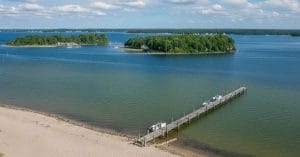
Greenpeace planted two red flags on the seabed of Vejle Fjord after measuring moderate oxygen depletion, while a university biologist says the restored parts of the fjord are doing better than their reputation suggests.
Greenpeace and the Danish Sport Fishing Association returned to Vejle Fjord on Wednesday to inspect the water. DR reports that the groups brought red flags bearing a white fish, to be planted if conditions proved poor.
Greenpeace campaign leader Emil Bejer-Pedersen said the flag is inspired by the red flags lifeguards raise when swimming is unsafe. He described it as a bathing flag for fish, signaling water that fish should avoid.
The organization carried an oxygen meter and other equipment in a fast inflatable boat. Before setting out, Bejer-Pedersen said he expected the flags would end up in the water.

According to DR, the measurements showed moderate oxygen depletion bordering on severe at the tested locations, and two flags were placed on the seabed. Greenpeace said the bottom there resembled a desert.
In April 2024, the same two organizations declared Vejle Fjord dead and staged a symbolic funeral. A gravestone was set up with an inscription expressing hope that the fjord would rise again.

DR notes that eight measuring stations in Vejle Fjord record environmental conditions every ten minutes year-round. Mogens Flindt, professor of biology at the University of Southern Denmark, has access to that data and says it shows a more nuanced picture.
Per Flindt, oxygen depletion is frequent in the inner fjord between the Vejle Fjord Bridge and the city of Vejle. At the stations outside the bridge, at depths of zero to four or five meters, it is rarely measured.
Restoration work and criticism
Those are the depths where eelgrass, mussel beds and stone reefs are being restored, Flindt said. He described the work as Denmark’s largest marine restoration project and said biodiversity there has risen over several years of eelgrass planting.

Flindt said the restored areas are limited, because eelgrass cannot be planted where light does not reach. Below 10 meters there is oxygen depletion in the outer fjord as well. He added that such events are fine, but should be based on data.
As reported by DR, Flindt said several other fjords are in worse condition, naming Haderslev Fjord, Flensburg Fjord and the Limfjord. Greenpeace’s measurements were not taken in the areas where restoration work is underway.
Bejer-Pedersen acknowledged the restoration effort and said pockets of life are welcome. He said the whole fjord should be able to support life, and pointed to nitrogen discharges from industrial agriculture as the root problem.

The flags stood for about five hours, the time Greenpeace spent on the fjord. DR reports that they were then taken to Skive, where Greenpeace repeats the action today.