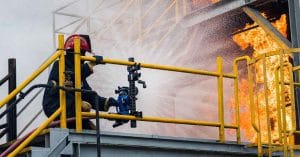
Three university students in Aarhus carried a wheelchair user down the stairs from a burning flat this week, a rescue that should never have been necessary in the first place.
The incident on Tuesday morning laid bare a gap that Danish fire authorities have been circling around for years but rarely name outright. When an apartment catches fire, whether you get out alive can depend less on building codes and more on whether you happen to have strong neighbours at home.
Expert briefings and internal analyses indicate that people with reduced mobility are significantly overrepresented among serious fire victims in Denmark, but official public statistics do not publish a precise percentage. Yet no Danish regulation requires residential landlords to provide evacuation chairs, refuge areas, or personal escape plans for tenants who cannot walk down stairs unassisted. That obligation exists in workplaces under Arbejdstilsynet rules, but not in the rental flats where a large share of younger adults and many international residents live.
Denmark’s Fire Death Rate Is Broadly Similar to Other Nordic Countries
Denmark records around 50 fire deaths per year, down from approximately 55 a decade ago, according to the National Fire Prevention Council. That puts the overall rate at roughly 8 to 9 deaths per million inhabitants, close to the EU average and broadly similar to other Nordic countries, according to Nordic Fire Statistics.

The difference between Denmark and better-performing countries is not in building materials or smoke alarm coverage. According to Forsikring and Pension surveys, Danish households have about 90 percent smoke alarm penetration, up from around 75 percent ten years ago. Instead, Swedish municipalities embed fire safety checks and evacuation planning into home care routines for vulnerable residents, while Danish policy largely leaves it to individual initiative. Det Centrale Handicapråd has warned since at least 2023 that fire prevention in Denmark rarely involves dialogue with disabled tenants, creating the ad hoc rescues that made headlines this week.
Rescue Depended on Students Being Home During Summer Holiday
The wheelchair user was in the flat when fire broke out shortly after 7 am on Tuesday. Neighbours heard the alarm and smoke, but the building has no lift and the stairwell is narrow. Three students on their way out saw smoke and ran up. They lifted the man in his chair and carried him down the stairs from his upper-floor apartment, a manoeuvre that required strength, coordination, and calm that cannot be assumed in every building at every hour.

Had the fire started at night, or had the students already left for lectures, the outcome might have been different. According to the Building Regulations (BR18), buildings must be designed so that people can bring themselves to safety or be rescued. However, BR18 offers no minimum standard for what rescue means when a resident cannot self-evacuate. The rule assumes help will arrive or that neighbours will intervene, a premise that works until it does not.
Foreign Residents Face Extra Barriers in an Emergency
International residents with disabilities often lack an established personal network in their building, making neighbour-assisted rescues less certain than in well-established Danish communities, according to integration reports cited by disability advocates. According to Statistics Denmark, foreign citizens make up roughly 11 percent of the population, but municipal housing reports from Copenhagen show they constitute around 15 to 20 percent of residents in some dense urban apartment districts where fire authorities report higher incident rates.

Language can slow help as well. While 112 operators handle English calls routinely, many internationals hesitate to call emergency services due to uncertainty about procedures or fear of misunderstanding. Official information on nyidanmark.dk and borger.dk focuses on visas, pensions, and disability benefits, not on what to do if your flat catches fire and you cannot walk.
Authorities Are Finally Reviewing Whether Current Rules Protect Wheelchair Users
A series of high-profile rescues has nudged Danish fire authorities toward action. The Ministry of Social Affairs commissioned a 2025 to 2026 study explicitly on safety for citizens with reduced functional capacity in their own homes, including fire risk and evacuation for both Danish and foreign residents. According to Social- og Boligstyrelsen, the mandate asks researchers to evaluate whether current guidance and building code requirements provide adequate protection for wheelchair users in multi-storey buildings.

Some municipalities now mention smoke alarm checks and escape route advice in safety packages for elderly and disabled residents, but these are voluntary visits that depend on residents knowing to ask. Landlords have no obligation to offer them, and the Danish Disability Council has raised concerns that systematic fire safety planning for tenants with mobility issues remains rare across housing associations.
Landlords Argue New Rules Would Raise Rents
EjendomDanmark, the landlords’ association, warns that mandatory evacuation equipment in every multi-storey block would significantly raise maintenance costs, hitting low-income and immigrant tenants hardest. They point out that older buildings were not designed for wheelchair access in stairwells, making retrofits difficult and expensive. Fire safety professionals note that Denmark’s overall fire death rate has declined, suggesting existing campaigns work reasonably well without sweeping new obligations.

Disability advocates counter that safety should not depend on chance. As Hans Jørgen Madsen, chair of Det Centrale Handicapråd, stated in 2024, Denmark must not accept that survival in a fire depends on whether young, strong neighbours happen to be passing by. The students in Aarhus were there this time. Next time, they might not be.