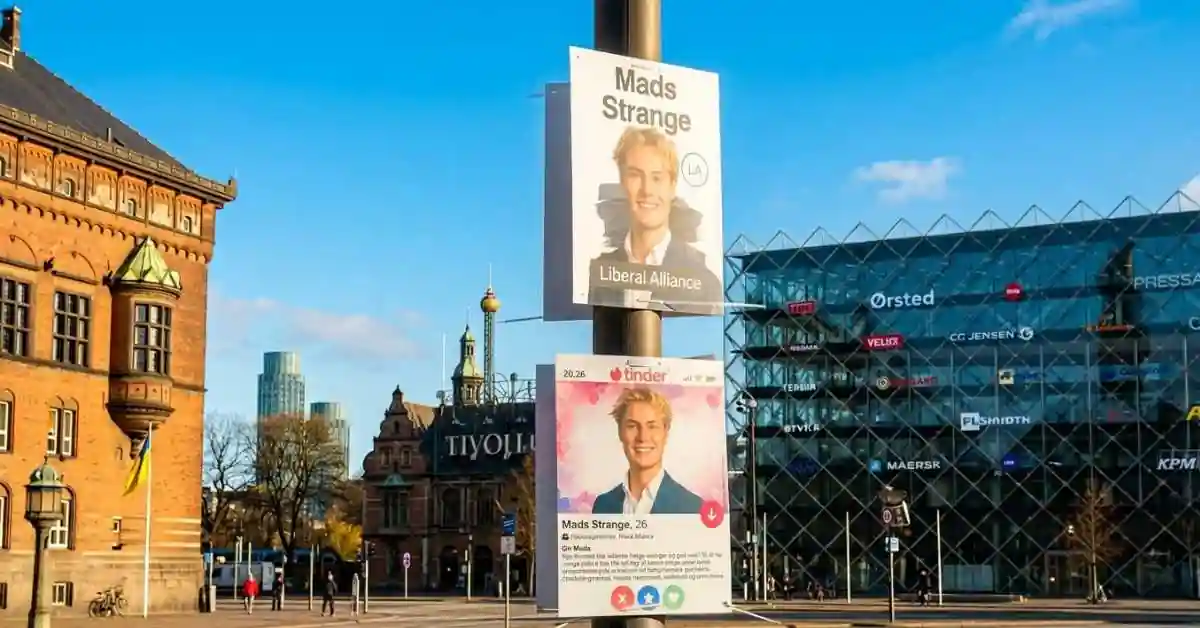
A Danish Liberal Alliance candidate who removed campaign posters featuring Tinder’s logo after the dating app complained may have acted prematurely, according to legal experts. Two specialists in trademark and intellectual property law say the posters likely did not violate Danish or European law, despite Tinder’s objections.
The Controversy Over Campaign Posters
Mads Strange, a Liberal Alliance candidate running in the upcoming Danish parliamentary election, created campaign posters that mimicked Tinder’s distinctive design. The posters featured the dating app’s logo and used the slogan “Swipe right on LA” to appeal to younger voters. The creative approach aimed to connect the party’s liberal policies on personal freedoms with the familiar metaphor of dating apps.
The posters appeared around March 10 in key constituencies across Greater Copenhagen. Strange, who is running in the Gladsaxe-Hvidovre district, hoped the eye-catching design would help him stand out among competing candidates. Danish election campaigns frequently incorporate pop culture references for visibility, but this particular case quickly drew attention for different reasons.
Swift Response From Tinder
Tinder’s Nordic public relations team responded within two days of the posters appearing. The company issued a formal complaint on March 12, stating that it does not permit use of its name, logo, or brand assets in political campaigns. A spokesperson emphasized that Tinder protects its brand and had contacted the candidate directly.
The dating app company expressed concern about being associated with any particular political party or candidate. According to legal experts, Tinder wants to appeal to a diverse user base and fears that political associations could alienate potential customers. Despite the company’s clear disapproval, it did not pursue legal action against Strange.
Quick Compliance and Removal
Strange announced on March 13 that he would remove the posters. In a statement to Danish media, he said he was laying the matter to rest and did not want to fight Tinder in court. The candidate expressed regret that the situation had been portrayed as a rule violation, noting he wanted to comply with all applicable regulations.
The swift compliance came even though Strange had not received a formal legal threat. He acknowledged that seeking permission beforehand would have been wiser. The entire sequence, from poster launch to removal, took less than 72 hours.
Legal Expert Analysis
Two legal experts consulted by Danish public broadcaster DR provided a different perspective on the controversy. Their analysis suggests that Strange may have removed the posters unnecessarily, as the use likely did not constitute a legal violation.
No Trademark Infringement Found
Sten Schaumburg-Müller, a law professor at the University of Southern Denmark, said viewers would not get the impression that Tinder was endorsing Strange or Liberal Alliance. He noted that while companies have a legally protected interest in not being dragged into political campaigns, the posters did not create that association. The professor emphasized the importance of free speech protections in political contexts.
Heidi Højmark Helveg, an attorney with over 20 years of experience specializing in marketing law, agreed with this assessment. She explained that the political use of Tinder’s logo does not violate trademark law. Furthermore, she does not believe the copyright protection of Tinder’s interface is broad enough for Strange to have infringed upon it.
User Terms Not Necessarily Binding
The experts also addressed Tinder’s community guidelines, which explicitly prohibit use of the company’s branding in political campaigns. However, they pointed out that such terms are not automatically enforceable under Danish and European contract law. Schaumburg-Müller noted that European legal systems take a more skeptical view of extensive user agreements compared to American approaches.
Højmark Helveg emphasized that both parties must enter into an agreement for it to be binding. Even if someone clicks “yes” to user terms, the validity can be questioned if the relevant clause appears buried deep in the fine print. In Strange’s case, it remains unclear whether he ever accepted Tinder’s terms, as he claims not to have an active profile on the platform.
The Clash Between American and European Law
Schaumburg-Müller highlighted an important dimension of the controversy. The case represents a collision between American corporate practices and European legal principles, particularly regarding freedom of expression.
Free Speech Considerations
Danish constitutional protections for free speech, outlined in Article 77 of the Constitution, play a significant role in this analysis. European trademark law, including EU Trademark Regulation 2017/1001, allows limited use of protected marks for purposes such as parody or criticism. These provisions aim to balance intellectual property rights with fundamental freedoms.
The experts suggested that political speech receives particularly strong protection under Danish law. Courts typically weigh heavily in favor of allowing controversial or provocative political expression during election campaigns. This principle extends to creative uses of commercial imagery when the context clearly indicates political rather than commercial intent.
What Tinder Could Actually Do
Despite the legal analysis favoring Strange, the experts acknowledged that Tinder does have some recourse. If Strange had an active profile on the platform, the company could exclude him from using the service. However, both experts expressed doubt that Tinder could take more substantial action beyond that.
Højmark Helveg characterized the situation as relatively risk-free for Strange. She said she cannot see what legal basis Tinder would have to pursue further action against him. Schaumburg-Müller agreed, suggesting that corporate discomfort with political associations does not necessarily translate into actionable legal claims.
Political Campaigning in the Digital Age
The controversy reflects broader trends in how Danish politicians attempt to reach voters, particularly younger demographics who engage heavily with social media and apps.
Targeting Young Voters
Liberal Alliance aimed to boost its support among 18 to 35-year-olds with the creative poster design. Recent polling data shows that 22 percent of voters aged 18 to 29 planned to vote for the party in the upcoming election. Denmark has high social media engagement rates, with approximately 85 percent of people under 30 using dating apps according to 2025 statistics.
Strange explained that the posters were meant to be used in a satirical and political context. He hoped the familiar Tinder interface would create an immediate connection with young voters who spend significant time on digital platforms. The “swipe right” metaphor provided a simple, memorable message about supporting Liberal Alliance.
Lessons for Future Campaigns
The incident may influence how other candidates approach creative campaigning in the 2026 parliamentary election and beyond. Strange acknowledged that his campaign team will be more cautious about seeking permission before incorporating recognizable brands into political materials. He suggested it is better to ask permission once too often than once too little.
However, the legal expert opinions suggest that candidates may have more freedom than corporate objections might indicate. The rapid resolution of this case, driven by Strange’s decision to comply rather than any legal ruling, may not provide clear guidance for future situations. Other candidates might choose to stand their ground if similar controversies arise.
The Question of Putting Posters Back Up
Following the expert analysis, Strange indicated he might reconsider his decision to remove the posters. He told DR that if it is no longer a problem legally, the posters could potentially go back up.
Low Legal Risk Assessment
Both legal experts confirmed that they see minimal risk in Strange reinstating the posters. Højmark Helveg said she considers it relatively risk-free and cannot identify what legal claims Tinder would pursue. The lack of any formal legal action from Tinder, combined with the strong free speech protections in Danish law, supports this assessment.
The experts’ public statements provide Strange with ammunition to justify reversing his decision. If he chooses to put the posters back up, he can point to professional legal opinions supporting the lawfulness of his actions. This would shift the burden back to Tinder to either accept the situation or take concrete legal steps.
Political Considerations Beyond Law
Despite the favorable legal analysis, Strange faces political considerations that extend beyond courtroom arguments. His Liberal Alliance colleagues initially supported the creative approach but endorsed removal after Tinder’s complaint. Reversing course again might create perceptions of indecisiveness or unnecessarily antagonizing a major tech company.
The publicity generated by the controversy has already given Strange significant visibility. Whether the original posters remain on display or not, the story has been covered extensively in Danish media. This attention may have achieved the campaign’s underlying goal of standing out from other candidates, regardless of the posters’ ultimate fate.
Broader Context in Denmark and Europe
The Tinder poster controversy fits into larger discussions about election campaigning regulations and intellectual property enforcement in the digital age.
Danish Election Campaign Rules
Danish election law, particularly Section 50 of the Valglov, allows considerable creative freedom in campaign poster design. Regulations are relatively light compared to some other European countries. The Danish Competition and Consumer Authority has not intervened in this case, maintaining its typical hands-off approach to political campaign materials.
This regulatory environment encourages innovative and attention-grabbing campaign tactics. Candidates compete intensely for visibility in a crowded information environment. The lack of strict guidelines means that boundaries are often tested through real-world cases rather than predetermined by clear rules.
European Trends in IP and Elections
According to the European Union Intellectual Property Office, complaints related to election campaigns have risen 20 percent in 2025 across EU member states. This trend reflects increasing intersection between digital platforms, recognizable brands, and political messaging. Different European countries have handled similar situations in varying ways, with Swedish courts upholding app logo parodies in 2024 while Germany has implemented stricter bans.
Denmark’s approach, emphasizing free speech protections while respecting intellectual property rights, attempts to balance these competing interests. The Strange case may influence future Danish campaign guidelines as parties and election authorities consider whether clearer standards are needed. However, any new regulations would need to navigate the strong constitutional protections for political expression that experts emphasized in their analysis.
A Personal Take
I find myself torn on this controversy. On one hand, political speech deserves robust protection, especially during elections when candidates need creative ways to reach disengaged voters. The legal experts make compelling arguments that Strange’s posters constituted legitimate political expression rather than trademark infringement. Young voters respond to familiar digital references, and dating app metaphors effectively communicate political messages.
On the other hand, I understand Tinder’s position about protecting brand neutrality. Companies invest heavily in building brands that appeal across political divides. Allowing politicians to freely appropriate corporate imagery without permission could force brands into unwanted political associations. Strange perhaps should have sought permission first, respecting both legal principles and corporate