President Donald Trump’s new Board of Peace held its first meeting in Washington, bringing together world leaders to discuss Gaza reconstruction. The initiative includes billions in funding commitments but faces questions about financing, military support, and governance structures that exclude Palestinian representation.
A Meeting Set to Music and Presidential Praise
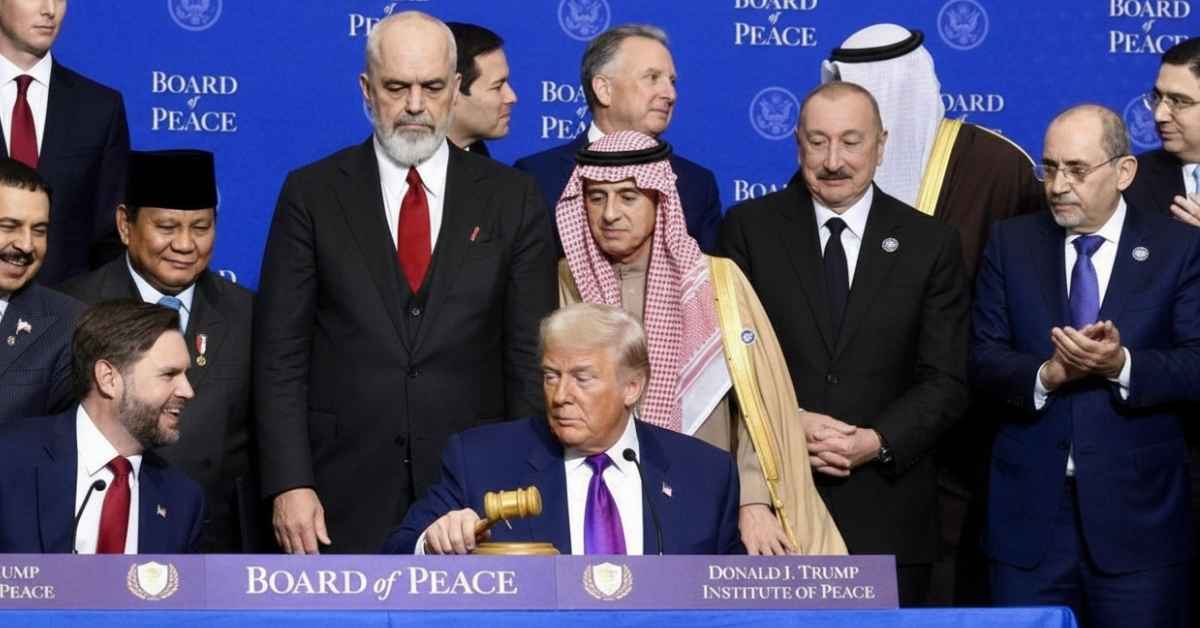
The Board of Peace inaugural gathering unfolded with distinctive Trump style. As world leaders assembled for a group photograph, Laura Branigan’s 1982 disco hit “Gloria” filled the room. The playlist continued with Elvis Presley, the Beach Boys, and James Brown’s “It’s a Man’s Man’s Man’s World.”
Compliments and Comments on Appearance
Trump spent 25 minutes welcoming attendees before addressing the Gaza conflict. He devoted much of that time to praising the assembled leaders, many from authoritarian governments, and commenting on their appearance, wealth, and power.
Red “Make America Great Again” caps sat on the table in front of several attendees. Trump pointed to 47-year-old Paraguayan President Santiago Peña and described him as young and handsome. He then clarified that while youth and good looks are nice qualities, he has no interest in handsome men, only women.
Anecdotes and Ambitions Beyond the United Nations
The president shared stories positioning himself as a leader who forces other countries into line. He claimed to have used tariff threats to end conflicts between countries like India and Pakistan. Indian officials subsequently denied this assertion.
Trump suggested the Board of Peace might eventually assume a role surpassing the United Nations. He said the council would essentially monitor the UN because the international body needs help. He referenced getting stuck on an escalator during a visit to UN headquarters in New York with First Lady Melania Trump.
Financial Commitments and Reconstruction Plans
Trump announced that participating countries have pledged seven billion dollars, approximately 44 billion kroner, to a Gaza reconstruction fund. The fund will finance rebuilding efforts in the war-torn territory once Hamas is disarmed.
Contributors From Across the Globe
Among the contributors Trump named were Kazakhstan, Azerbaijan, the United Arab Emirates, Morocco, Bahrain, Qatar, Saudi Arabia, Uzbekistan, and Kuwait. The United States will add another ten billion dollars, roughly 63 billion kroner, to the Board of Peace.
Trump did not specify where American funding would originate or whether he would seek congressional approval. Reuters estimates total reconstruction costs for Gaza, largely reduced to rubble after more than two years of war, could reach 70 billion dollars or around 444 billion kroner.
The Economic Challenge Ahead
Financing represents one of the initiative’s greatest obstacles. DR’s USA correspondent Kim Bildsøe Lassen points to economic sustainability as a critical question. Creating the necessary economic foundation and securing enough soldiers for a peacekeeping force present significant challenges.
Notably, no neighboring countries like Egypt or Jordan have committed troops. The absence of regional military support raises doubts about implementation feasibility.
Military Commitments and Deployment Plans
Several countries announced willingness to contribute soldiers to an international stabilization force in Gaza. Indonesia, Morocco, Kazakhstan, Kosovo, and Albania offered military personnel.
Indonesian Leadership Role
Indonesian President Prabowo Subianto pledged up to 8,000 soldiers. The force will initially operate in Israeli-controlled areas if Hamas refuses disarmament. An American general will command the operation with an Indonesian deputy commander.
The deployment will begin in Rafah. Objectives include training 12,000 police officers and establishing a 20,000-soldier force. Kim Bildsøe Lassen notes that signs suggest parts of the Gaza peace plan implementation might continue.
Unanswered Questions About Implementation
Numerous critical questions remain unresolved. The specific operational mechanisms remain unclear. The governing apparatus structure has not been defined. How the council will function going forward remains uncertain, particularly given Trump’s evident control.
The Board of Peace composition consists primarily of Middle Eastern countries plus some leaders from outside the region. Reuters suggests these outside participants may be seeking to strengthen relationships with Trump.
Governance Structure and International Concerns
Several major Western allies are absent from the council’s founding membership. This absence has sparked concern about the initiative’s reach and effectiveness.
A Trump-Centered Institution
Kim Bildsøe Lassen emphasizes that Trump’s control over the Board of Peace is absolute. The president sits at the head of the table and will determine everything that happens within this new institution. Some observers fear it will become a parallel structure to the United Nations.
The governance framework places Gaza reconstruction authority in Trump’s hands. A Gaza Executive Board operates under the Board of Peace with support from an International Stabilization Force led by Major General Jasper Jeffers. Notably, the executive board includes neither Palestinian nor Israeli members.
Minimal Palestinian Input
This external governance system was created with minimal Palestinian input or control over outcomes. The exclusion of Palestinian representatives marks a departure from traditional UN-led post-conflict governance models, which typically include local stakeholder participation.
The United Nations Security Council endorsed the overall plan through Resolution 2803 in November 2025. However, the resolution includes demilitarization requirements as conditions for any pathway to Palestinian self-determination and statehood.
Hamas Disarmament and Security Requirements
Hamas disarmament remains central to the reconstruction plan’s success. The militant group initially rejected demilitarization terms before signing an agreement in October 2025.
Ongoing Compliance Tensions
Hamas agreed only to hand over Gaza administration to a Palestinian body of independent technocrats. The group never committed to disarming or relinquishing influence. This creates continued tension around plan implementation.
Trump issued another ultimatum at the World Economic Forum in Davos in January 2026. He demanded Hamas disarm and release remaining hostage remains within weeks or face being destroyed quickly. The threat indicates ongoing compliance issues even months after the initial agreement.
Verification and Milestones
Verified security milestones are embedded in the UN Security Council resolution. Full demilitarization serves as a condition for Palestinian self-determination. The framework requires Hamas to meet ambitious governance and security targets before any movement toward statehood.
Coming months will test the council’s effectiveness on several fronts. Hamas disarmament and subsequent Israeli withdrawal represent immediate challenges. The size and adequacy of the reconstruction fund requires ongoing attention. Humanitarian aid flow to Gaza’s population needs continuous monitoring.
Regional Context and Parallel Developments
The Board of Peace meeting occurred alongside significant regional tensions. The United States has threatened Iran with military action and initiated substantial military buildup in the region. These moves come as Washington demands Tehran abandon its nuclear program.
Israeli West Bank Expansion
Israel’s security cabinet approved sweeping measures in February 2026 expanding Israeli authority across the West Bank. The decisions accelerate settlement growth in occupied territory. Israeli Finance Minister Bezalel Smotrich stated the government would continue to bury the idea of a Palestinian state.
These parallel developments raise questions about comprehensive peace prospects. European policy analysts warn that the current framework risks closing off Palestinian statehood possibilities. The Chatham House assessment cautions that the plan could doom aspirations for a unified Palestinian state.
Risk of Creating Two Gazas
Reconstruction is beginning in areas controlled by the Israeli military. This concentration of development raises concerns about uneven progress. Analysts warn the approach could create two distinct Gazas: one inhabitable but sanitized, disarmed, depoliticized and tightly supervised, and another cut off, marginalized and unstable.
The reconstruction strategy focuses on rebuilding transportation networks, energy infrastructure, housing, and job creation. Long-term goals include reconnecting Gaza with regional and global economic partners. However, the plan also calls for displacement of approximately two million Palestinians to neighboring territories.
International Reception and Criticism
The Trump peace initiative has received negative reactions from several nations and international organizations. European analysts have issued particularly pointed warnings about the framework’s long-term implications.
European Calls for Review
The European Council on Foreign Relations has called on Arab and European governments to review the framework carefully. The organization urges these states to adjust their engagement strategies before supporting a process that could eliminate Palestinian statehood prospects. Critics argue the plan prioritizes real estate development over human rights and political self-determination.
European policy experts warn that external governance models without Palestinian participation create risks. Such structures may establish permanent dependent governance rather than fostering genuine political recovery. The compressed timeline from Trump’s September 2025 announcement to the October agreement signing reflected urgency but left limited room for inclusive consultation.
Removal Requirements and Reconstruction Scale
The physical reconstruction challenge is immense. More than 50 million tonnes of debris and unexploded ordnance require removal before rebuilding can proceed at scale. Safe zones are being established in Rafah with shelter, food, healthcare, and education provision.
Plans call for developing “New Rafah” as the first reconstruction priority. The World Bank is coordinating international funding alongside American contributions. However, the connection between reconstruction progress and political settlement remains unclear.
Sources and References
DR: Milliarder, smiger og 80’er-hit: Trump samlede sit nye fredsråd for første gang