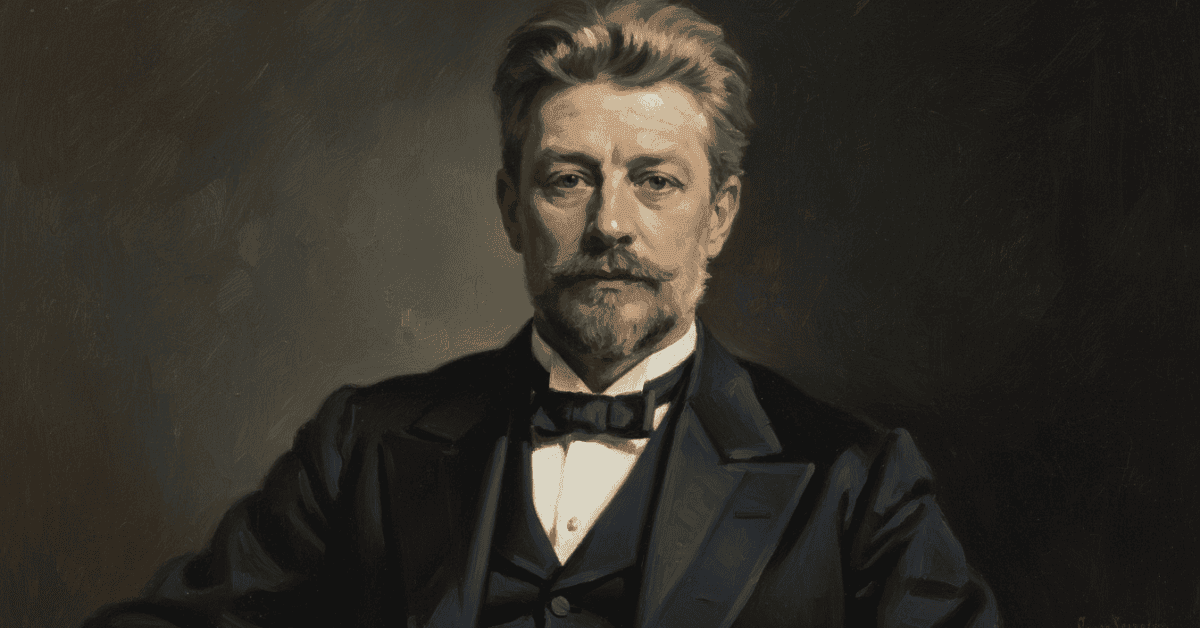
Georg Brandes made literature political. Not by running for office or aligning with a party, but by treating books as instruments of societal change. He called out empty romanticism. He demanded realism. And he insisted that writers take on the world around them—inequality, repression, hypocrisy—head-on. He wasn’t a novelist or a poet. He was a critic. But in the Danish and European context of the late 19th century, that gave him power. He knew how to use it.
- Early Life and Education: Born in Copenhagen in 1842 to a Jewish family, Brandes studied law, philosophy, and aesthetics at the University of Copenhagen, developing a focus on cultural critique.
- Influence of Abroad and Political Engagement: Living in Berlin, Paris, and London, Brandes engaged with radical thinkers and refined his political and literary ideas, aiming to revitalize Danish literature.
- Main Currents in Nineteenth Century Literature: His 1871 lecture series urged Danish writers to address social realities like inequality and repression, signaling the start of the Modern Breakthrough.
- Promotion of Realism and Naturalism: Brandes rejected escapist art, advocating for literature that confronts societal issues, making it an ethical and social tool.
- European Influence and Later Years: He introduced Nietzsche to Europe, supported groundbreaking writers, and in his later years critiqued religious dogma, leaving a lasting legacy.
Early Life of Georg Brandes
Georg Morris Cohen Brandes was born in Copenhagen in 1842 to a Jewish family that valued education and ambition. His father was a merchant; his mother, deeply engaged in her children’s learning. Brandes moved easily through the city’s elite academic institutions, first Borgerdyd School, then the University of Copenhagen, where he enrolled at 17. He began studying law but shifted to philosophy and aesthetics. His master’s thesis, completed in 1864, traced the idea of tragedy across history—already signaling a shift away from legal codes and toward cultural critique.
Brandes grew up in a city caught between tradition and the stirrings of modern thought. The university still leaned conservative, but the streets were alive with debate. He absorbed it all. Early on, he read Søren Kierkegaard and John Stuart Mill. The former gave him an instinct for existential questioning; the latter gave him language for liberty, individual rights, and utilitarian reasoning.

A Danish Critic Who Went Abroad to Think
Brandes was restless in Denmark. After graduation, he left. He lived for periods in Berlin, Paris, and London, cities whose artistic and political energy far surpassed Copenhagen’s. Abroad, he met revolutionary thinkers, followed anarchist debates, and read everything from Nietzsche to Taine. His time in Berlin and Paris sharpened his political instincts; London gave him a firsthand look at both empire and poverty.
This period was not academic tourism. Brandes wasn’t collecting theories; he was sharpening his approach. In those years, he developed the critical framework that would define his career. He returned to Denmark with a mission: to import the seriousness, urgency, and relevance he had found abroad into the stagnant Danish literary scene.
Main Currents in Nineteenth Century Literature
In 1871, Brandes began a lecture series at the University of Copenhagen titled Main Currents in Nineteenth Century Literature. It was a turning point, both for him and for Danish literature. Over the course of several years, Brandes mapped the intellectual developments reshaping Europe—liberalism, socialism, secularism—and called on Danish writers to engage with them.
The “Main Currents” lectures introduced the principles of a new realism and naturalism to Danish and Scandinavian audiences. Brandes argued that literature should not retreat into fantasy or nostalgia. It should confront the real: class divisions, gender inequality, religious hypocrisy, and the crises of modern life. He wasn’t polite about it. He was urgent, polemical, and unapologetic. Many hated him for it. Many more listened.
The Modern Breakthrough
Brandes became synonymous with det moderne gennembrud—the Modern Breakthrough. It wasn’t a movement he invented, but it was one he gave structure and legitimacy. His criticism validated writers who broke with tradition and embraced realism. Among them were Henrik Ibsen, August Strindberg, and Bjørnstjerne Bjørnson. They didn’t all agree with Brandes, but they all benefited from his influence. His reviews, lectures, and books gave their work political and philosophical grounding.

He also made enemies. The Danish establishment blocked him from a professorship, despite his qualifications. He had supporters, including Viggo Hørup and other left-leaning intellectuals, but the university held firm. Brandes stayed outside the institution, but not on the margins. His ideas spread and his essays were translated. His reputation in Germany, France, and Britain sometimes outpaced his standing in Denmark.
Realism, Naturalism, and the Fight Against Conventionality
Brandes’s writing rejected hyper-aesthetic language and symbolic obscurity. He demanded clarity, relevance, and confrontation. In his 1872 book The Emigrant Literature, he pushed for a break from inherited norms, celebrating authors who had rejected their own literary traditions. He later wrote monographs on figures like Goethe and Shakespeare, but even in those, his focus remained political and moral. Literature, for Brandes, was never just art. It was an ethical tool.
He defended naturalism—not as fatalism, but as truth-telling. He saw conventional literature as a form of denial and believed authors had a responsibility to document the world’s inequalities and hypocrisies, and to challenge their readers to confront them.
Nietzsche and the Broader European Landscape
Brandes was among the first to introduce Friedrich Nietzsche to a broader European readership. His 1890 book Friedrich Nietzsche – seine Persönlichkeit und sein System helped shape Nietzsche’s early reputation. The two men corresponded, though they never met. Brandes identified in Nietzsche what he called “aristocratic radicalism”—an uncompromising rejection of herd morality that fascinated him, even if he didn’t fully endorse it.
His international reach extended beyond Nietzsche. Brandes was read and published across the continent. He settled in Berlin for a period and maintained an active correspondence with writers, scholars, and activists. His influence, while often contested in Denmark, was firmly established in the broader European intellectual tradition.
Conclusion About Georg Brandes
In the last decades of his life, Brandes focused increasingly on anti-religious polemic. He wrote critically about Christianity, Judaism, and the historical foundations of religious belief. His later writings included works on the historicity of Jesus, which were widely read and fiercely criticized. He never softened his stance, never retreated from his belief that intellectuals should confront dogma, not accommodate it.
When Georg Brandes died in 1927, he left behind over 30 books and countless essays, and a legacy that advanced Danish literary criticism. His enemies accused him of arrogance. His supporters called him fearless. Both were right. He was never neutral. He believed literature should provoke, not soothe. And for over fifty years, he used his voice to make sure it did.
Summary
- Early life: Born in 1842 in Copenhagen to a Jewish merchant family, Brandes studied philosophy and aesthetics at the University of Copenhagen, where he shifted focus from law to cultural criticism.
- Education abroad: He lived in Berlin, Paris, and London after graduation, engaging with radical thinkers and developing the political and literary ideas that would define his career.
- Career breakthrough: His 1871 lecture series Main Currents in Nineteenth Century Literature urged Danish writers to engage with social realities like inequality and repression, launching the Modern Breakthrough.
- Critical influence: Though denied a professorship, Brandes became one of Europe’s most influential critics, promoting realism, naturalism, and political engagement in literature.
- Writers supported: He elevated figures like Ibsen and Strindberg, giving legitimacy to those breaking with romantic conventions.
- Writing style: Brandes opposed escapism in literature, demanding clarity and relevance. He championed literature as an ethical and social force.
- International role: He introduced Nietzsche to a wider European audience and maintained intellectual ties across the continent, even when Denmark’s establishment resisted him.
- Later work: In his final years, Brandes focused on anti-religious writings and critiques of dogma, never softening his critical stance.
- Legacy: When he died in 1927, Brandes left behind over 30 books and a transformed literary culture.

Frequently Asked Questions
What role did Georg Brandes play in transforming literature into a tool for societal change?
Georg Brandes made literature political by promoting realism and confronting social issues like inequality, repression, and hypocrisy rather than retreating into fantasy.
How did Georg Brandes influence European literature and intellectual thought?
He introduced new ideas like realism and naturalism, supported groundbreaking writers, and helped spread Nietzsche’s philosophy, thus shaping European intellectual discourse.
Why was Georg Brandes denied a professorship at the University of Copenhagen?
The Danish establishment blocked him due to his outspoken views, polemical style, and his challenges to traditional norms, despite his qualifications.
How did Georg Brandes’s later years reflect his views on religion?
In his later years, he focused on anti-religious polemics, criticizing Christianity, Judaism, and religious dogma, adhering to his belief that intellectuals should challenge dogma rather than accept it.